
Fixed Asset Capitalization and the De Minimis Safe Harbor in QuickBooks (2026)


Every time a business buys tangible property (laptops, tools, furniture, equipment), the accounting team decides two things: is this an expense or an asset, and if it is an asset, does the de minimis safe harbor let us expense it anyway?
The wrong choice inflates the balance sheet, understates current-year deductions, and creates depreciation schedules that clutter the books for the next seven years.
The IRS answered the question in 2013 with the final tangible property regulations under Treasury Decision 9636. The de minimis safe harbor election under Reg §1.263(a)-1(f) lets qualifying businesses expense small-dollar property purchases without capitalizing.
This guide covers the exact thresholds, the annual election mechanic, the book capitalization policy that should accompany it, and the QuickBooks setup that keeps the two aligned.
What is fixed asset capitalization?
Fixed asset capitalization is the accounting treatment of tangible property with an economic useful life beyond one year. Instead of expensing the full cost in the year of purchase, the business records the property as an asset on the balance sheet and deducts the cost gradually through depreciation.
Section 263(a) of the Internal Revenue Code requires capitalization for costs of acquiring, producing, and improving tangible property regardless of amount. Section 162 permits deduction of ordinary and necessary business expenses in the year paid or incurred. The tension between these two sections is where the de minimis safe harbor operates.
Without a safe harbor, a $200 stapler and a $200,000 forklift both require the same capitalize-or-expense analysis. The final tangibles regulations resolved decades of case-law confusion by providing an elective, prospective framework that eliminates the analysis for small-dollar items.
Coverage of the depreciation mechanics that apply after capitalization is in Finlens' depreciation methods guide.
What is the de minimis safe harbor?
The de minimis safe harbor is an annual tax election under Reg §1.263(a)-1(f) that allows a business to deduct amounts paid for tangible property up to a specific per-item or per-invoice threshold, instead of capitalizing.
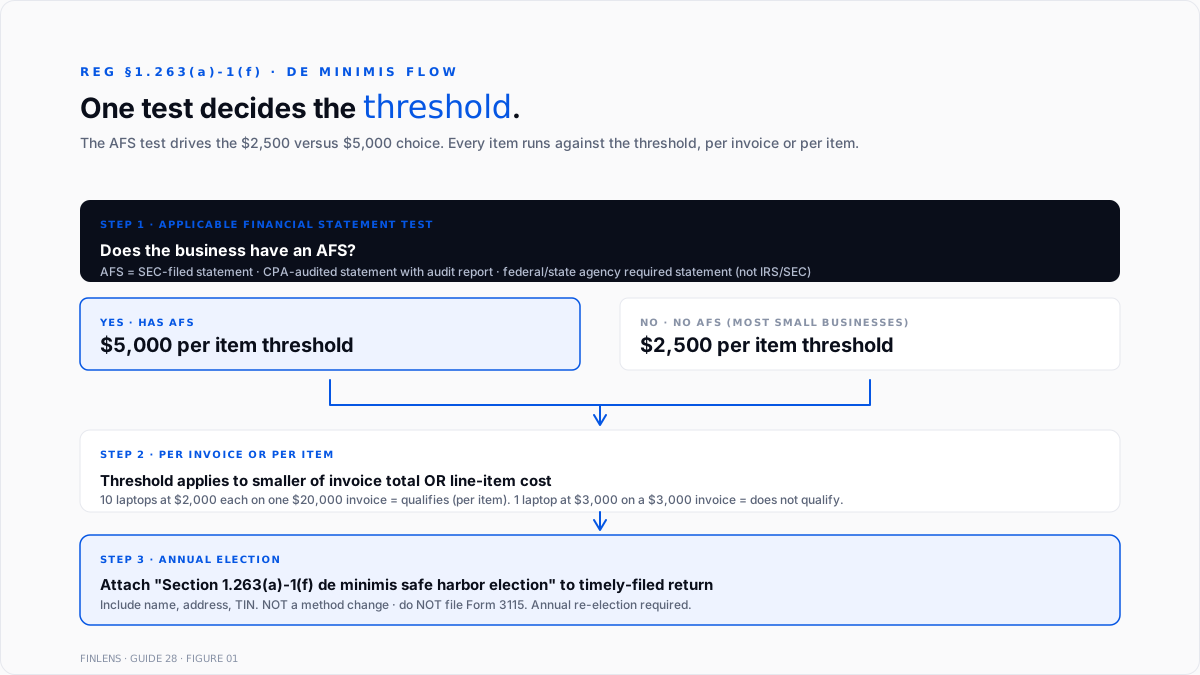
Two thresholds apply, determined by whether the business has an Applicable Financial Statement (AFS):
- $5,000 per invoice or item if the business has an AFS
- $2,500 per invoice or item if the business does not have an AFS
An AFS includes a financial statement filed with the SEC, a CPA-audited financial statement with a CPA report, or a financial statement required by a federal or state agency other than the IRS. Most small businesses do not have an AFS and use the $2,500 threshold.
The threshold applies per invoice or per item (whichever is smaller). Ten $250 items on a single invoice qualify. One $3,000 item on an invoice does not qualify under the $2,500 threshold even if the whole invoice is small.
The election is annual. It applies to all qualifying purchases in the year. Once elected for a year, the business cannot pick and choose which qualifying items to expense and which to capitalize.
What is the $2,500 versus $5,000 threshold decision?
The AFS test determines which threshold applies. The test is binary.
Businesses with an AFS use the $5,000 threshold. This includes public companies filing with the SEC, private companies with audited financial statements from a CPA firm that produces a written audit report, and businesses required to submit audited statements to state regulators.
Businesses without an AFS use the $2,500 threshold. This covers most small businesses. A CPA-prepared financial statement without a formal audit and audit report is not an AFS. A tax return is not an AFS. Bookkeeper-produced statements are not an AFS.
The distinction matters because an unaudited financial statement is the norm for small businesses. Firms that mistakenly claim AFS status when they do not have one face IRS challenge at examination. The safe harbor protection depends on correctly applying the right threshold.
Broader coverage of what qualifies as a business expense write-off is in Finlens' how to write off business expenses guide.
How is the de minimis election filed?
The election runs as an attached statement on the timely-filed federal tax return, including extensions. The specific requirements are set by the IRS.
Statement title: "Section 1.263(a)-1(f) de minimis safe harbor election."
Required content. The taxpayer's name, address, and Taxpayer Identification Number (TIN, EIN, or SSN). A statement declaring the election is being made.
Filing timing. With the timely-filed original federal tax return for the year in which the de minimis amounts were paid. If the return is on extension, the election must be filed by the extended due date.
Form 3115 does not apply. The de minimis election is an annual election, not a method change. Form 3115 (Application for Change in Accounting Method) is not filed for de minimis. This is the opposite of an inventory method change or a depreciation method change.
Annual re-election is required. The election does not carry over. Each year requires a fresh election statement on that year's return. Missing the election in a year means small-dollar purchases in that year must be capitalized under the general rules.
The election covers all qualifying property in the year. It cannot be applied selectively to some purchases and not others. Once elected, the safe harbor applies to every item that qualifies under the threshold and every item that satisfies the written policy requirement.
What is the written accounting policy requirement?
The written accounting policy requirement varies by AFS status.
Businesses with an AFS must have a written policy. The policy must exist at the beginning of the taxable year. It must expense items below a stated threshold for book purposes. The threshold in the policy can equal or exceed the $5,000 safe harbor limit.
Businesses without an AFS do not need a written policy but must have a consistent practice. The practice must exist at the beginning of the taxable year and be applied consistently in the books. Written or unwritten, the practice must exist before the year starts.
Consistency requirement. The book policy must actually be followed. A written policy that expenses items under $2,500 while the bookkeeper capitalizes $500 laptops on the balance sheet violates the consistency requirement and voids the safe harbor.
The pattern most CPAs recommend: adopt a written policy even without an AFS. The extra documentation costs nothing and eliminates the ambiguity at examination. A sample written policy specifies the threshold ($2,500), the categories covered (tangible property acquired or produced), the treatment (immediate expense), and the effective date (beginning of the taxable year).
How does book capitalization policy align with tax de minimis?
The de minimis safe harbor is a tax election. Book capitalization policy is a separate accounting choice made by the business. The two are related but not identical.
Book capitalization policy is what the business does on its books. Under GAAP (ASC 360), any tangible property with a useful life beyond one year is technically a fixed asset. In practice, businesses set a materiality threshold (typically $500 to $5,000) below which they expense purchases for book purposes.
The tax de minimis safe harbor is what the IRS accepts on the tax return. The safe harbor requires book expense to match. Property expensed for book purposes qualifies for the de minimis deduction on tax. Property capitalized for book purposes does not qualify for de minimis, even if it is under the threshold.
The clean approach: align book policy with tax de minimis. Set the book capitalization threshold at $2,500 (no AFS) or $5,000 (AFS). Adopt the written policy. Elect de minimis annually on the return. Book and tax match.
The messy approach: keep a $500 book threshold and elect de minimis for tax. Items between $500 and $2,500 are capitalized for book (violating the safe harbor's book-expense requirement), but the taxpayer elects de minimis for tax. The safe harbor is voided because the property was not expensed on the books.
Coverage of the fixed asset schedule maintenance that follows capitalization is in Finlens' fixed asset accounting guide.
How is the de minimis safe harbor set up in QuickBooks?
The QBO setup runs in four steps. The steps work in QBO Simple Start through Advanced and in Desktop Pro, Premier, and Enterprise.
Step 1: Set the book capitalization threshold. Decide the threshold ($2,500 or $5,000). Document it in a written policy dated the first day of the taxable year. File it with the year's accounting records.
Step 2: Create the expense category. In the chart of accounts, add a "Small Tools and Equipment" expense account (or "De Minimis Property"). This account holds every purchase that qualifies for the safe harbor.
Step 3: Categorize purchases at entry. When a qualifying purchase enters QuickBooks, categorize it as a small tools and equipment expense. Do not enter it as a fixed asset item.
Step 4: Enter on the tax return. At year-end, the tax preparer attaches the "Section 1.263(a)-1(f) de minimis safe harbor election" statement to the return. The book expense entries align with the tax deduction.
Property that exceeds the threshold enters QBO as a fixed asset item under the Fixed Asset account type. Depreciation schedules run against the fixed asset. Section 179 and bonus depreciation elections apply at year-end where appropriate.
Coverage of the tax deduction stack (§179, bonus depreciation, de minimis) is in Finlens' Section 179 vs. bonus depreciation guide and Section 179 deduction limit guide.
What are the other tangible property safe harbors?
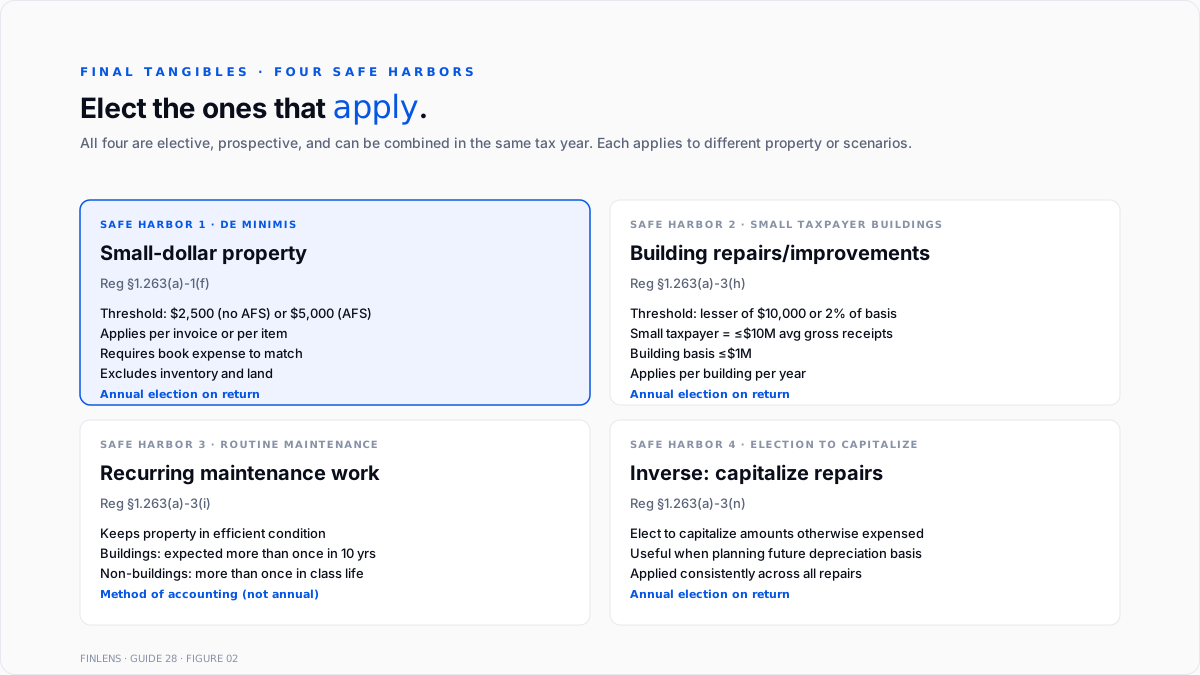
Three additional safe harbors from the final tangibles regulations complement the de minimis election.
Small taxpayer safe harbor for buildings (Reg. §1.263(a)-3(h)). Available to small taxpayers (average annual gross receipts of $10 million or less over the prior three years) with a building of an unadjusted basis of $1 million or less. Permits current expensing of amounts paid for repairs, maintenance, and improvements up to the lesser of $10,000 or 2% of the unadjusted basis of the building.
Routine maintenance safe harbor (Reg §1.263(a)-3(i)). Permits expensing of routine maintenance activities that keep property in its ordinarily efficient operating condition. For buildings, activities must reasonably be expected to occur more than once during a 10-year period. For non-buildings, activities must reasonably be expected to occur more than once during the property's class life.
Election to capitalize repair and maintenance costs (Reg §1.263(a)-3(n)). The opposite of the de minimis election. Permits a taxpayer to elect to capitalize amounts that would otherwise be deducted as repair or maintenance. Useful when the taxpayer wants a larger depreciable basis for future tax planning.
The three safe harbors and the de minimis election form the compliance framework for tangible property. Firms working through a large capital project consider each safe harbor at the transaction level to optimize the current-year deduction against future depreciation.
What is the repairs vs. capital improvements test?
Property above the de minimis threshold requires the general capital vs. expense analysis. The final tangibles regulations codified the BAR test.
Betterment. Amounts paid fix a material condition or defect that existed before acquisition, add a physical enlargement or expansion, or materially increase productivity, efficiency, strength, quality, or output.
Adaptation. Amounts paid adapt the property to a new or different use not consistent with the taxpayer's ordinary use at the time of acquisition.
Restoration. Amounts paid replace a component that the taxpayer treated as a separate asset, restore property that has been fully depreciated, restore property from a state of nonfunctional disrepair, rebuild the property to like-new condition after the end of its class life, or replace a major component or substantial structural part.
If the expenditure meets any of the three tests, it is a capital improvement and must be capitalized. If it does not meet any of the three tests, it is a deductible repair.
The unit of property definition matters. For buildings, the unit of property is the entire building plus each of eight key systems (plumbing, electrical, HVAC, elevator, escalator, fire protection, gas distribution, and security). For non-buildings, the unit is all functionally interdependent components.
What are the most common de minimis safe harbor mistakes?
Six mistakes recur across CPA firm engagements.
Missing the annual election. The business qualifies, but the tax preparer forgets to attach the election statement. The IRS treats the small-dollar purchases as required capitalizations, disallowing the deduction. There is no retroactive fix. The following year requires a fresh election.
Claiming AFS status without an AFS. A business uses the $5,000 threshold while operating with a CPA-compiled statement rather than a CPA-audited statement with an audit report. The safe harbor protection reduces to $2,500 at examination. Amounts between $2,500 and $5,000 lose the deduction.
Book cap policy misaligned with de minimis. Book policy captures items at $500. Tax return elects de minimis. Items between $500 and $2,500 sit on the balance sheet as fixed assets, meaning they were not expensed for book purposes and the safe harbor is voided.
Applying the threshold to the whole invoice. A single invoice for $8,000 covering four laptops at $2,000 each qualifies because each item is under $2,500. A single invoice for $3,000 covering one laptop does not qualify because the single item exceeds $2,500. Firms that focus on the invoice total miss the per-item application.
Categorizing repairs vs. improvements incorrectly. A $15,000 HVAC repair could be a deductible repair (routine maintenance safe harbor) or a capital improvement (betterment via increased efficiency). The BAR test decides. Firms that default to expense understate the depreciable basis and lose future deductions.
Confusing de minimis with Section 179. De minimis is an annual election to expense small-dollar items outright. Section 179 is a depreciation election for larger asset purchases up to $1.22M in 2026. They apply to different property and stack in a specific order: de minimis first, then §179 on remaining qualifying property, then bonus depreciation on the remainder. Coverage of Section 179 mechanics is in Finlens' Section 179 deduction limit guide.
Conclusion
Finlens is a QuickBooks-compatible AI accounting platform. For firms managing fixed asset purchases across a busy chart of accounts, Finlens applies the capitalize-versus-expense rules at the transaction level, keeps book policy aligned with the tax de minimis election, and flags edge cases before month-end close.
Every incoming purchase runs against the firm's capitalization policy. Amounts under the threshold route to the Small Tools and Equipment expense account. Amounts over the threshold are flagged for fixed asset review with the BAR test applied to the specific transaction. Repairs and improvements are separated automatically based on the underlying invoice and the associated property.
The book-tax alignment is maintained continuously. Firms that adopt the de minimis election get a written policy generated for the year, a matching book category setup, and an audit trail of every transaction that qualified under the threshold. At tax time, the elected statement generates automatically for attachment to the return.
For CPA firms serving multiple clients with mixed AFS status, Finlens's multi-entity view surfaces the threshold applied to each client and flags any misalignment between book policy and tax election. Firms operating without an AFS but using the $5,000 threshold get an immediate warning. Coverage of the underlying depreciation calculation that follows is in Finlens' How to Calculate Depreciation guide.
.png)
FAQ
Does the de minimis safe harbor need to be capitalized on the balance sheet?
No. The point of the safe harbor is that qualifying property is not capitalized. It is expensed on the income statement in the year of purchase. If the property is on the balance sheet as a fixed asset, the safe harbor does not apply because the book-expense requirement is not met.
What happens if a business misses the annual de minimis election?
The property that would have qualified must be capitalized under the general rules. Depreciation applies over the property's class life (5 years for computers, 7 years for furniture, and 15 years for qualified improvement property). The next year's return can include the election, but the missed year's items stay capitalized.
Can the de minimis threshold be higher than $2,500 or $5,000?
Yes, but items above the safe harbor threshold do not receive audit protection. A business without an AFS can adopt a $5,000 book capitalization threshold. Items between $2,500 and $5,000 are expensed on the books but not protected by the safe harbor. The IRS can challenge the deduction under the general rules if the deduction does not clearly reflect income.
Does the de minimis safe harbor apply to inventory?
No. Inventory is excluded from the de minimis safe harbor. Property acquired for resale follows Section 263A rules. Property held for the firm's own use qualifies. The distinction matters for firms that both hold inventory for resale and buy tools for internal use.
Does the de minimis safe harbor stack with Section 179 or bonus depreciation?
De minimis applies first, on qualifying small-dollar items. Section 179 applies to remaining qualifying asset purchases up to the annual limit ($1.22M in 2026). Bonus depreciation applies to remaining qualifying property. Each layer covers a different property. A single asset does not receive all three; the taxpayer chooses the treatment.
What is an Applicable Financial Statement?
An AFS includes financial statements filed with the SEC, financial statements audited by a CPA with a formal audit report used for non-tax purposes (bank loans, shareholder reporting, other regulatory filings), or financial statements required by a federal or state government agency other than the IRS or SEC. Compilations, reviews, and tax-return-only statements do not qualify.
Can a partnership elect de minimis at the partner level?
No. The election is made by the entity that pays or incurs the amount. A partnership makes the election on its Form 1065. The individual partners do not make separate elections. LLCs taxed as partnerships follow the partnership rule. S corporations make the election on Form 1120-S.
Is the small taxpayer safe harbor for buildings the same as the de minimis safe harbor?
No. The small taxpayer safe harbor under Reg §1.263(a)-3(h) applies to buildings and permits current expensing of repairs, maintenance, and improvements up to the lesser of $10,000 or 2% of unadjusted basis, per building.
The de minimis safe harbor under Reg §1.263(a)-1(f) applies to tangible property acquisitions up to $2,500 or $5,000 per item. The two safe harbors cover different scenarios and can both be elected in the same year.

