
The QuickBooks guide to PTO accrual under ASC 710 (2026)


This is a working reference for founders and controllers who track paid time off in QuickBooks and need the liability on the balance sheet. Every technique is sourced to Intuit's own documentation, FASB standards, or a real thread on the QuickBooks Community. Numbers cited from user reports are flagged as anecdotal rather than benchmarks.
The problem this guide addresses
QuickBooks Payroll in the United States tracks paid time off in hours. ASC 710 requires the obligation to sit on the balance sheet in dollars. Nothing in the product bridges those two, which is why most accrual-basis books carry an unrecorded liability that grows all year and is discovered at the audit.
Failure mode one: the hours are right and the liability does not exist. A QuickBooks Desktop user on thread 10255 was working through year-end close with the accrued and used vacation amounts already calculated. Payroll items mapped vacation hours used to an expense account, so hours paid were visible.
What they could not work out was which accounts to debit and credit to show the accrued unused vacation as a liability.
Nine replies. The question is not naive. QuickBooks records the usage and reports the hours, and then stops. The unused balance is a calculation the operator performs and posts, or it does not exist.
Failure mode two: assuming the product does it. QuickBooks Payroll in Canada does post automated vacation liability entries to the chart of accounts. The US product does not.
Intuit's Canadian vacation accrual documentation describes those automated entries plainly. A controller who has read it, or who worked on the Canadian product, will reasonably expect a liability to appear. It never will.
The ASC 710 identity
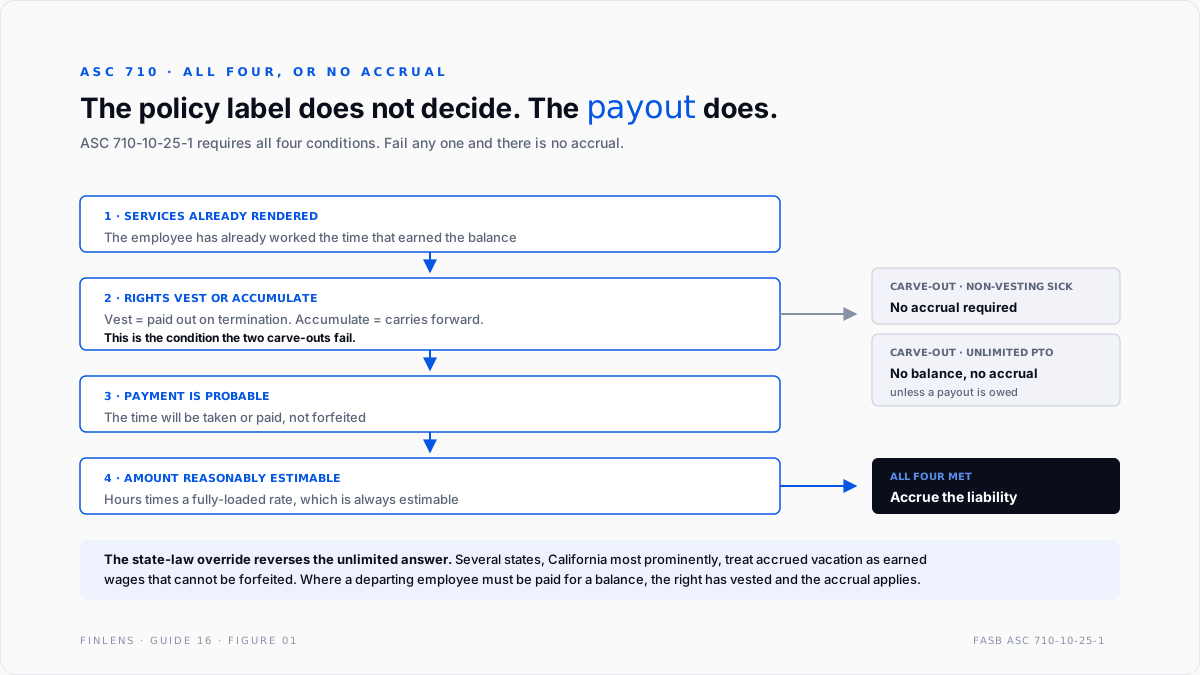
The standard sets four conditions, and all four must be met before an accrual is required.
ASC 710-10-25-1 → accrue when ALL of:
1. The obligation relates to services ALREADY RENDERED
2. The obligation relates to rights that VEST or ACCUMULATE
3. Payment is PROBABLE
4. The amount is REASONABLY ESTIMABLE
Two carve-outs follow directly from condition two, and both are regularly got wrong in opposite directions.
Non-vesting sick pay need not be accrued. Sick leave that is forfeited if unused, and never paid out on termination, fails the vesting and accumulating test. ASC 710 explicitly permits not accruing it. Many books accrue it anyway, which overstates the liability.
Unlimited PTO generally produces no accrual. If there is no balance to carry and no payout on termination, condition one and condition two both fail. But if state law or company practice requires a payout, the accrual comes back, and the policy label does not control the answer.
The measurement identity is the one most often simplified away.
PTO liability = accrued unused hours
x fully-loaded hourly rate
Fully loaded = base wage
+ employer FICA at 7.65%
+ employer unemployment, where the wage base is not exhausted
Accruing at the base wage alone understates the liability by roughly 8%, because the employer pays its share of payroll taxes on the hours when they are eventually taken. That is a real cost the business will incur and condition four says it is estimable.
What QuickBooks actually gives you
Three things, and the fourth is the one you need.
Intuit's documentation on setting up and tracking time off in QuickBooks Payroll covers the policy setup. The accrual options are yearly, every pay period, based on hours worked, or manually, and the choice affects when hours appear but not whether a liability posts. It does not.
The report itself runs from Reports, searching Vacation and Sick Leave, setting a date range and running it.
For salaried staff the hours have to be entered against the pay type rather than derived from a timesheet, which Intuit covers under entering sick pay or vacation pay hours for salaried employees. A salaried employee whose leave is never entered accrues forever and never draws down, which produces a liability that is both overstated and untrue.
The reconciliation that does exist. The dollar total on the Vacation and Sick Leave report is the figure the accrued PTO liability account should agree to. Where they differ, a journal entry adjusts the liability to the report. That single check is the whole control.
And there is a hard reason to run it monthly. In QuickBooks Online the Vacation and Sick Leave report shows only the current balance. Historical available balances are not retained, and the report cannot be pulled as at a past date. Intuit's suggested workaround is the Payroll Details report exported to Excel and sorted by hand.
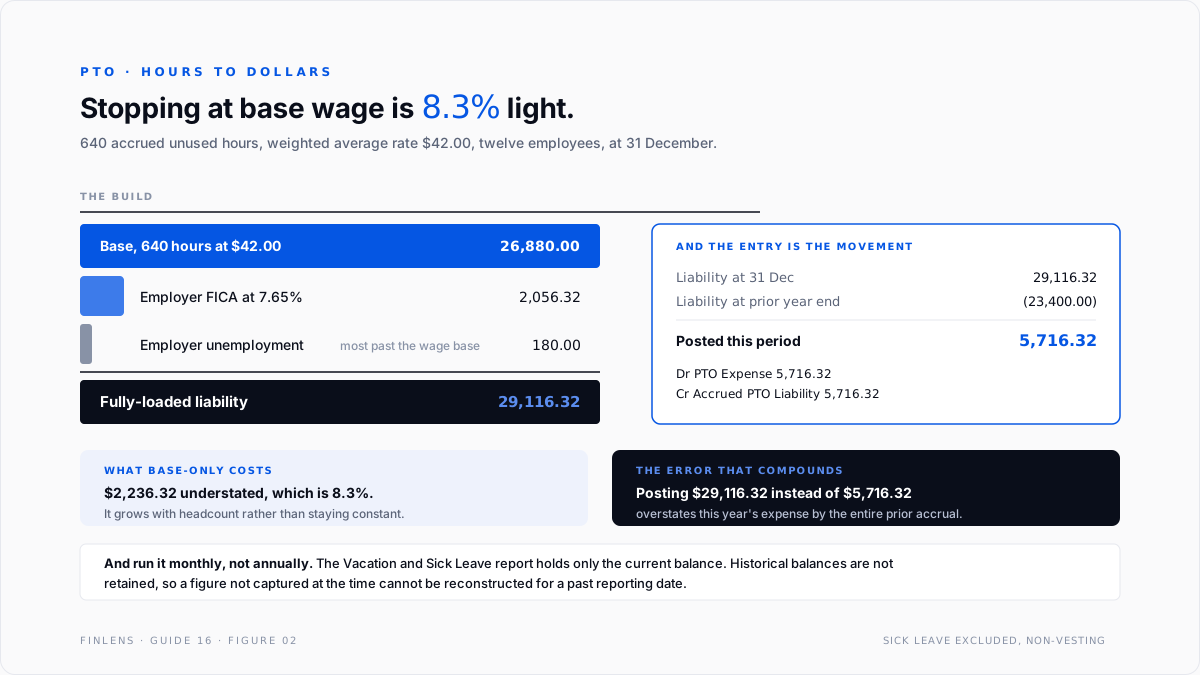
That makes the liability impossible to reconstruct retrospectively. An auditor asking what the balance was at 30 June cannot be answered from the product in December. The only reliable approach is to capture and post the figure every month, which turns a year-end scramble into a two-minute check and leaves a defensible record.
Where payroll runs on Gusto, Rippling or ADP, none of this applies and the balance comes from the provider instead, with the entry posted through the monthly journal covered in the third-party payroll journal entry guide.
The accounts and the entry
Four accounts carry it.
Post the movement, not the balance. This is the single most common mechanical error. The entry each period is the change in the liability, not the whole liability recomputed and posted again. A business that posts the full balance every quarter quadruples it by year end.
The entry.
Dr PTO Expense (the increase)
Cr Accrued PTO Liability (the increase)
When PTO is taken, the paycheck already charges wage expense through payroll. The accrual is then reduced by that usage, which is why the movement can be negative in a month where staff take more leave than they earn. A liability that only ever goes up is a liability nobody is reducing for usage.
Vesting, state law, and why the policy label does not decide
The accounting follows the obligation, not the policy document.
Vesting means payable on termination. Where accrued vacation must be paid out when someone leaves, the right has vested and the accrual is mandatory. Several states, California most prominently, treat accrued vacation as earned wages that cannot be forfeited. A use-it-or-lose-it vacation policy is unenforceable in those states, which means the accrual applies regardless of what the handbook says.
Accumulating means it carries forward. A balance that rolls into next year accumulates even if it would not be paid out on termination, and ASC 710 requires accrual for accumulating rights where payment is probable.
Caps change the number, not the principle. A policy capping accrual at 160 hours still produces a liability, measured at the capped balance.
Carryover limits behave the same way. A policy allowing 40 hours to roll into the new year creates a liability for those 40 hours at the reporting date, and the hours above the limit simply never enter the measurement. The cap is an input to the calculation, not an exemption from it.
The practical consequence for a multi-state employer. The same policy can require accrual for employees in one state and not another, which makes the state assignment on each employee a financial reporting input rather than only a tax one. The state assignment mechanics sit in the multi-state payroll guide.
The failure-mode catalog
Seven diagnoses cover most PTO accrual work.
1. No liability on the balance sheet at all. Symptom: an accrual-basis book with a PTO policy and no accrued PTO account. Cause: the US product does not post it. Fix: compute from the Vacation and Sick Leave report and post the movement. This is thread 10255.
2. Accrued at base wage only. Symptom: the liability is close but consistently light. Cause: employer payroll taxes omitted. Fix: gross up by employer FICA, and by unemployment where the wage base is not exhausted.
3. The full balance posted every period. Symptom: a liability that grows faster than the hours. Cause: posting the balance rather than the movement. Fix: reverse and restate to the movement basis.
4. Non-vesting sick leave accrued. Symptom: a liability materially larger than the vacation balance alone. Cause: sick pay that is forfeited and never paid out is being accrued. Fix: ASC 710 permits not accruing it. Separate the two policies in the calculation.
5. Usage never reduces the accrual. Symptom: a liability that only increases. Cause: the entry adds the period's earned hours and ignores hours taken. Fix: the movement is earned minus taken, and in a heavy-leave month that is negative.
6. Salaried leave never entered. Symptom: a balance that rises every period and never falls, for employees who visibly take holidays. Cause: salaried pay does not require hours, so the leave is taken in life and never recorded in payroll. Fix: enter the hours against the pay type. Without it the accrual is fiction in both directions.
7. Unlimited PTO accrued, or not accrued where it should be. Cause: the policy label was used as the test instead of the payout obligation. Fix: ask whether a departing employee gets paid for a balance. If yes, there is an accrual whatever the policy is called.
Worked example
Twelve employees. At 31 December the Vacation and Sick Leave report shows 640 hours of accrued unused vacation. The weighted average hourly rate across those employees is $42.00. Sick leave is non-vesting and forfeited at year end, so it is excluded.
The prior year-end liability was $23,400.00.
The entry is $5,716.32, not $29,116.32. The balance is the second figure. The expense is the movement, and posting the balance would overstate this year's expense by the entire prior-year accrual.
What stopping at base wage costs. Accruing $26,880 instead of $29,116.32 understates the liability by $2,236.32, which is 8.3%. On its own that is not material in most files. Compounded across years and never corrected, it becomes the audit adjustment nobody budgeted for, and it grows with headcount rather than staying constant.
Where in-QBO PTO accrual stops scaling
Threshold one: the first accrual-basis close. This is not a volume threshold. One employee with a vesting PTO balance already requires a calculation QuickBooks will not perform.
Threshold two: more than one PTO policy. Separate vacation, sick and personal policies with different vesting and different carryover rules mean separate calculations, and the Vacation and Sick Leave report does not segment by vesting status.
Threshold three: more than one state. Different payout rules by state mean the same policy accrues for some employees and not others, which cannot be derived from the report.
Threshold four: any question about a prior date. Because the report holds only the current balance, a restatement, an audit sample or a due-diligence request about a past period cannot be answered from QuickBooks at all unless the figure was captured at the time.
Threshold five: rate changes mid-year. The liability is measured at the rate expected when the time is taken, not the rate when it was earned. A raise increases the liability for hours already accrued, and nothing in QuickBooks revalues it.
Threshold six: terminated employees. The Vacation and Sick Leave report can be filtered to active staff, but a leaver with an unpaid balance at the reporting date is still an obligation. Dropping terminated employees from the report also drops them from the accrual.
The Finlens approach
Finlens reads the payroll and ledger data in QuickBooks and treats the PTO liability as a monitored balance rather than a year-end exercise.
1. Hours-to-dollars bridging. Accrued hours from the payroll reports are valued at a fully-loaded rate per employee, including employer taxes, so the balance sheet figure exists monthly rather than being reconstructed in January.
2. Movement-basis posting. The period entry is computed as the change in the liability, with earned and taken shown separately, which removes the balance-versus-movement error and makes a negative month explicable rather than alarming.
3. Vesting classification. Policies are separated by whether the right vests or accumulates, so non-vesting sick leave is excluded from the accrual and the exclusion is documented rather than assumed.
Four supporting capabilities sit around those three.
- Rate revaluation, flagging the liability impact when a pay rate changes against an existing balance.
- State-rule overlay, identifying employees whose state requires payout and therefore accrual regardless of the policy label.
- Report-to-ledger tie, reconciling the accrued PTO account to the Vacation and Sick Leave report every period.
- A cross-file view for firms, listing clients with a PTO policy and no accrued PTO liability.
Verification checklist
Eight lines to run at each close.
- An accrued PTO liability account exists and is non-zero where staff carry balances.
- The liability ties to the dollar total on the Vacation and Sick Leave report.
- The rate used is fully loaded, including employer FICA.
- The entry posted is the movement in the liability, not the balance.
- Hours taken in the period reduced the accrual.
- Non-vesting sick leave is excluded, and the exclusion is documented.
- Employees in states requiring payout are accrued regardless of policy wording.
- Pay rate changes in the period have been reflected in the balance, not only in future accruals.
FAQ
Does QuickBooks post a PTO liability automatically?
Not in the United States. It tracks hours and reports them. The Canadian product does post automated vacation entries, which is a common source of the wrong expectation.
Does sick leave have to be accrued?
Not where it is non-vesting, meaning forfeited if unused and never paid out. ASC 710 permits not accruing it. Vesting sick leave is accrued like vacation.
Does unlimited PTO create a liability?
Usually not, because there is no balance and no payout. If state law or practice requires a payout on termination, the accrual applies regardless of the label.
What rate should be used?
Fully loaded. Base wage plus employer payroll taxes, measured at the rate expected when the time is taken rather than when it was earned.
Should the entry be the balance or the movement?
The movement. Posting the balance each period compounds the liability and overstates expense by the prior accrual.
Which report reconciles the liability?
The Vacation and Sick Leave report. Its dollar total is what the accrued PTO account should agree to, and the check is worth running monthly.

