
Direct vs Indirect Costs: How to Classify Every Business Expense (COGS vs Overhead)


Direct costs are expenses you can trace directly to a specific product, service, or project. Indirect costs (also called overhead) are general business expenses that support whole operation but can't be tied to any single output. The distinction determines where each expense lands on your P&L direct costs flow through Cost of Goods Sold (COGS), reducing gross profit. Indirect costs sit in Operating Expenses, reducing operating income further down.
This guide covers definitions, "cost object" concept, examples in each category, allocation methods for indirect costs, how split flows through P&L, and why grant recipients and government contractors care about distinction most of all.
The core definition
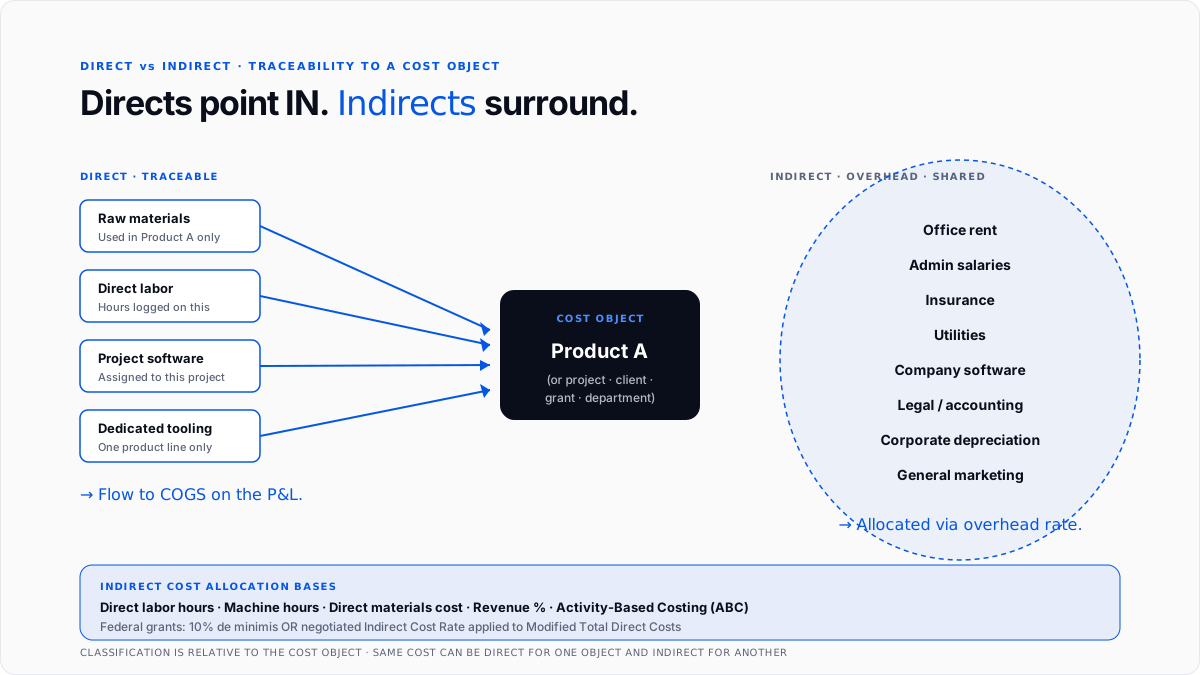
Direct costs can be traced to a specific "cost object" product you're making, service you're delivering, or project you're running. If you can look at an invoice and say "this bought materials for Product A" or "this paid developer who worked only on Client X's project," it's a direct cost.
Indirect costs support business generally. Office rent benefits every department. The controller's salary benefits every project. The utility bill can't be split cleanly between Product A and Product B. These are overhead.
Traceability is test. Not "which department pays it" which specific product/service/project can we point to?
The "cost object" concept
A cost object is whatever you're trying to measure cost of. Different cost objects change classification:
- Cost object = one product line. Manufacturing that product's materials = direct. Corporate rent = indirect.
- Cost object = one client project. Developer hours on that project = direct. HR team salary = indirect.
- Cost object = one grant. Grant-funded lab equipment = direct. University administration = indirect.
- Cost object = one department. That department's dedicated staff = direct. Company-wide software = indirect.
A cost can be direct for one cost object and indirect for another. The classification is always relative to what you're measuring.
Direct cost examples
Manufacturing / product businesses:
- Raw materials (steel, wood, chemicals used in this specific product)
- Direct labor (assembly workers whose time is tracked per unit)
- Direct factory supplies (glue, screws, dedicated to one product line)
- Purchased components (LCD screens for a specific device model)
- Freight-in on inventory
- Direct product tooling (a mold used only for this product)
Service / project businesses:
- Consultant hours billed to a specific client
- Contractor payments for a specific project
- Software licenses assigned to one client engagement
- Travel expenses for one client visit
- Materials purchased for one specific job
Grant-funded organizations:
- Grant-specific research materials
- Grant-funded staff time (payroll allocated to that grant)
- Grant-specific travel
Indirect cost examples (overhead)
General & administrative overhead:
- Corporate office rent and utilities
- Administrative staff salaries (HR, accounting, executive)
- General liability insurance
- Legal and accounting retainers
- General office supplies
- Company-wide software (accounting, HRIS, CRM)
- Business licenses and permits
- Depreciation on corporate assets
Factory / production overhead:
- Factory rent (if factory makes multiple products)
- Indirect labor (supervisors, maintenance staff, quality control)
- Factory utilities
- Depreciation on shared equipment
- Factory insurance
- Materials handling
Selling & marketing overhead:
- General marketing campaigns (not tied to a specific product)
- Sales team base salaries (commissions are direct/variable)
- Marketing software subscriptions
- Trade show expenses
Allocation methods for indirect costs
Because indirect costs can't be traced to one cost object, businesses use allocation bases to distribute them proportionally:
1. Direct labor hours. Divide overhead by total direct labor hours across products, then allocate per hour worked on each product.
2. Machine hours. Common in capital-intensive manufacturing overhead is allocated based on how many hours each machine ran producing each product.
3. Direct materials cost. Allocate overhead as a % of direct material cost per product.
4. Revenue (sales) allocation. Split overhead in proportion to product-line or client revenue.
5. Activity-Based Costing (ABC). More sophisticated identify specific activities that drive overhead (order processing, quality inspections, setups) and allocate based on how much each product/client consumes.
6. Federal grant overhead rate. Grants use a "Federally negotiated Indirect Cost Rate" (IDCR) a % applied to modified total direct costs to fund grantee's overhead. Common rates: 10% de minimis, or negotiated rates from 25% to 60%+ for research universities.
The allocation method affects reported product/project profitability significantly a change from labor-hour to machine-hour allocation can flip a product from profitable to unprofitable overnight.
Where each type flows on P&L
Standard income statement structure:
Revenue Less: Direct costs (COGS) ← direct materials + direct labor + direct overhead = Gross Profit Less: Indirect costs (Operating Expenses) ← G&A, selling, marketing overhead = Operating Income
For sole proprietors filing Schedule C:
- Direct costs typically flow through Part III → Cost of Goods Sold → Line 4
- Indirect costs flow through Part II Operating Expenses → Lines 8–27 (see small business tax deductions for full list)
For pass-through entities (partnerships, S-corps), same COGS-vs-operating-expense split applies on Form 1065 or 1120-S, then flows to owners via Schedule K-1.
Direct vs. indirect is DIFFERENT from fixed vs. variable
Two independent frameworks:
- Direct vs. indirect = traceability (can we tie it to one cost object?)
- Fixed vs. variable = behavior (does it change with volume?)
The four combinations:
Both classifications matter. Direct/indirect drives your COGS-vs-operating-expense P&L presentation. Fixed/variable drives your break-even and scale economics.
Why direct vs. indirect matters most for grants and government contracts
Federal grant recipients and government contractors must strictly separate direct from indirect costs to comply with 2 CFR 200 (Uniform Guidance) or FAR (Federal Acquisition Regulation):
Direct costs are billed against grant/contract. The IRS and awarding agency can audit whether a cost was truly direct.
Indirect costs are recovered via negotiated Indirect Cost Rate applied to Modified Total Direct Costs (MTDC).
Misclassifying an indirect cost as direct (billing office rent to a grant) is a form of cost overstatement and can trigger:
- Grant disallowance (repayment demanded)
- Loss of federal funding eligibility
- False Claims Act penalties (double or triple damages + $13K+ per false claim)
- Debarment from federal contracts
Universities, hospitals, and nonprofits with federal grants have entire finance teams dedicated to this compliance. The same allocation discipline drives construction accounting, from job costing to revenue recognition, where indirect cost pools feed percentage-of-completion rather than just overhead recovery.
Product-line and client profitability analysis
Beyond P&L structure, direct/indirect classification enables:
Product profitability: Direct costs of Product A subtracted from Product A revenue = Product A's contribution to overhead + profit. Only allocate indirect costs to see fully-loaded product margin.
Client profitability: Same math at client level for service businesses. Which clients cover their allocated overhead + generate margin? Which are net losers when true costs are considered?
Cost-plus pricing: Government contracts and some B2B contracts are "cost-plus" customer pays direct costs + a markup. You MUST correctly categorize direct vs. indirect to bill accurately and pass audit.
Common direct vs. indirect mistakes
Treating all payroll as direct: Only labor traceable to a specific product/project/client is direct. Corporate/admin salaries are indirect. HR, finance, IT typically indirect. Sales base salary indirect; commissions direct-variable.
Missing indirect costs entirely in break-even models: Some small businesses only model direct costs, then wonder why "profitable" price still leaves them cash-negative overhead was never covered.
Applying overhead rate too aggressively: A 40% overhead markup on top of direct costs can make you uncompetitive vs. rivals with leaner G&A. Benchmark your overhead rate against industry norms.
Allocating overhead differently across cost objects: If one product bears a labor-hour allocation and another bears a machine-hour allocation, you can't fairly compare their reported margins. Use consistent methodology.
Ignoring direct-cost boundary in contracts: Cost-plus contracts specify which costs are billable direct read carefully. Some contracts allow certain "indirect" items (specific software, security screening) as direct; others don't.
Conclusion
Direct costs trace to one product, project, or client; indirect costs (overhead) don't. Direct costs land in COGS; indirect costs sit in operating expenses. Fair overhead allocation drives accurate product-line profitability, honest client margin analysis, and compliant grant reporting get split wrong and every downstream financial decision is built on bad data.
Frequently asked questions
What are examples of direct costs?
Raw materials, direct labor on a specific product, freight-in on inventory, project-specific consultant fees, dedicated project software licenses.
What are examples of indirect costs?
Office rent, admin salaries, general liability insurance, utilities, office supplies, company-wide software subscriptions, depreciation on shared assets.
Is depreciation direct or indirect?
Depends. Depreciation on machinery dedicated to one product = direct. Depreciation on shared factory equipment = indirect. Depreciation on corporate office = indirect.
Is rent direct or indirect?
Almost always indirect (shared across products/projects). Exception: a facility dedicated to a single product line.
Is direct labor same as variable labor?
Not necessarily. Direct labor is traceable to a specific product/project. Variable labor scales with volume. Hourly production workers are usually BOTH direct and variable. A salaried project manager might be direct (traceable to one project) but fixed (same salary regardless of hours worked).
Do I need to split direct and indirect for tax purposes?
For inventory-based businesses, yes COGS (direct) is calculated separately from operating expenses (indirect). See our Schedule C guide for how COGS flows through Part III.
What's "de minimis" indirect cost rate?
10% of Modified Total Direct Costs flat rate available to federal grant recipients that don't have a negotiated Indirect Cost Rate. Available for most grants under 2 CFR 200.414(f).
Can a cost be both direct and indirect at same time?
For same cost object, no. For different cost objects, yes a piece of equipment used across three products is indirect at product level but could be direct if cost object were "manufacturing facility."

