
Small Business Tax Deductions: The 20 Categories That Actually Move the Needle


Small business tax deductions are operating expenses you can subtract from gross receipts to reduce taxable business income. For sole proprietors and single-member LLCs, they land on Schedule C lines 8 through 27. For partnerships and S-corps, they flow through Form 1065 or 1120-S onto each owner's Schedule K-1. Track them well and you cut both federal income tax AND self-employment tax at margin.
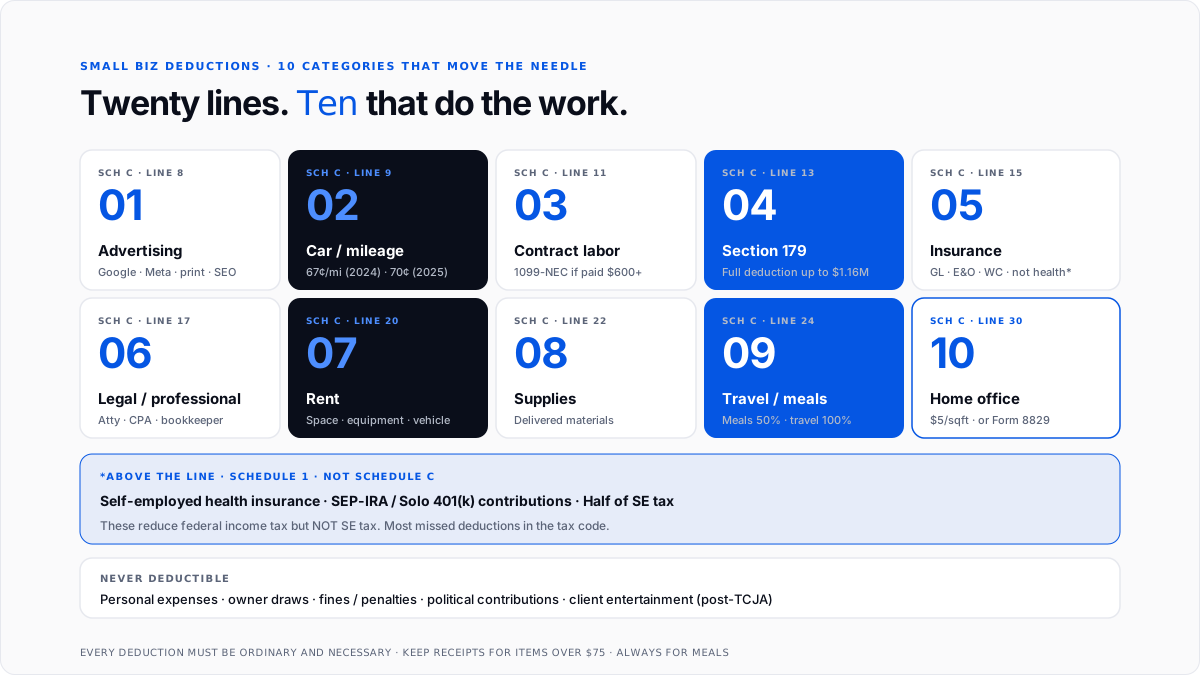
This guide covers 20 deduction categories that actually move needle for most small businesses, where each one goes on return, and deductions filers routinely miss.
The two rules every deduction must pass
Per IRS guidance built into Schedule C instructions and (retired) Publication 535, every business expense must be:
- Ordinary: Common and accepted in your trade or business
- Necessary: Helpful and appropriate for your business
That's a low bar in practice, but it excludes personal expenses. A meal with your spouse doesn't qualify unless spouse is a legitimate business associate discussing business.
The 20 deduction categories
Below are deductions organized by Schedule C line number, with notes on what qualifies and where it commonly gets miscoded.
1. Advertising (Line 8): Facebook/Google ads, business cards, sponsored content, direct mail, website design, SEO fees, branded merchandise.
2. Car and truck expenses (Line 9): Two methods available:
- Standard mileage: 67¢/mile for 2024, 70¢/mile for 2025
- Actual expenses: Gas, insurance, repairs, depreciation × business-use %
You must pick one method in year one. Standard mileage can't be switched in later years if you started with actuals.
3. Commissions and fees (Line 10): Referral fees, sales commissions to reps, platform fees (Etsy, Amazon, Upwork).
4. Contract labor (Line 11): Payments to 1099 contractors. If you paid anyone $600+, they need a Form W-9 and a 1099-NEC.
5. Depreciation and Section 179 (Line 13): Two accelerations of depreciation available:
- Section 179: Deduct up to $1,160,000 of equipment placed in service in 2024 (rising each year)
- Bonus depreciation: 60% for 2024, 40% for 2025, 20% for 2026 (phasing down)
Combined with regular MACRS depreciation on balance, most equipment gets fully deducted in year one for small businesses.
6. Employee benefits (Line 14): Health, dental, vision, life insurance premiums for EMPLOYEES (not owner). Owner health insurance goes on Schedule 1, Line 17 instead.
7. Insurance other than health (Line 15): General liability, professional liability (E&O), commercial auto, workers' comp, cyber, business property, business interruption. NOT health insurance for owner (see #21).
8. Interest (Line 16a/16b): Mortgage interest on business property (16a) and other business interest credit cards used for business, business loans, equipment financing (16b).
9. Legal and professional services (Line 17): Attorney fees, CPA fees, bookkeeper fees, tax preparation, business consultants, business insurance broker fees.
10. Office expense (Line 18): Supplies used up during year printer paper, pens, staples, subscription software billed monthly. Larger items (over ~$200) may need to be depreciated instead.
11. Pension and profit-sharing plans (Line 19): Employer contributions to employee retirement plans (SEP-IRA, SIMPLE IRA, 401(k)). Owner's OWN contributions go on Schedule 1, not Line 19.
12. Rent (Line 20a/20b): Vehicle/equipment rentals (20a) and business property rent (20b). If you paid a landlord $600+, you may need to issue a 1099-MISC.
13. Repairs and maintenance (Line 21): Fixing broken equipment, servicing HVAC in commercial space, patching leaks. Improvements that ADD value or extend useful life get capitalized and depreciated, not expensed.
14. Supplies (Line 22): Items directly used in delivering your product/service. For a hair salon: hair products used on clients. For a contractor: consumable materials on job sites.
15. Taxes and licenses (Line 23): State/local business taxes, sales tax remitted (not collected), franchise tax, professional licensing fees, business permits. NOT federal income tax or self-employment tax.
16. Travel and meals (Line 24a/24b):
- Travel (24a): Airfare, hotel, rental car, taxi to/from airport, tips on business trips. Trip must have a primary business purpose.
- Meals (24b): 50% deductible for business meals with a legitimate business purpose. 100% deductible for company-wide events (holiday party, all-hands lunch).
17. Utilities (Line 25): Electric, gas, water, sewer, garbage, business internet, business phone (dedicated line or business-use % of shared).
18. Wages (Line 26): W-2 wages paid to employees (see Form 941 for quarterly reporting). Owner draws don't go here sole prop owner takes draws through personal return.
19. Other expenses (Line 27 + Part V): The catch-all for expenses that don't fit above:
- Bank fees, merchant processing fees (Stripe, PayPal, Square)
- Business subscriptions (SaaS not billed monthly enough to fit "office expense")
- Continuing education, professional development
- Dues to professional associations
- Uniforms (only if required and not suitable for street wear)
- Software (specifically business-use)
20. Cost of Goods Sold (Line 42 → Line 4 via Part III): For product businesses only. Beginning inventory + purchases + direct labor + materials − ending inventory. See Schedule C guide for full COGS mechanics.
The commonly missed deductions
Beyond 20 core categories, small business filers routinely miss:
21. Self-employed health insurance (Schedule 1, Line 17, NOT Schedule C): Owner's health, dental, vision, and long-term care premiums up to amount of Schedule C net profit. Above-the-line adjustment reduces AGI even if you take standard deduction.
22. Half of SE tax (Schedule 1, Line 15): Half of self-employment tax is deducted above line, reducing income tax (not SE tax itself).
23. QBI deduction (Form 8995 or 8995-A): Up to 20% of qualified business income deducted below line. See our QBI deduction guide.
24. Retirement plan owner contributions (Schedule 1): SEP-IRA, Solo 401(k), SIMPLE IRA contributions for owner reduce federal income tax (not SE tax). See IRA contribution limits.
25. Startup costs: Up to $5,000 of pre-opening expenses deductible in year 1, rest amortized over 15 years. Goes on Line 27 (Other expenses) with Part V detail.
26. Home office deduction (Line 30 via Form 8829): $5/sq ft simplified up to $1,500 max, OR actual expenses × business-use %. Detailed in our home office deduction guide.
27. Business use of cell phone: If a phone is used for both business and personal, deduct business-use percentage (Line 25 utilities or Line 27 other).
28. Depreciation of equipment purchased in prior years: Section 179 in year one is one option but if you didn't elect it, equipment is still depreciating. Track prior years' Form 4562 to capture current-year deprecation.
29. Business gifts: $25 per recipient per year cap. Line 27.
30. Bad debts: For accrual-basis filers, uncollectible receivables written off. For cash-basis filers, no deduction you never recognized income.
One item is routinely claimed in the wrong place: foreign income tax is usually worth far more as the Foreign Tax Credit on Form 1116 than as a deduction against business income.
Deductions that DON'T qualify (common myths)
Personal expenses "disguised" as business": Groceries, personal clothing, home mortgage principal, personal car repairs. The IRS is aggressive about disallowing these.
Fines and penalties: Traffic tickets, IRS penalties, EPA fines never deductible even if incurred during business travel.
Political contributions: Not deductible.
Illegal activities: Cost of doing business in a federally illegal activity (e.g., marijuana under §280E) can't be deducted, though COGS may still apply.
Client entertainment (post-TCJA): Sports tickets, concert tickets, golf outings with clients 0% deductible since 2018 under TCJA (previously 50%).
Life insurance premiums for owner: Not deductible if business is beneficiary. Group-term life for employees (up to $50K coverage) IS deductible.
Owner draws: Sole prop owner draws are personal, not business. Only W-2 wages paid to actual employees go on Line 26.
Where each category flows on return
For sole proprietors and single-member LLCs, all 20 core deductions land on Schedule C:
- Lines 8–27 → Part II Operating Expenses
- Line 30 → Home office (from Form 8829 or simplified)
- Line 42 → COGS (from Part III if applicable)
Net profit or loss (Line 31) then flows to:
- Schedule 1, Line 3 → Form 1040 taxable income
- Schedule SE → self-employment tax calculation
For S-corps: expenses land on Form 1120-S, then K-1 to shareholders. For partnerships: Form 1065, then K-1s to partners.
Common deduction mistakes
Not tracking mileage day-of: IRS requires contemporaneous records a mileage log created on April 14 for whole prior year is not audit-defensible. Use an app that timestamps automatically.
Deducting meals with family/friends as "business.": Fails "ordinary and necessary" test unless there's a genuine business purpose documented.
Missing depreciation on prior-year equipment: Once placed in service, equipment continues to generate deduction in future years even if forgotten. Missed years require Form 3115 (Change in Accounting Method) to catch up.
Combining home office and Schedule A itemizing: The home office deduction (Schedule C Line 30) is a separate business deduction you can also claim mortgage interest and property tax on Schedule A if itemizing.
Not issuing 1099-NECs for contract labor over $600: Contract labor deduction is still valid, but not issuing 1099 exposes you to $310+ per-form penalty and can invalidate deduction on audit.
Miscoding COGS as regular expense: For product businesses, materials go through Part III (COGS), not Line 22 (Supplies). COGS reduces gross receipts differently than operating expenses reduce gross income.
Conclusion
Twenty categories cover ~95% of deductions most small businesses actually claim. The ones that move needle most are contract labor, mileage/vehicle, Section 179 depreciation on equipment, and home office deduction plus above-the-line adjustments (health insurance, retirement, half of SE tax) that most filers miss.
Frequently asked questions
Are business tax deductions same as tax credits?
No. Deductions reduce taxable INCOME (indirect tax savings at your marginal rate). Credits reduce tax OWED dollar for dollar. Both are valuable, but credits are more powerful per dollar.
Can I deduct expenses from years before I officially opened business?
Yes, as startup costs. First $5,000 deducted in year 1, rest amortized 15 years.
Do I need receipts for every deduction?
For deductions over $75, yes (per IRC §274(d)). For meals, always. For cash payments, always plus a 1099-NEC if $600+.
What if I forgot to deduct something in a prior year?
File Form 1040-X to amend. 3-year statute of limitations.
Are business deductions same for LLCs, S-corps, and sole props?
Same categories, different forms. Sole prop / SMLLC → Schedule C. S-corp → Form 1120-S. Partnership / multi-LLC → Form 1065.
Do deductions reduce self-employment tax?
Schedule C business deductions YES (they reduce net profit before SE tax). Above-the-line adjustments (health insurance, retirement, half of SE tax) NO they only reduce income tax.
Are business deductions limited by income?
Some are (home office capped at business net profit). Most aren't for typical operating expenses. Excess business losses beyond $305K single / $610K MFJ are capped and carried forward.
Can I switch between cash and accrual accounting to change deduction timing?
Yes, but changing accounting methods requires Form 3115 and IRS approval. Small businesses under $30M average gross receipts can use cash method by default.

