
Home Office Deduction: Simplified vs Regular Method (Form 8829 Filing Guide)


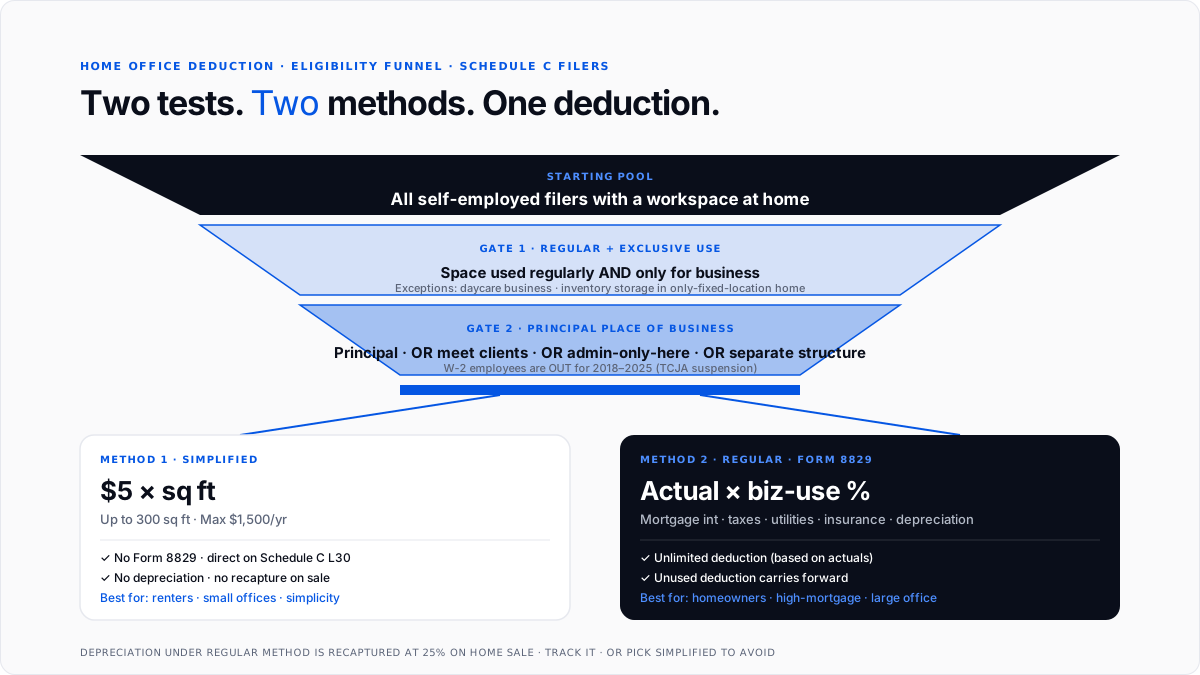
The home office deduction lets self-employed filers deduct expenses tied to portion of their home used for business. If you're a sole proprietor, freelancer, or single-member LLC owner with a dedicated workspace at home, you can pick between simplified method ($5 per square foot, up to $1,500 max) or regular method (Form 8829 with actual expenses × business-use percentage). W-2 employees can't claim it Tax Cuts and Jobs Act suspended unreimbursed employee business expenses through 2025.
This guide covers two eligibility tests, both calculation methods, specific expenses that qualify, exceptions to exclusive-use requirement, and depreciation trap that catches home sellers years later.
The two eligibility tests
Per IRS Home Office Deduction page, you must pass BOTH tests to claim deduction:
Test 1 Regular and Exclusive Use. The space must be used regularly (not occasionally) AND exclusively (not part-time personal use) for business. A corner of your living room where you sometimes work doesn't qualify you use couch personally too. A converted bedroom used only as your office does qualify.
Test 2 Principal Place of Business. The space must be one of:
- Your principal place of business where you conduct most of your business activity, OR
- Where you meet clients or customers in normal course of business, OR
- A separate structure on your property used for business (detached garage converted to studio)
You can also qualify if you use home space substantially and regularly for administrative activities and have no other fixed location to do them (this is how many contractors and consultants qualify actual work happens at client sites, but admin work happens at home).
Two exceptions to exclusive-use rule
Daycare business. If you run a daycare in your home, space doesn't have to be exclusively used for business kids use space during operating hours, family uses it evenings and weekends. You allocate expenses based on hours of business use vs. total available hours.
Inventory or product-sample storage. If your home is your only fixed business location, space used to store inventory or product samples qualifies even if you also use it for personal purposes.
Outside these two exceptions, exclusivity is strict IRS will disallow deduction if space has any personal use.
W-2 employees cannot claim it (2018–2025)
Post-TCJA, unreimbursed employee business expenses including a W-2 employee's home office are NOT deductible for tax years 2018 through 2025. If your employer requires you to work from home, they can:
- Reimburse you via an accountable plan (not taxable to you, deductible for them)
- Or you simply cannot deduct space
This is set to sunset after 2025 unless Congress extends TCJA. Until then, home office deduction is a self-employed benefit only.
The simplified method
Under Rev. Proc. 2013-13, IRS offers a simplified method that avoids Form 8829:
- Rate: $5 per square foot of qualified home office space
- Cap: 300 square feet maximum
- Max deduction: $1,500 per year
- Form: Skip Form 8829 entirely; enter deduction directly on Schedule C Line 30
Who benefits: Small offices, renters (no mortgage interest to deduct anyway), filers who value simplicity over maximum deduction.
Trade-offs:
- No depreciation of your home (which sounds bad but is actually a benefit see depreciation recapture section)
- Can't carry over unused deduction to future years
- Related home expenses (mortgage interest, real estate tax) still deductible on Schedule A if itemizing
The regular method (Form 8829)
The regular method calculates actual expenses × business-use percentage:
Step 1: Determine business-use percentage.
- Business square feet ÷ Total home square feet = Business-use %
- Example: 200 sq ft office ÷ 2,000 sq ft home = 10%
Step 2: Categorize expenses.
Direct expenses (100% deductible): Costs entirely related to office (painting office, dedicated business phone line, office-only repairs).
Indirect expenses (× business-use %): Costs benefiting whole home:
- Mortgage interest
- Real estate taxes
- Home insurance
- Utilities (electricity, gas, water, sewer, garbage)
- Home maintenance and repairs
- Depreciation of home (regular method only)
Unrelated expenses (0% deductible): Landscaping, lawn care, home improvements to non-business areas.
Step 3: Apply business-use percentage.
Continue 10% example: If total home utilities were $3,000, deductible = $300.
Step 4: File Form 8829. Attach to Schedule C. Deduction flows to Schedule C Line 30.
Simplified vs. Regular a quick comparison
When simplified wins: Renters, small offices under 300 sq ft, filers whose actual expenses × business-use % would be under $1,500 anyway.
When regular wins: Homeowners with large mortgages, filers with utilities exceeding $10K+/year, filers with office over 300 sq ft.
The depreciation recapture trap
If you use regular method AND depreciate your home, when you sell home you must recapture depreciation as taxable gain even if you'd otherwise qualify for $250K/$500K Section 121 home-sale exclusion. This is at a fixed 25% rate (Section 1250 recapture).
Example:
- 10% business-use, $500K home purchased in 2015
- Deducted depreciation over 10 years: $12,000 total
- Sell home in 2025 for $700K
- Section 121 exclusion protects personal-use portion of gain
- But $12,000 in prior depreciation is recaptured at 25% = $3,000 owed on sale
This trap is why some filers with modest home offices choose simplified method no depreciation, no recapture.
Deduction is limited by business income
The home office deduction cannot create a net Schedule C loss. If your business income (before home office deduction) is $8,000 and your calculated home office deduction is $12,000, you deduct $8,000 this year and carry remaining $4,000 forward to future years (regular method only simplified method has no carryforward).
Practically, most established businesses don't hit this cap. It matters for startups in year one or side hustles with irregular income.
What counts as "home"
Per IRS, "home" includes:
- House
- Apartment
- Condo
- Mobile home / RV (as principal residence)
- Boat (as principal residence)
- Separate structures on your property (detached garage, workshop, studio)
Not included:
- Any part of property used as a hotel/motel/inn (that's Schedule E, not home office)
- Purely commercial property owned separately (that's business real estate)
Common home office deduction mistakes
Claiming a corner of a personal room. Fails exclusive-use test. The IRS looks for a discrete space (whole room or clearly demarcated area) used only for business.
W-2 employees claiming it. Not allowed for 2018–2025 under TCJA. If you're both W-2 employed AND have a self-employment side hustle, only SE portion supports home office deduction and only if your home is principal place of business FOR SE work.
Deducting mortgage principal. Only mortgage INTEREST is deductible × business-use %. Principal payments are not deductible for anyone.
Not tracking depreciation for recapture. Regular method depreciation compounds over years sell without tracking it and you'll face a nasty CP2000 for underreported depreciation recapture. Keep Form 8829 depreciation running total.
Simplifying when you shouldn't. A $2,500/year homeowner with a big mortgage-interest tax shield often nets $3,000–$5,000 via regular method vs. capped $1,500 via simplified. Run both scenarios.
Forgetting utility increases. Mid-year increases in utility costs (winter heating, summer AC) push actual expenses higher. Track quarterly utility bills for accurate regular-method deduction.
Not claiming at all out of "audit fear." The IRS audits home office deductions at similar rates to other Schedule C line items. A legitimate deduction backed by documentation is not risky. See our Schedule C filing guide for how deduction flows through return.
The gig-worker / rideshare edge case
Uber, Lyft, DoorDash, and other rideshare/delivery drivers frequently ask about home office deduction. In most cases:
- If you use your home for administrative work (trip planning, expense tracking, tax records) and have no other fixed location for it, you can claim home office
- The exclusive use test still applies space you use for admin must be used only for that
- The vehicle itself is a separate car and truck expense category (not home office)
The Schedule C interaction
The home office deduction flows into Schedule C Line 30, reducing net profit. Net profit then flows to:
- Form 1040 Line 3 → federal income tax
- Schedule SE → self-employment tax at ~15.3%
Because home office deduction reduces net Schedule C profit, it also reduces SE tax. A $3,000 home office deduction in 22% federal bracket saves ~$660 in income tax + $424 in SE tax (14.13% effective) = **$1,084 combined**.
Conclusion
The home office deduction is one of most valuable deductions available to self-employed filers often worth $1,000–$5,000/year in combined income + SE tax savings. Simplified method is safe default for renters and small offices; regular method with Form 8829 usually wins for homeowners with high home expenses.
Frequently asked questions
Can I take home office deduction and standard deduction on my personal return?
Yes. The home office is a Schedule C business deduction, entirely separate from personal standard deduction on Form 1040.
Can I switch between simplified and regular method year to year?
Yes. You choose fresh each tax year. If you took depreciation in prior years and switch to simplified this year, you still need to track that depreciation for future recapture.
What if my office is in a shared space (family room)?
The exclusive-use test likely disqualifies you. Most tax pros require a dedicated room or a clearly demarcated section (with physical partition) used only for business.
How do I document deduction?
Keep: (1) photo of office, (2) square footage measurement of both office and total home, (3) utility bills, (4) mortgage/rent records, (5) date placed in service, (6) Form 8829 or simplified calculation for year.
Can I claim it if I rent instead of own?
Yes. Rent × business-use % is deductible. Simplified method works equally well for renters.
Does home office deduction trigger audits?
Not more than other Schedule C deductions. Historically deduction was audit-flagged, but with Form 8829 and clear IRS guidance, legitimate claims are routine.
Can I take home office deduction on Airbnb income?
Only if space is used regularly and exclusively for Airbnb business (administrative work, guest management). The Airbnb rental space itself is separate that's Schedule E rental income, not Schedule C.
Do partners in a partnership claim home office on Schedule E?
Generally yes, if partnership agreement requires them to maintain home office space at their own expense. The Unreimbursed Partnership Expense (UPE) flows through Schedule K-1 and onto Schedule E, Part II.

