
What Does a QuickBooks Consultant Actually Do?


A QuickBooks consultant is a specialist you hire to fix, configure, or extend your QuickBooks setup, usually on a project basis rather than as ongoing bookkeeping. They set up new company files, clean up messy books, build custom reports, connect QuickBooks to other systems, and train your team. Rates run $15-$25/hr on marketplaces like Upwork for basic help, $50-$150/hr for certified ProAdvisors, and $150-$300/hr for consultants who also hold a CPA license.
This guide walks through what consultants actually do, how they differ from bookkeepers and pro advisors, what a fair rate looks like in 2026, and when hiring one is the right call versus other help options.
What does a QuickBooks consultant actually do?
QuickBooks consultants handle project work, not ongoing daily bookkeeping. Six categories cover the vast majority of engagements.
New file setup. Configure the chart of accounts, set up sales tax by jurisdiction, connect bank feeds, import historical data from a spreadsheet or another accounting system, and set customer and vendor templates.
Cleanup projects. Reconstruct 12 or 24 months of books that were entered incorrectly, categorized inconsistently, or never reconciled. Often the pain point that pushes a business to hire a consultant in the first place.
Custom reports. Build reports that native QuickBooks templates don't produce. Class-based P&L, project profitability rollups, custom KPI dashboards, and board-ready financials with specific formatting.
Integrations. Connect QuickBooks to third-party tools (Stripe, Shopify, HubSpot, Salesforce, Ramp) that don't have out-of-the-box connectors, or fix broken syncs from tools that do.
Migrations. Move from QuickBooks Desktop to QuickBooks Online, or migrate off QuickBooks entirely (rare but happens). Move data between company files when a business restructures.
Team training. Walk new hires or existing staff through the specific workflows the business uses. Custom training materials for the company's actual chart of accounts and processes.
Consultants stop at "the system works." They don't sit inside the books daily doing categorization and reconciliation. That's a bookkeeper's job.
How is a QuickBooks consultant different from a bookkeeper?
Different roles, different cadences.
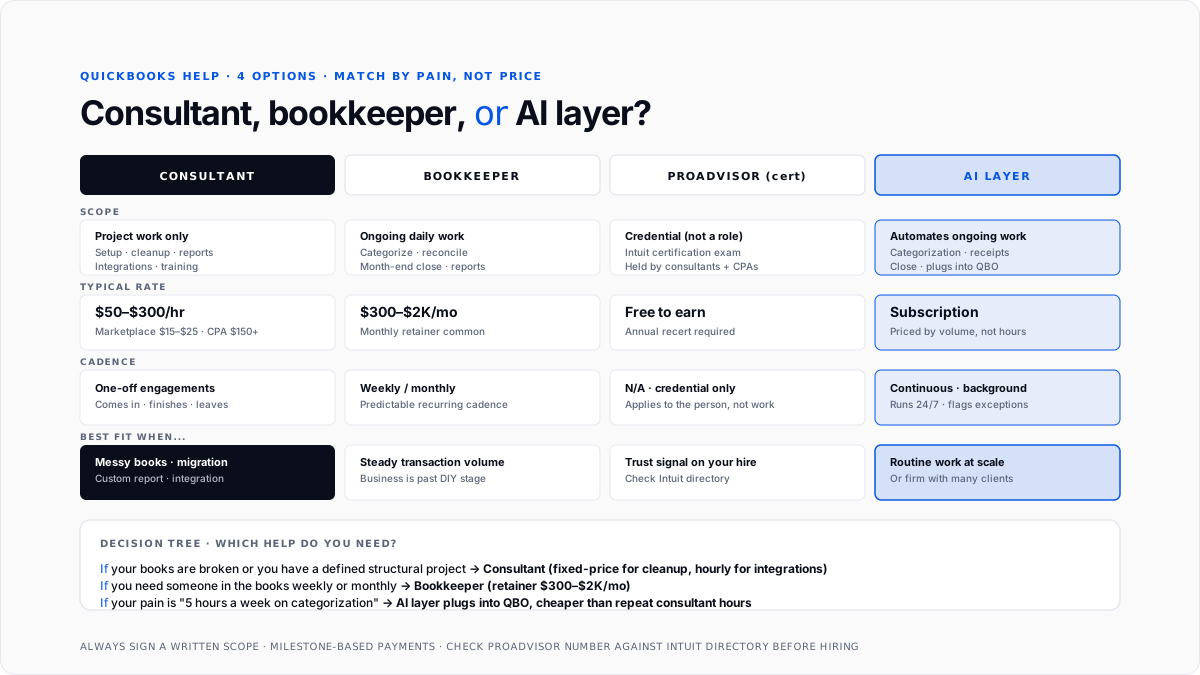
QuickBooks consultant. Project-based. Comes in for a defined engagement (setup, cleanup, custom report, integration, training). Bills hourly or fixed-price for the project. Leaves once the deliverable is complete. Comes back when you need the next project.
Bookkeeper. Ongoing monthly relationship. Sits inside QuickBooks each week or month categorizing transactions, reconciling accounts, running month-end close, and preparing reports for the owner or CPA. Bills are monthly retainer or hourly, typically $300-$2,000/month for a small business.
Most growing businesses need both at different points. A consultant sets up the file and cleans up whatever mess exists, then hands over to a bookkeeper (or an in-house employee) for ongoing work. Trying to have a bookkeeper handle a complex cleanup or custom integration is usually a mismatch. Trying to have a consultant do monthly close is overpriced.
For the fee side of ongoing bookkeeping, our piece on bookkeeping services fees covers the market rates.
What is a ProAdvisor, and how is it different from a consultant?
QuickBooks ProAdvisor is a certification, not a job title. Intuit awards it to bookkeepers, accountants, and consultants who pass Intuit's free certification exams. There are ProAdvisor tiers (Online, Advanced, Desktop, Payroll) and being a ProAdvisor is what unlocks the Intuit-side accountant portal, discount client subscriptions, and Intuit's ProAdvisor listing directory that clients search.
Almost every professional QuickBooks consultant is a ProAdvisor. Not every ProAdvisor is a consultant — most are bookkeepers or CPAs who took the cert to work with QuickBooks-using clients. When you're hiring, "consultant" describes the work (project-based fixes) and "ProAdvisor" describes the credential (certified by Intuit).
What does a QuickBooks consultant cost per hour?
Rates split into four tiers based on qualifications and complexity.
Marketplace freelance (Upwork, Fiverr, Guru): $15-$25/hr. Median rate around $15/hr per Upwork's own data. Best for straightforward tasks like data entry, basic reconciliation, or template configuration. Quality varies widely.
Certified ProAdvisor (independent): $50-$150/hr. Most mid-market small-business consulting engagements land here. Rate depends on years of experience, location, and complexity. A ProAdvisor with 5+ years of QuickBooks-only work typically charges $75-$125/hr.
ProAdvisor + CPA credential: $150-$300/hr. Consultants who also hold a CPA license charge more because they can advise on tax implications, audit prep, and GAAP compliance alongside the QuickBooks work.
Firm-based consulting (accounting firm's QuickBooks practice): $175-$350/hr. Firms bundle consultant hours into their broader engagement scope. Higher hourly rate but often includes senior staff review and firm accountability.
Fixed-price project rates are common for defined deliverables. A 12-month cleanup for a small business usually runs $1,500-$5,000 depending on transaction volume and complexity. New file setup from scratch runs $500-$2,000. Custom report build runs $200-$1,000 per report.
When should you hire a QuickBooks consultant?
Six specific signals push the answer to yes.
Your books haven't been reconciled in months. Or ever. Consultant cleanup pays for itself in tax accuracy and lender-ready financials.
You're migrating from Desktop to Online or from another system. Data structure differences mean a wrong migration creates months of downstream cleanup. A consultant does it right the first time.
A native integration doesn't exist for a tool you use. Custom API connections between QuickBooks and niche software need someone who knows both sides.
You need a report. QuickBooks doesn't ship natively. Board-ready formats, non-standard segmentation, and KPI dashboards.
Your team is new to QuickBooks and needs training on your specific workflows. Off-the-shelf tutorials don't match your actual chart of accounts.
Your CPA flagged that your books are wrong. Structural issues (incorrect setup, wrong accounting method, misclassified transactions at scale) need a consultant to unwind and restructure.
When should you skip the consultant?
You need ongoing monthly bookkeeping. Hire a bookkeeper on retainer instead. Consultants at $75-$150/hr are 3-5x more expensive than a monthly bookkeeper for the same work volume.
You just want to learn how to send invoices. Free YouTube tutorials from Hector Garcia CPA, Simon Sez IT, and Bookkeeping Master cover the basics. Consultants shouldn't be teaching you what a 15-minute video would.
Your books are simple and clean. A solo owner running Solopreneur or Simple Start with clean bank feeds doesn't need consultant time. See AI vs DIY accounting for the DIY vs. automated stack decision.
Your problem is really an AI-automation problem. If your pain is "I spend 5 hours a week on categorization," a consultant charging $100/hr to speed up your workflow costs more per year than an AI layer that automates the categorization directly.
How do you find and hire a good QuickBooks consultant?
Four sourcing paths ranked by quality signal.
Intuit's ProAdvisor directory. Filter by location, experience level, and industry specialization. Directly listed ProAdvisors have completed Intuit certification.
CPA firm's consulting division. Most mid-sized CPA firms have a QuickBooks practice. Highest quality, highest cost.
Personal referral. Ask other business owners in your industry who they use.
Marketplaces (Upwork, Fiverr, Guru). Cheapest bracket, but quality varies wildly. Look for consultants with 10+ QuickBooks reviews, a 95%+ job success rate, and specific mentions of your industry in their profile.
Before signing an engagement, establish a written scope: deliverables, timeline, hourly cap or fixed price, who owns the file access, and what happens if scope expands. Ask candidates to walk you through a previous cleanup or setup they've done, in specifics. If they can't describe a specific past client's problem and how they solved it, keep looking.
What are the common mistakes when hiring a QuickBooks consultant?
Hiring hourly for an unbounded engagement. Cleanup projects with no cap on hours can spiral. Insist on a fixed price or a written hourly cap.
Not verifying ProAdvisor status. Anyone can call themselves a "QuickBooks expert." Ask for the ProAdvisor certification number and check it against Intuit's directory.
Skipping the scope document. Verbal agreements about deliverables lead to scope creep and disputes.
Giving master admin access when a limited user role would work. Grant the consultant a specific accountant seat with only the access they need for the project.
Paying upfront in full. Legitimate consultants accept milestone-based payments. Full upfront payment is a red flag.
Not asking about their exit plan. A good consultant hands off cleanly (documentation, walkthrough, transition to your bookkeeper or in-house team). If the consultant plans to "always be needed," that's misaligned.
How does Finlens fit alongside a QuickBooks consultant?
Finlens is a QuickBooks-compatible AI accounting layer built for CPA firms managing many client books and for small businesses running QuickBooks without an in-house bookkeeper. It sits alongside QBO and automates the ongoing categorization, receipt matching, and month-end close work that a consultant can't cost-effectively do (because it happens daily) and that a bookkeeper spends most of their time on.
For a business considering a consultant for cleanup and then a bookkeeper for ongoing work, the honest question is what happens after cleanup. If the answer is that a bookkeeper will spend hours a week on repetitive categorization, an AI layer like Finlens compresses that work into background automation while keeping QuickBooks as the source of truth.
For CPA firms that run consulting alongside client books, Finlens delivers the same automation at scale, so consultants can focus on the high-value structural work (setup, cleanup, custom reports, integrations) rather than staffing routine bookkeeping across dozens of client files.
Conclusion
QuickBooks consultants handle project work: setup, cleanup, custom reports, integrations, migrations, and team training. They differ from bookkeepers (who handle ongoing daily work) and from ProAdvisors (a certification, not a role). Rates run $15-$25/hr on marketplaces, $50-$150/hr for certified ProAdvisors, $150-$300/hr for CPA+ProAdvisor consultants, and $175-$350/hr for firm-based engagements. Hire one when you have a defined structural problem (messy books, migration, custom report, integration, training need). Skip in favor of a bookkeeper if you need ongoing monthly work, or an AI layer if your problem is really routine categorization at volume. Always sign a written scope with a fixed price or hourly cap.
FAQs
What does a QuickBooks consultant do?
A QuickBooks consultant handles project work on your QuickBooks file: new company setup, data cleanup, custom reports, integrations with third-party tools, migrations between QuickBooks versions, and team training. They stop when the project deliverable is complete and don't sit inside the books daily.
How much does a QuickBooks consultant cost per hour?
Rates split into four tiers. Marketplace freelance (Upwork, Fiverr): $15-$25/hr. Certified ProAdvisor independent: $50-$150/hr. ProAdvisor + CPA: $150-$300/hr. Firm-based consulting: $175-$350/hr. Fixed price for defined projects: $1,500-$5,000 for a 12-month cleanup, $500-$2,000 for new file setup, and $200-$1,000 per custom report.
What is the difference between a QuickBooks consultant and a bookkeeper?
A consultant handles project work (setup, cleanup, custom reports, integrations) on an hourly or fixed-price basis. A bookkeeper handles ongoing monthly work (categorization, reconciliation, and month-end close) on a monthly retainer or hourly basis. Most growing businesses need both at different points.
What is a QuickBooks ProAdvisor, and how is it different from a consultant?
ProAdvisor is a certification from Intuit awarded to bookkeepers, accountants, and consultants who pass Intuit's free certification exams. The consultant describes the type of work (project-based). ProAdvisor describes the credential. Almost every professional QuickBooks consultant is a ProAdvisor; not every ProAdvisor is a consultant.
When should you hire a QuickBooks consultant?
Six specific signals: books haven't been reconciled in months, you're migrating from Desktop to Online, a native integration doesn't exist for a tool you use, and you need a custom report. QuickBooks doesn't ship natively, your team needs training on your specific workflows, or your CPA flagged structural issues in your books.
How do you find a good QuickBooks consultant?
Four paths ranked by quality signal: Intuit's ProAdvisor directory (filter by location and specialization), CPA firm's consulting division (highest quality and cost), personal referral from other business owners in your industry, and marketplaces like Upwork or Fiverr (cheapest but quality varies). Before signing, ask for the ProAdvisor certification number and check Intuit's directory.
What should be in a QuickBooks consultant engagement contract?
Deliverables, timeline, hourly cap or fixed price, who owns the file access, and what happens if scope expands. Milestone-based payment schedule (never full upfront). A specific exit plan for when the project is complete and how the work hands off to your bookkeeper or in-house team.
Can I use an AI tool instead of a QuickBooks consultant?
Depends on the problem. Cleanup, setup, custom reports, and integrations still need a consultant. Ongoing categorization, reconciliation, and month-end close can be handled by an AI layer that plugs into QuickBooks. If your pain is "I spend hours a week categorizing transactions," AI automation is often cheaper than repeated consultant hours.

