
Social Security Wage Base 2026: What Employers and Self-Employed Need to Know


The Social Security wage base also called taxable maximum or contribution and benefit baseis maximum amount of earnings subject to Social Security tax each year. Wages above wage base are not taxed for Social Security, though they are still taxed for Medicare (which has no wage cap). The wage base is announced annually by Social Security Administration and typically rises with National Average Wage Index.
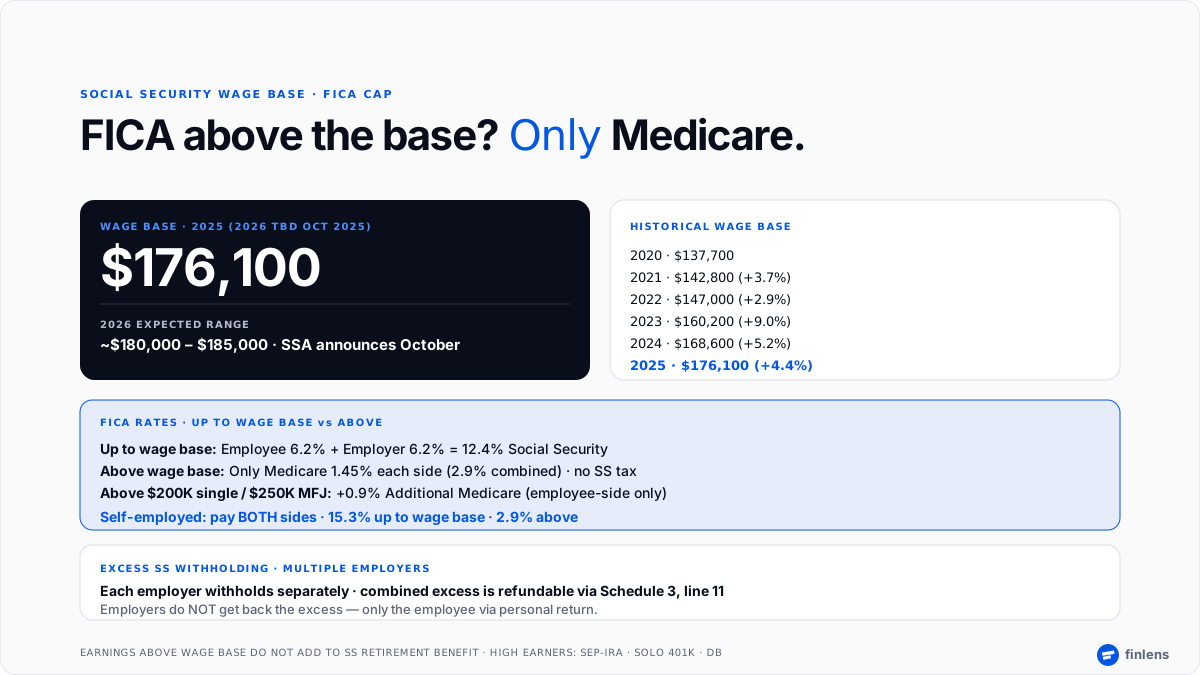
For reference: 2024 wage base was $168,600 and 2025 wage base is $176,100. The 2026 wage base is set by SSA's Contribution and Benefit Base and is announced in October preceding tax year. Confirm exact 2026 figure against official SSA notice before running payroll for year.
What wage base actually caps
Social Security tax is levied at 6.2% on employee and 6.2% on employer a combined 12.4% on wages up to wage base. Once wages cross wage base for year, no more Social Security tax is owed by either party on excess.
Medicare tax is levied separately at 1.45% on employee + 1.45% on employer a combined 2.9%with no wage cap. High earners are also subject to an Additional Medicare Tax of 0.9% on wages above $200,000 (single filer) or $250,000 (married filing jointly), paid only by employee side.
The 2025 practical picture:
Combined effective rate on wages up to wage base: 15.3% (7.65% each side).
Combined effective rate on wages between wage base and $200K: 2.9% (Medicare only, split 1.45%/1.45%).
Combined effective rate above $200K/$250K Additional Medicare threshold: 3.8% employee-side, 1.45% employer-side.
How wage base is set
The Social Security wage base adjusts annually based on National Average Wage Index. In years when average wages rise, wage base rises. In years of stagnant or falling average wages, wage base holds steady (it doesn't decrease).
Historical wage base trajectory:
The SSA publishes following year's wage base each October alongside annual COLA (Cost-of-Living Adjustment). Get announced 2026 figure from SSA Cost-of-Living Adjustment page as soon as it's published.
Self-employment tax and wage base
Self-employed filers pay both employee and employer sides of FICA15.3% combined on earnings up to wage base, plus 2.9% on any excess above wage base, plus Additional Medicare Tax where applicable.
The 2025 self-employment tax structure:
- First $176,100 of net SE earnings → 15.3% self-employment tax
- Above $176,100 → 2.9% self-employment tax (Medicare only)
- Above $200,000 (single) → additional 0.9% Additional Medicare
Self-employed filers can deduct employer-equivalent half (7.65%) as an above-the-line deduction on Form 1040, which lowers their income tax but not their self-employment tax. Net SE earnings are calculated on Schedule SE, based on 92.35% of net earnings from Schedule C or Schedule K-1.
For a self-employed filer with $250,000 in net Schedule C income:
- SE tax on first $176,100 × 92.35% = $162,610 × 15.3% = $24,879
- SE tax on excess $73,900 × 92.35% = $68,247 × 2.9% = $1,979
- Total 2025 SE tax: ~$26,858
This is why S-corp election matters for high-income self-employed filers. Paying yourself a reasonable W-2 salary through an S-corp and taking balance as distributions can significantly reduce SE tax exposure above wage base.
Multiple employers excess SS tax refund
If you work multiple W-2 jobs during year and your combined wages exceed wage base, each employer is required to withhold Social Security tax on your wages with them even though you've collectively crossed wage base and shouldn't owe additional SS tax on excess.
The IRS refunds excess automatically. On your Form 1040, Schedule 3 (Additional Credits and Payments)line 11 (Excess social security and tier 1 RRTA tax withheld)captures overpayment as a credit. If you paid $176,100 × 6.2% = $10,918 to Employer A and $50,000 × 6.2% = $3,100 to Employer B in 2025, $3,100 from Employer B (all excess) is refundable via credit.
Each employer does NOT get a refund on their sideonly employee.
Impact on Social Security benefits
Earnings above wage base are NOT taxed for Social Security AND do not count toward Social Security benefit calculation. Benefits are calculated based on highest 35 years of indexed earnings, capped each year at that year's wage base.
Practical impact: earning $500,000 in a single year doesn't produce more retirement benefit than earning wage base benefit calculation ignores everything above. This is one reason high earners generally can't rely on Social Security as their primary retirement income; they need to save separately in retirement accounts.
Planning around wage base
For W-2 employees: no planning options. Your employer withholds through wage base and stops. If you have multiple jobs, excess refund is automatic on your return.
For self-employed filers: consider whether an S-corp election reduces total SE tax exposure. Practitioner guidance and mechanics are in our S-corp payroll and reasonable comp discussion. The wage base is ceiling above which Social Security stops accruing on both sides.
For employers: wage base determines when you can stop withholding and matching Social Security on high earners. Payroll software automates this cutoff at individual employee level. For firms managing multiple client payrolls, our payroll services pricing guide covers how wage-base logic factors into practice-management workflow.
For retirement planning: high earners with income well above wage base typically use SEP-IRA, Solo 401(k), or defined benefit plans to shelter income beyond what Social Security recognizes. Our guide on how to write off business expenses covers retirement plan contribution deductibility.
The wage base also affects quarterly estimated tax payments for self-employed filers who need to project SE tax alongside income tax across year.
Conclusion
The Social Security wage base is annual ceiling on Social Security-taxable wages, adjusted every October for following year based on National Average Wage Index growth. 2025 is $176,100. 2026 will be announced October 2025. Above base, only Medicare tax applies and Additional Medicare on top for high earners. Multiple-employer excess is refundable via Schedule 3.
FAQ
What is Social Security wage base for 2026?
The 2026 Social Security wage base is set by Social Security Administration and announced in October 2025. The 2025 wage base is $176,100. Historical rises have been 3–9% year-over-year, so 2026 is expected to be roughly $180,000–$185,000. Confirm against official SSA COLA notice.
What is Social Security tax rate?
6.2% for employee, 6.2% for employer12.4% combined on wages up to annual wage base. Self-employed filers pay both sides (15.3% combined with Medicare). Medicare is 1.45% each side with no wage cap.
What happens when I earn above Social Security wage base?
No additional Social Security tax is owed by employee or employer on wages above wage base. Medicare tax continues (1.45% each side, plus 0.9% Additional Medicare Tax on employee wages above $200K single / $250K MFJ). Excess Social Security withholding from multiple employers is refundable via Schedule 3 on Form 1040.
Is Social Security wage base same as Medicare wage base?
No. Social Security has a wage base cap (2025: $176,100). Medicare has no wage cap1.45% each side on all wages, plus 0.9% Additional Medicare Tax on employee wages above $200K single / $250K MFJ.
What is FICA vs FUTA?
FICA is federal insurance contributionsSocial Security (6.2%) + Medicare (1.45%). FUTA is federal unemployment tax0.6% (after state credit) on first $7,000 of each employee's wages. Different taxes with different wage caps and rules.
Does wage base apply to self-employed people?
Yes. Self-employed filers pay both employee and employer sides of Social Security12.4% on net earnings up to wage base. Above wage base, only Medicare (2.9%) applies. Net SE earnings are calculated on Schedule SE from Schedule C or K-1.
Can I get a refund of excess Social Security tax?
Yes if you had multiple W-2 employers and combined wages crossed wage base excess is refundable on Schedule 3 of Form 1040. Not refundable if you had a single employer that shouldn't have exceeded wage base (contact employer for correction instead).
Where do I find current-year Social Security wage base?
The SSA publishes it on Contribution and Benefit Base page at ssa.gov/oact/cola/cbb.html. Annual COLA and wage-base announcements come in October of preceding year, effective January 1.

