
The QuickBooks guide to ASC 842: ROU assets and lease liabilities (2026)


This is a working reference for founders and controllers putting a lease on the balance sheet in QuickBooks. Every technique is sourced to Intuit's own documentation, FASB standards, or a real thread on the QuickBooks Community. Numbers cited from user reports are flagged as anecdotal rather than benchmarks.
The problem this guide addresses
ASC 842 put nearly every lease on the balance sheet. QuickBooks has no lease module, no amortization engine, and no concept of a lease at all. The entire standard has to be implemented as journal entries from a schedule maintained somewhere else, and the first sign that something is missing usually arrives as arithmetic.
Failure mode one: the entry that will not balance. A QuickBooks Desktop user on thread 86127 signed a building lease at the start of the year and set up a lease liability account and a lease expense account. Then asked what the fourth account was. Bank decreases, lease liability decreases, lease expense increases. What balances it?
Two replies, 147 views. The missing account is the right-of-use asset, which was never created. The user discovered the other half of ASC 842 by noticing the entry would not foot, which is a better diagnostic than most implementations get.
A second error sits in the same post: the lease liability was set up entirely as a current liability, when it has to be split between current and non-current.
Failure mode two: treating the lease as rent. A lease recorded as a monthly rent expense against the bank is complete, balanced, and wrong under ASC 842. Nothing in QuickBooks objects, nothing fails to reconcile, and the balance sheet is simply missing an asset and a liability that should be on it.
The ASC 842 identity
Three equations. The first is the only one that is ever intuitive.
AT COMMENCEMENT
Lease liability = present value of remaining lease payments
ROU asset = lease liability
+ prepaid rent - lease incentives + initial direct costs
AFTER COMMENCEMENT → they stop being equal
OPERATING LEASE
Lease cost = straight line, same every period
Interest = liability balance x discount rate
ROU amortization = lease cost - interest ← the plug
FINANCE LEASE
Interest = liability balance x discount rate
ROU amortization = straight line
Total expense = front-loaded, declines over the term
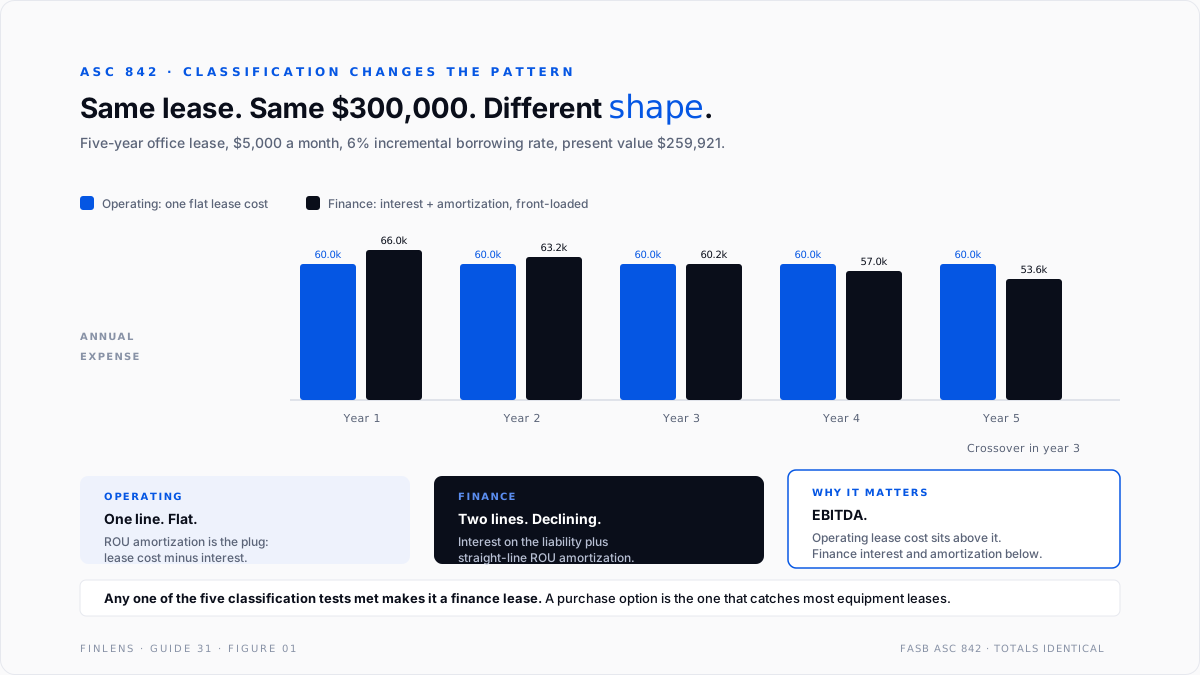
That difference is the whole classification question. An operating lease produces one flat expense line. A finance lease produces two lines whose sum starts high and falls.
Two consequences follow immediately.
The ROU asset and the lease liability diverge after day one. They begin equal and amortize on different schedules, so a reconciliation that expects them to stay equal will fail every month. Only at the end do both reach zero together.
On an operating lease, the ROU amortization is a derived number. It is lease cost minus interest, not a straight-line calculation of its own. Computing it independently is a common way to produce an ROU balance that never retires cleanly.
Classification, and why most leases are operating
ASC 842 keeps five tests. Any one of them met makes the lease a finance lease. All five failed makes it operating.
Most real estate leases are operating. Most equipment leases with a bargain purchase option are finance. The lease-to-own arrangements that come up constantly in QuickBooks threads are finance leases wearing a rental label, and the giveaway is the purchase option.
Reassessment is not optional. Classification is made at commencement and revisited only on a modification or a change in the assessment of renewal options. A lease that was operating at signing does not drift into finance because circumstances changed, but a renewal decision can trigger both a reclassification and a remeasurement at once.
Short-term leases are the one genuine escape. A lease of twelve months or less with no purchase option the lessee is reasonably certain to exercise can use the practical expedient and stay off the balance sheet, expensed straight-line.
Twelve months is measured including renewal options reasonably certain to be exercised, which is where a nominally eleven-month lease that everyone expects to roll fails the test.
The account structure
Six accounts, and two of them are the ones people forget.
The current and non-current split is not optional. Thread 86127 shows the whole liability sitting in current, which overstates current liabilities and destroys the current ratio. The split has to be recalculated at every balance sheet date, because the twelve-month window moves.
Operating and finance ROU assets are presented separately under ASC 842, which is why they are separate accounts rather than one.
All six are created through the ordinary add an account flow, and the Account type chosen there is what determines where each one lands on the balance sheet. An ROU asset typed as a plain Other Current Asset will present as working capital, which it is not.
Where a lease was being expensed as rent before transition, the prepaid balance is part of the opening ROU measurement rather than something to write off. That interaction is covered in the prepaid and accrued expenses guide.
Building the schedule, and what QuickBooks will not do
QuickBooks holds none of this. The schedule is built outside and the entries are posted in, which makes the schedule the system of record and the ledger the consequence.
Step one, determine the discount rate. The rate implicit in the lease if readily determinable, which it rarely is, otherwise the incremental borrowing rate. Private companies may elect the risk-free rate as a practical expedient, which is simpler and produces a larger liability.
Step two, determine the lease term. The non-cancellable period plus renewal options reasonably certain to be exercised. This judgment drives everything, and getting it wrong changes every number in the schedule.
Step three, build the amortization table. Period, payment, interest, principal reduction, closing liability. For an operating lease add the straight-line lease cost column and derive ROU amortization as the difference.
Step four, post the commencement entry. Dr ROU Asset, Cr Lease Liability, at present value, adjusted for prepaid rent, incentives and initial direct costs.
Step five, post monthly from the schedule. Never from a recurring template with fixed amounts, because the interest and principal split changes every period.
The recurring-entry trap. A lease payment is the one monthly entry that looks perfectly suited to a recurring template and is actively wrong as one.
Intuit's own guidance makes the point without meaning to: the Scheduled recurring type is described as being for transactions with a fixed schedule and amounts that do not change, such as rent payments.
Under ASC 842 a lease payment is exactly not that. The cash is constant and the accounting split moves every period, so a fixed template silently produces a liability that will not retire to zero.
Where the schedule is maintained in a spreadsheet, importing journal entries is a better route than re-keying twelve rows a year per lease, and it keeps the schedule as the single source.
The failure-mode catalog
Six diagnoses cover most lease work.
1. No ROU asset. Symptom: the monthly entry does not balance, or a liability sits on the balance sheet with no corresponding asset. Cause: only half the standard was implemented. Fix: recognize the ROU asset at commencement value and catch up amortization. This is thread 86127.
2. The whole liability in current. Symptom: current ratio collapses on adoption. Fix: split current and non-current, and recalculate the split at every reporting date rather than once at commencement.
3. A recurring template with fixed amounts. Symptom: the liability does not reach zero at the end of the term, usually off by a few thousand. Cause: interest and principal were held constant. Fix: post from the schedule.
4. ROU amortized straight-line on an operating lease. Symptom: lease expense that is not flat, or an ROU balance that does not retire with the liability. Cause: amortization computed independently rather than as lease cost minus interest.
5. A finance lease recorded as rent. Symptom: a lease-to-own arrangement expensed monthly with no asset. Cause: the purchase option was not treated as a classification trigger. Fix: classify, recognize, and present interest and amortization separately. Where the arrangement is genuinely a purchase, the fixed asset capitalization guide applies instead.
6. Lease payments in the wrong cash flow section. Symptom: operating cash flow distorted after adoption. Cause: operating and finance leases present differently. Operating lease payments are operating. Finance lease principal is financing and only the interest is operating. Fix: split the finance lease payment, as covered in the cash flow statement guide.

Worked example
A five-year office lease. $5,000 per month, paid at the start of each month, 60 payments. Incremental borrowing rate 6%. No incentives, no initial direct costs, no purchase option, and the term is not a major part of the building's life. Operating lease.
At commencement. The present value of 60 payments of $5,000 at 6% annual, 0.5% monthly, paid in advance, is approximately $260,000.
Of that liability, roughly $53,000 is due within twelve months and sits in current. The remaining $207,000 is non-current.
Month one. Straight-line lease cost is total payments of $300,000 divided by 60, which is $5,000 flat. Because this payment is made at commencement, interest in month one is zero and the entire $5,000 reduces the liability.
Month two. The liability stands at $255,000. Interest at 0.5% is $1,275. Lease cost is $5,000. ROU amortization is $5,000 minus $1,275, which is $3,725.
Total expense over the term is $300,000 either way. Classified as finance instead, month two would show interest of $1,275 plus straight-line amortization of $4,332, which is $5,607 of expense rather than $5,000, and the final year would run below $5,000.
The pattern, not the total, is what classification changes. A business near a covenant on EBITDA cares a great deal, because finance lease amortization and interest sit below the EBITDA line while an operating lease cost sits above it.
Classification moves the same cash across the EBITDA boundary, which is why the five tests are worth applying carefully rather than assuming.
Where in-QBO lease accounting stops scaling
Threshold one: the first lease. This is not a volume threshold. One lease already requires an external schedule, because QuickBooks cannot build an amortization table.
Threshold two: modifications and remeasurement. A renewal, a rate change, a change in term assessment or a partial termination requires the liability to be remeasured and the ROU asset adjusted. Each is a new schedule, and modifications are where most spreadsheet implementations break.
Threshold three: disclosure. ASC 842 requires maturity analysis, weighted-average remaining term and weighted-average discount rate. None of it comes out of QuickBooks.
Threshold four: sublease and lessor accounting. ASC 842 treats the lessor side and subleases under their own rules, with a separate classification and a separate set of entries. Nothing in QuickBooks distinguishes a lease receivable from an ordinary receivable.
Threshold five: more than about ten leases. Beyond that, maintaining schedules and the current and non-current split by hand across reporting dates stops being reliable, which is the point at which lease software pays for itself.
The Finlens approach
Finlens reads the QuickBooks ledger and tests the relationships a lease implementation has to hold, since the schedule itself lives outside the file.
1. Balance convergence testing. The ROU asset and lease liability balances are tracked against the expected schedule, so a drift caused by a fixed recurring template is caught in the month it starts rather than at the end of the term.
2. Completeness detection. Recurring payments with the signature of a lease, consistent amounts to the same payee over a long horizon, are flagged where no corresponding ROU asset and lease liability exist. That is the test for leases never brought on balance sheet at all.
3. Current and non-current split monitoring. The split is recalculated at each reporting date and compared to what is posted, because the twelve-month window moves and the posted split usually does not.
Four supporting capabilities sit around those three.
- Classification review, flagging leases with purchase options or long terms that are being treated as operating.
- Cash flow section checking, confirming finance lease principal is presented in financing rather than operating.
- Expense-pattern validation, confirming an operating lease produces a flat charge and a finance lease a declining one.
- A cross-file view for firms, listing clients with lease-shaped recurring payments and no ROU asset.
Verification checklist
Eight lines to run at each reporting date.
- Every lease on the balance sheet has both an ROU asset and a lease liability.
- The lease liability is split between current and non-current, and the split was recalculated at this date.
- Operating lease expense is flat across periods, and finance lease expense declines.
- ROU amortization on operating leases equals lease cost minus interest, not an independent straight-line figure.
- The posted liability balance agrees to the external amortization schedule.
- Finance lease principal appears in financing on the cash flow statement, with only interest in operating.
- Any lease modification in the period triggered a remeasurement and a new schedule.
- Recurring payments that look like leases have been reviewed for leases never recognized.

FAQ
What is the fourth account in a lease payment entry?
The right-of-use asset. Bank down, lease liability down, lease expense up, ROU asset down. Without it the entry does not balance, which is exactly how thread 86127 found the gap.
Do the ROU asset and the lease liability stay equal?
Only at commencement. They amortize on different schedules and diverge immediately, reaching zero together at the end of the term.
Which leases stay off the balance sheet?
Leases of twelve months or less with no purchase option reasonably certain to be exercised, under the short-term practical expedient. Renewal options reasonably certain to be exercised count toward the twelve months.
Can the monthly entry be a recurring template?
No. The interest and principal split changes every period. A fixed template leaves a liability that will not retire to zero.
Does classification change total expense?
No. It changes the pattern and the presentation. A finance lease is front-loaded and splits into interest and amortization, both below EBITDA, while operating lease cost is flat and above it.
Does QuickBooks have a lease module?
No. There is no lease object, no amortization engine and no disclosure support. Everything is journal entries from an external schedule.

