
The QuickBooks guide to the cash flow statement: direct versus indirect (2026)


This is a working reference for founders and controllers producing a statement of cash flows from QuickBooks. Every technique is sourced to Intuit's own documentation, FASB standards, or a real thread on the QuickBooks Community. Numbers cited from user reports are flagged as anecdotal rather than benchmarks.
The problem this guide addresses
The statement of cash flows is the only one of the three primary statements QuickBooks builds by derivation rather than by accumulation. The profit and loss adds up transactions. The balance sheet adds up balances.
The cash flow statement starts from net income and reasons its way to cash, and every line between those two points is an adjustment that can be wrong without anything looking broken.
Failure mode one: a filter that inverts the answer. A rental business on thread 36185 ran a cash flow report filtered to one class and its subclasses. The report included every rental invoice, each correctly tagged with a class. It included none of the payments, because payments carry no class tag.
The result was an accounts receivable line that treated the entire invoice population as unpaid, reducing net cash by the full invoiced amount. Five replies. The filter did not narrow the report. It broke the reconciliation, because it removed one side of a paired relationship and left the other.
Failure mode two: looking for a cash-basis option that does not exist. QuickBooks offers no cash-basis statement of cash flows, and users regularly report this as a missing feature. It is not missing. The statement exists to reconcile accrual net income to cash.
On a cash basis, net income already equals the net change in cash, so the reconciliation has nothing to do and the statement collapses into the profit and loss. The absence of the toggle is the correct behaviour.
The cash flow identity
Two equations, and the second is the one that gets checked.
OPERATING (indirect method)
Net income
+ non-cash expenses (depreciation, amortization, bad debt)
± changes in working capital (A/R, A/P, inventory, prepaid, accrued)
= Cash from operations
THE PROOF
Cash from operations
+ Cash from investing
+ Cash from financing
= Net change in cash → must equal the movement in the bank balance
The sign convention on working capital is where most readings go wrong, and it inverts between the two sides of the balance sheet.
An asset increase consumes cash. Accounts receivable rising means revenue was recognized and not collected, so the adjustment is negative. Inventory rising means cash was spent on goods not yet sold.
A liability increase provides cash. Accounts payable rising means expenses were recognized and not paid, so the adjustment is positive. The business is financing itself on its suppliers.
That is the whole reason a profitable month can be cash-negative, and it is the question the statement exists to answer.
Why QuickBooks only produces the indirect method
Both methods are permitted under FASB ASC 230, Statement of Cash Flows. They differ only in how the operating section is presented, and they always produce the same total.
Indirect starts at net income and adjusts. It is what QuickBooks produces, it is what the overwhelming majority of filers use, and it is derivable from data the general ledger already holds.
Direct lists actual cash receipts and cash payments by category: cash collected from customers, cash paid to suppliers, cash paid to employees. It is far more readable for an operator, and FASB has long expressed a preference for it.
Intuit's own article on running a statement of cash flows puts it under Reports, Standard reports, and states plainly that the report runs on accrual basis only.
QuickBooks does not produce the direct method, and the reason is structural. Building it requires classifying every cash movement by its operating purpose, which means knowing that a given bank payment was to a supplier rather than to an employee. The general ledger knows the account, not the cash-flow category.
Producing a direct-method statement from QuickBooks means exporting bank activity and categorizing it outside the file.
The practical consequence. A board or lender asking for a direct-method statement is asking for work QuickBooks cannot do. A thirteen-week cash forecast, which is built directly and by category, is often what they actually want, and that is covered in the 13-week cash flow forecast guide.
The three sections and what belongs in each
Misclassification between sections does not change net change in cash. It changes the story completely.
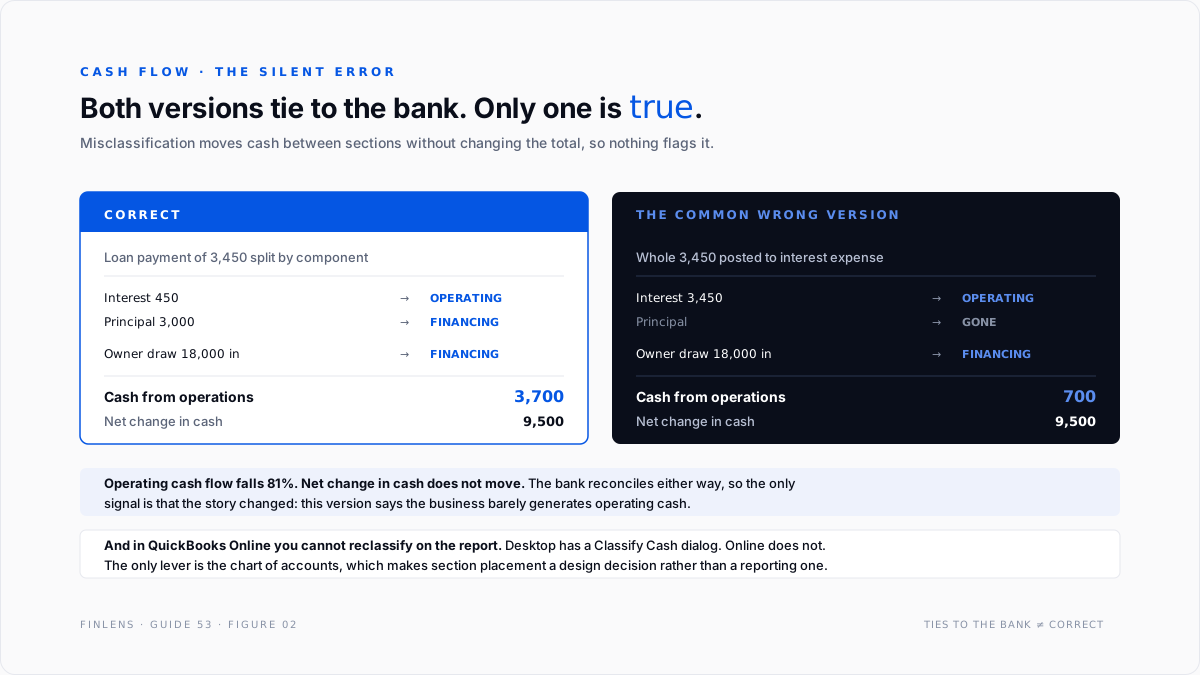
The classic distortion is the loan payment. A single bank payment carries interest, which is operating, and principal, which is financing. Posting the whole payment to one line moves cash between sections and makes operating cash flow look worse or better than it was.
The second is the owner distribution. Distributions are financing. Booked as an expense they reduce net income, which flows into the operating section, and the business appears to be generating less cash from operations than it does.
Capitalization decisions determine the operating and investing split entirely, and those are covered in the fixed asset capitalization guide.
The limit that has no workaround
QuickBooks decides which section each account belongs to, and in QuickBooks Online that decision cannot be overridden.
QuickBooks Desktop carries a Classify Cash dialog that lets an account be reassigned between operating, investing and financing. QuickBooks Online has no equivalent. Intuit's position, stated repeatedly in support threads, is that reclassification in the Statement of Cash Flows is unavailable online and is a feature request rather than a setting.
Three consequences follow, and they shape how the report has to be used.
The chart of accounts is the only lever. If an account is landing in the wrong section, the fix is the account type, not the report. An account typed as Other Current Asset behaves differently from one typed as Fixed Asset, and that typing is what drives the classification.
Loan accounts need care at setup. A loan recorded as a liability of the right type produces the right financing treatment automatically. One recorded as a generic other current liability may not, and no report setting corrects it afterwards.
Reconciling the sections is a design review, not a reporting task. When operating cash flow looks wrong and the arithmetic is right, the question is how the accounts are typed. That is a chart-of-accounts conversation, and it belongs with the month-end close rather than with report customization.
For teams needing a forward view rather than a corrected historical one, Intuit's cash flow planner is a separate tool with its own definitions, and its numbers will not agree with the statement.
The failure-mode catalog
Six diagnoses cover most cash flow statement work.
1. Class or location filter applied. Symptom: an A/R line far larger than reality, often equal to total invoiced. Cause: invoices carry the class, payments do not, so the filter keeps one side of the pair.
Fix: do not filter a cash flow statement by class unless class coverage is complete on both invoices and payments. The coverage question is covered in the P&L customization guide. This is thread 36185.
2. Net income does not agree to the profit and loss. Cause: a different date range, a different accounting method, or a filter applied to one report and not the other. Fix: the top line of the cash flow statement must equal the bottom line of the P&L for the identical period and method.
If it does not, stop and reconcile that before reading anything below it.
3. Net change in cash does not agree to the bank. Cause: an account that should be a cash or cash-equivalent account is classified as something else, or the reverse. Fix: confirm which accounts QuickBooks is treating as cash.
Undeposited Funds is a frequent surprise: it is an asset, it is not cash, and a large balance there moves the working capital adjustment. That account is covered in the Undeposited Funds guide.
4. Non-cash transactions appearing in the statement. Cause: journal entries that move balances between accounts QuickBooks reads as cash-relevant, or transfers recorded as transactions rather than transfers. Fix: review large single-line adjustments in the working capital section, since each should trace to a real balance movement.
5. The dashboard graphic disagrees with the statement. Cause: the cash flow visual on the QuickBooks home screen uses a different window and definition from the formal statement, and the cash flow planner is a third artefact again.
Fix: treat the graphic as indicative only. Nothing leaves the building based on it. Desktop has a different surface, covered in Intuit's guide to tracking cash flow in QuickBooks Desktop, including the Classify Cash option Online lacks.
6. Depreciation missing from the addbacks. Symptom: cash from operations materially below expectation with no working capital explanation. Cause: depreciation was never posted, which is common in files where the schedule lives in a spreadsheet and the monthly journal entry is skipped. Fix: post the entry.
A missing addback is a missing expense, so both the P&L and the cash flow statement were wrong.
Worked example
A services business closes March. Net income is $42,000. Cash in the bank rose $9,500.
The operating section explains the gap.
A $42,000 profit produced $3,700 of operating cash. The entire difference is working capital: a $38,000 receivables build plus an $11,400 payables paydown, partly offset by $4,900 of accruals and $6,200 of depreciation.
Now book the loan payment wrong. The bank payment was $3,450, of which $3,000 is principal and $450 is interest. Posting the full $3,450 to interest expense reduces net income to $39,450, removes the financing outflow, and reports cash from operations of $700 instead of $3,700.
Net change in cash is identical in both. The bank reconciles either way. Only the story changes, and the wrong story says this business barely generates operating cash. A statement that ties to the bank is not thereby correct, which is the single most important thing to understand about this report.
Where in-QBO cash flow reporting stops scaling
Threshold one: the direct method is required. QuickBooks cannot produce it. Exporting bank activity and categorizing by operating purpose is the only route.
Threshold two: segment or entity cash flow. Filtering by class breaks the A/R and A/P reconciliation, as thread 36185 documents. Cash flow by segment is not reliably derivable inside the file, and multi-entity cash flow needs consolidation first, covered in the multi-entity accounting guide.
Threshold three: forward-looking cash. The statement is historical by definition. Anything about next quarter is a forecast and a separate artefact.
Threshold four: section correction. Because QuickBooks Online cannot reclassify accounts on the report, a file whose chart of accounts was built without regard to cash flow sections produces a statement that is structurally wrong and locally unfixable.
Threshold five: foreign currency. Cash movements in more than one currency require the effect of exchange rate changes on cash to be separated as its own line, which QuickBooks does not present.
The Finlens approach
Finlens reads the QuickBooks ledger and tests the relationships a cash flow statement depends on rather than reformatting the output.
1. Tie-out testing on both ends. Net income on the statement is tested against the P&L for the identical period and method, and net change in cash is tested against the actual movement in bank and cash-equivalent balances. A break on either end is reported before anyone reads the middle.
2. Section classification auditing. Loan payments are decomposed into interest and principal and checked for correct section placement, and owner distributions are checked for expense misclassification. These two account for most of the distortion in operating cash flow in small-company files.
3. Working capital attribution. Each working capital adjustment is traced to the underlying balance movement and expressed in days, so a receivables build is reported as a DSO change rather than as a number with no context.
Four supporting capabilities sit around those three.
- Cash-account definition checking, confirming which accounts are being treated as cash and flagging Undeposited Funds balances large enough to distort the result.
- Non-cash transaction isolation, separating journal entries from real cash movements in the working capital lines.
- Depreciation completeness, flagging periods where no depreciation posted against a file that carries fixed assets.
- A cross-file view for firms, listing clients whose net change in cash does not tie to bank movement.
Verification checklist
Eight lines to run on any statement of cash flows before it is circulated.
- Net income at the top equals net income on the P&L for the same period and the same accounting method.
- Net change in cash equals the actual movement in bank and cash-equivalent balances.
- No class or location filter is applied.
- Loan payments are split between interest in operating and principal in financing.
- Owner distributions sit in financing, not in operating as an expense.
- Depreciation and amortization appear as addbacks, and the amounts agree to the schedules.
- Each working capital adjustment traces to a real balance sheet movement.
- The accounting method is stated on the report, and it is accrual.

FAQ
Why is there no cash-basis cash flow statement?
Because the statement reconciles accrual net income to cash. On a cash basis net income already equals the net change in cash, so there is nothing to reconcile. The absence of the option is correct behaviour rather than a gap.
Can QuickBooks produce a direct-method statement?
No. The direct method requires classifying each cash movement by operating purpose, which the general ledger does not record. It has to be built from exported bank activity.
Why is the A/R line enormous when I filter by class?
Because invoices carry a class and payments usually do not, so the filter keeps the invoices and drops the payments. The report then treats every invoice as unpaid.
Why does a profitable month show negative operating cash?
Almost always working capital. Receivables growing faster than collections, inventory building, or payables being paid down all consume cash while net income stays positive.
Does Undeposited Funds count as cash?
No. It is an other current asset. A large balance there sits in working capital rather than in cash, which surprises people reconciling the statement to the bank.
If the statement ties to the bank, is it right?
Not necessarily. Section misclassification moves cash between operating, investing and financing without changing the total. The statement still ties and still tells the wrong story.

