
The QuickBooks guide to SaaS KPIs: MRR, ARR, and runway (2026)


This is a working reference for founders and controllers deriving SaaS metrics from QuickBooks for a board pack. Every technique is sourced to Intuit's own documentation, FASB standards, or a real thread on the QuickBooks Community. Numbers cited from user reports are flagged as anecdotal rather than benchmarks.
The problem this guide addresses
QuickBooks has no MRR field. It has no ARR field, no churn field, and no runway field. Every SaaS metric on a board pack is derived from the general ledger by someone making decisions about which number to start from, and the three obvious starting points give three different answers.
Failure mode one: recognized revenue landing in the wrong month. A QBO user on thread 43405 invoices multiple clients annually, records the payment as a sales receipt to deferred revenue, then issues a monthly credit memo against the original invoice to realize revenue as services are delivered.
The newly realized revenue did not appear on the profit and loss at the credit memo date. It appeared at the date of the original annual invoice. Nine replies. The revenue was recognized, the total was right, and every month's figure was wrong. Any MRR computed from that P&L is wrong by construction, and nothing about the file looks broken.
Failure mode two: picking the wrong source number. Bookings, revenue and cash are three different things in a subscription business, and they diverge most at exactly the moment people most want a metric: when annual prepayment is growing. A board pack that quotes one and labels it another is the most common reporting error in early-stage SaaS.
The three-number problem
BOOKINGS contract value signed → sales performance
REVENUE recognized in the period → the P&L, and the basis for MRR
CASH collected in the period → the bank, and the basis for runway
One annual contract signed on 1 March at $24,000, paid up front:
Bookings, March $24,000
Revenue, March $2,000
Cash, March $24,000
MRR is built from revenue. Runway is built from cash. They never agree, and both are correct.
A business growing on annual prepayment shows cash well ahead of revenue, which flatters runway and understates nothing. A business shifting from annual to monthly billing shows the reverse, and looks like it is collapsing when its revenue is flat. Neither pattern is visible from a single number.
The mechanics of getting revenue into the right month are covered in the deferred revenue guide. This guide assumes that work is done, because every metric below is wrong if it is not.

The metric definitions and where each comes from
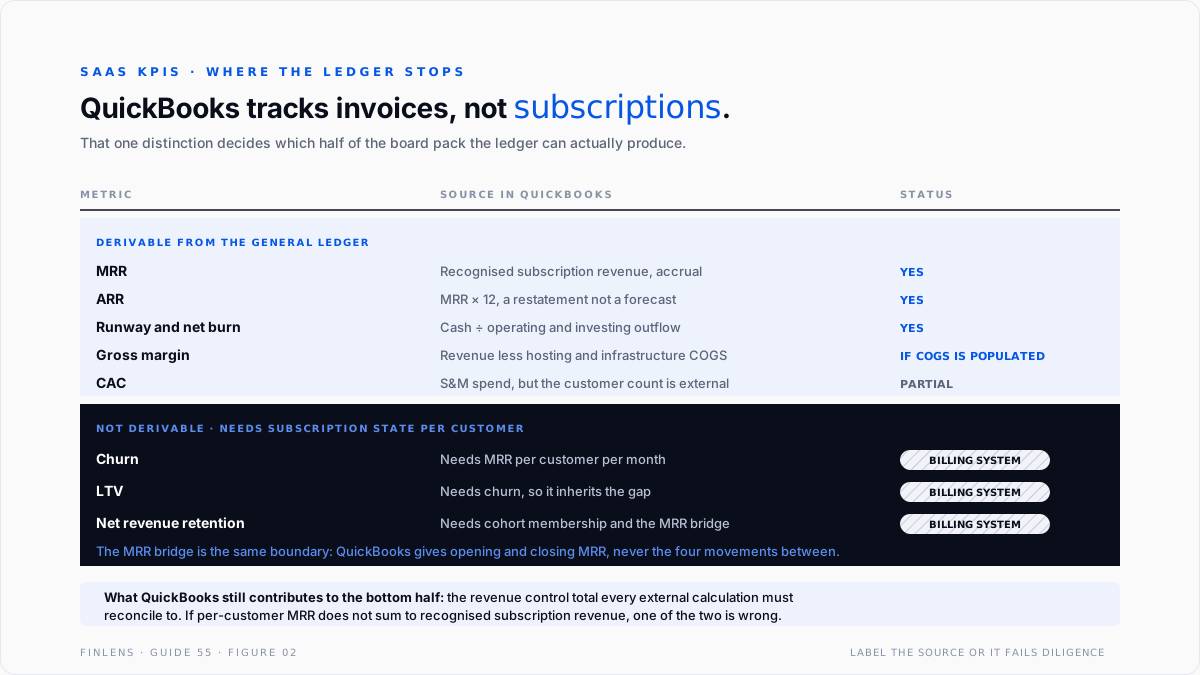
The line in that table is the important part. Everything above it comes out of the ledger. Everything below it needs a customer-level subscription record that QuickBooks does not maintain, because QuickBooks tracks customers and invoices, not subscriptions and their states.
ARR is not a forecast. It is this month's recurring revenue multiplied by twelve. Quoting ARR as though it were next year's revenue, in a business with meaningful churn, overstates the number by the churn rate.
MRR excludes non-recurring revenue. Implementation fees, professional services and one-time charges are revenue and are not MRR. If they share an income account with subscriptions, MRR cannot be isolated, and the fix is the chart of accounts rather than the report.
The chart of accounts that makes this possible
Six account decisions determine whether any of this is derivable.
One income account for everything is the single most common blocker. A file where subscriptions, setup fees and professional services all post to Sales cannot produce MRR at any level of effort, and no amount of report customization recovers it. Splitting the account is a half-day of work that unlocks every metric above.
Segmenting by product line or plan tier on top of that is a Class decision, covered in the P&L customization guide.
Building the metrics monthly
Five steps, in order.
Step one, confirm the accounting method is accrual. On cash basis, revenue is recognized when invoices are paid, so an annual prepayment lands entirely in one month. MRR on a cash basis is not a smaller version of the right answer. It is noise.
Step two, verify deferred revenue is amortizing. Opening deferred revenue plus new deferrals minus recognized revenue should equal closing deferred revenue. If that identity does not hold, recognition is not working and the P&L months are wrong, which is the thread 43405 condition.
Step three, take MRR from the subscription revenue account only. Not from invoices, not from cash, not from total revenue.
Step four, compute net burn from the cash flow statement, not from net income. Net income excludes financing and investing and includes non-cash charges, so it is the wrong basis for runway. The statement mechanics are in the cash flow statement guide.
Step five, state the basis on the pack. Accrual, the period, and which account set MRR was drawn from. A metric without its basis is not auditable, and the first question a diligence process asks is how the number was built.
The MRR movement schedule, and why it stops halfway
Every SaaS board pack eventually wants the MRR bridge rather than the MRR total. It is the standard decomposition and it looks like this.
Opening MRR
+ New first-time customers
+ Expansion existing customers paying more
- Contraction existing customers paying less
- Churn customers who left
= Closing MRR
QuickBooks can give you the two ends and none of the middle. Opening and closing MRR come straight out of recognized subscription revenue for consecutive months. The four movement components in between all require knowing, per customer, what they paid last month and what they pay this month.
That comparison is not hard in principle. It is just not a thing the general ledger stores. QuickBooks records that a customer was invoiced, not that a customer holds a subscription at a price with a start date and a state.
Why the bridge matters more than the total. Two businesses can both show MRR flat at $312,000. One added $40,000 of new and lost $40,000 to churn. The other added $4,000 and lost $4,000.
The first is a leaky bucket burning acquisition spend to stand still. The second is stable. The total is identical and the businesses are not comparable, which is exactly why investors ask for the bridge.
The honest position. If the billing system holds subscription state, the bridge comes from there and QuickBooks supplies the revenue control total to tie it against. If there is no billing system, the bridge has to be built from a maintained customer schedule, and it should be labelled as such.
The one thing worth doing in QuickBooks either way is tying the sum of per-customer MRR from whatever external source back to recognized subscription revenue on the P&L.
If those two disagree, one of them is wrong. Discovering that during diligence is considerably more expensive than discovering it monthly.
Net revenue retention and the same boundary
Net revenue retention is the single metric most asked for at Series A and beyond, and it sits on the wrong side of the same line.
NRR = (opening cohort MRR + expansion - contraction - churn)
÷ opening cohort MRR
It needs cohort membership, which is a signup date per customer, and it needs the same four movement components. Neither is in the ledger.
What QuickBooks does contribute is the revenue control total that any external NRR calculation must reconcile to, and the account structure that keeps non-recurring revenue out of it. An NRR figure computed over total revenue rather than subscription revenue is inflated by implementation fees, and that is a common and quiet error.
The failure-mode catalog
Six diagnoses cover most SaaS metric work.
1. Recognized revenue dated to the original invoice. Symptom: monthly revenue bears no relationship to the recognition schedule, though the annual total is right. Cause: using credit memos against the original invoice to realize revenue, which inherits the invoice date.
Fix: recognize through journal entries dated in the recognition period, or use the Advanced revenue recognition feature. This is thread 43405.
2. MRR computed from invoices. Symptom: MRR spikes in the months annual contracts renew. Cause: invoicing is a billing event, not a revenue event. Fix: take MRR from recognized revenue.
3. MRR computed from cash. Symptom: MRR that moves with collections and drops when a large customer pays late. Cause: conflating runway inputs with revenue inputs.
4. One income account. Symptom: MRR cannot be isolated at all. Fix: split the chart of accounts. There is no reporting workaround.
5. Runway from net income. Symptom: runway that ignores a capital raise or a large equipment purchase. Cause: net income is not cash. Fix: use net change in cash from operations plus investing, excluding financing, since financing inflows extend runway rather than being generated by the business.
6. Churn quoted with no underlying data. Symptom: a churn figure nobody can reproduce. Cause: QuickBooks holds no subscription state, so churn has been estimated. Fix: either source it from the billing system, or label it as an estimate. A metric nobody can rebuild does not survive diligence.
Worked example
A SaaS business closes March. Cash is $1,840,000.
The revenue picture.
MRR is $312,000, not $371,000. Implementation is non-recurring. Usage is recurring but variable and is reported alongside rather than inside MRR, since including it makes the figure move with customer behaviour rather than with the subscription book.
ARR is $3,744,000.
The cash picture. Cash from operations for March is negative $186,000. Investing is negative $22,000. Financing is zero.
Net burn is $208,000. Runway is $1,840,000 ÷ $208,000, which is 8.8 months.
Now take the three wrong turns.
The runway error is the dangerous one. Thirteen months of runway and 8.8 months of runway produce entirely different decisions about when to raise. The difference is working capital and equipment, neither of which touches net income, and both of which consume cash.
Where QuickBooks stops being the source
Threshold one: per-customer MRR. Churn, net revenue retention and expansion all need MRR per customer per month. QuickBooks holds invoices by customer, not subscription states, so this is the hard boundary.
Threshold two: cohort analysis. Retention by signup cohort requires subscription start dates the ledger does not record.
Threshold three: contracted ARR versus recognized ARR. A signed contract starting next quarter is in neither revenue nor deferred revenue. It exists only in the contract, so bookings and backlog live outside the file.
Threshold four: usage-based and hybrid pricing. Where a material share of revenue is consumption-driven, monthly recurring revenue stops being the right abstraction and the metric set has to change rather than the report.
The Finlens approach
Finlens reads the QuickBooks ledger and produces the metrics it can support, while naming the ones it cannot.
1. Recognition-integrity testing. The deferred revenue roll-forward is tested every period, so revenue recognized in the wrong month is caught as a break in the identity rather than discovered when a board member asks why December looks odd.
2. Revenue decomposition. Recognized revenue is split into recurring, non-recurring and variable from the account structure, so MRR is isolated and the board pack can show all three without anyone re-keying.
3. Runway from cash, with its drivers. Net burn is computed from operating and investing cash rather than from net income, and the month-over-month change is attributed to working capital, capex and operating loss separately, which is what makes the number actionable.
Four supporting capabilities sit around those three.
- Account-structure diagnosis, reporting when a single income account makes MRR underivable and what splitting it would unlock.
- Basis labelling, carrying method, period and source accounts onto every metric so it stays auditable.
- Derivability flagging, marking churn and LTV as externally sourced rather than presenting them as ledger output.
- A cross-file view for firms, listing SaaS clients whose deferred revenue roll-forward does not tie.
Verification checklist
Eight lines to run before any SaaS metric reaches a board pack.
- The accounting method is accrual, and it is stated on the pack.
- Opening deferred revenue plus new deferrals minus recognized revenue equals closing deferred revenue.
- MRR comes from the subscription revenue account only, not from total revenue, invoices or cash.
- Non-recurring and variable revenue are reported separately from MRR.
- ARR is labelled as MRR times twelve, not as a forecast.
- Runway uses net change in cash from operations and investing, excluding financing.
- Any churn or LTV figure is labelled with its source, and that source is not QuickBooks.
- Every metric carries its period, its basis and the accounts it was drawn from.

FAQ
Does QuickBooks calculate MRR?
No. There is no MRR field. It is derived from recognized subscription revenue, and the derivation is only as good as the revenue recognition behind it.
Should MRR come from invoices or from revenue?
Revenue. Invoicing is a billing event. In a business with annual contracts, invoice-based MRR spikes at every renewal and means nothing.
Why does our monthly revenue not match the recognition schedule?
Frequently because revenue is being realized with credit memos against the original invoice, which inherits the invoice date rather than the recognition date.
Can churn be calculated from QuickBooks?
Not reliably. Churn needs MRR per customer per month, which requires subscription state the ledger does not hold. It belongs to the billing system.
Should runway use net income or cash?
Cash. Net income excludes capex and working capital movements, both of which consume cash, so net-income runway is systematically optimistic.
Does usage revenue belong in MRR?
Report it separately. It is recurring but not contracted, so folding it in makes MRR move with consumption rather than with the subscription book.

