
Intangibles, Amortization and Goodwill in QuickBooks: The Allocation Decides Everything


Goodwill is a residual. It is whatever is left of a purchase price after every other asset has been identified and measured.
That makes it the easiest line on an acquisition entry to get wrong, because anything you fail to identify becomes goodwill by default. And goodwill, unlike the things you failed to identify, does not amortize.
This guide covers how to split an acquisition across the three buckets that matter, why the book life and the tax life of the same intangible will never agree, and what the 2025 change to research expensing means for the software you build rather than buy.
What the neighbours already cover
Fixed asset capitalization and the de minimis threshold covers what becomes an asset. Depreciation methods in QuickBooks covers tangible asset schedules and the two-book problem in general. Lease accounting under ASC 842 covers right-of-use assets, which are their own category.
This guide is about assets you cannot touch.
Three buckets, and only one of them is goodwill
Every dollar of an acquisition price lands in one of three places.
Tangible assets, measured at fair value. Equipment, vehicles, inventory, receivables.
Identifiable intangible assets, which are the ones with a name. A customer list. A covenant not to compete. A trade name. A licence or a patent. These are separable or arise from contractual rights, so they get their own line and their own useful life.
Goodwill, which is everything left over.
The error is almost never in bucket one. It is the boundary between buckets two and three, and it happens because identifying an intangible takes work and leaving it in goodwill takes none.
A user posting as DCSBDA showed the pattern in How to record a bank loan to purchase a business, 2 replies and 94 views, in November 2022.
Their deal: $100,000 total, $30,000 cash down, $70,000 bank loan. Allocation stated as $50,000 goodwill, $30,000 equipment and machinery, $20,000 trucks. A Level 11 contributor posting as Rainflurry gave the entry, debiting goodwill, equipment and trucks against loan payable and cash. It balances and it is a reasonable answer to the question asked.
Look at what is not there. Half the purchase price went to goodwill and not one identifiable intangible was named. No customer list. No non-compete. Those almost certainly existed in the purchase agreement.
Goodwill does not amortize, unless you elect
Under ASC 350-20, goodwill is not amortized. It is tested for impairment, which is a different exercise with a different cadence and a different kind of answer.
Private companies have an alternative. Under ASU 2014-02, a private company may make an accounting policy election to amortize goodwill on a straight-line basis over 10 years, or less if it can demonstrate another useful life is more appropriate.
Three details matter in practice.
Goodwill is amortized per amortizable unit, meaning goodwill from each separate business combination runs on its own schedule.
The useful life can be revised on changes in circumstances, but the cumulative amortization period for any one unit cannot exceed 10 years. And on adoption you must separately elect whether impairment testing happens at the entity level or the reporting unit level.
Most small acquirers should take the election. Impairment testing is expensive, judgemental, and produces a number nobody wanted. Amortization produces a predictable expense. That is a conversation to have with your auditor or reviewer before the first close, not after.
There is a second election, and most people miss it
Electing to amortize does not switch impairment off. It changes when you have to think about it.
Without any election, goodwill impairment under Subtopic 350-20 means monitoring for triggering events continuously, through the period, not just at the date you close the books. That is the part that costs money, because it is a watching brief rather than a task.
ASU 2021-03, issued in March 2021, gives private companies and not-for-profits a separate alternative.
Elect it and you are not required to monitor for triggering events during the reporting period. Instead you evaluate the facts and circumstances as of the end of each reporting period, interim or annual, and ask whether a triggering event exists and whether it is more likely than not that goodwill is impaired.
Two elections, then, and they are independent. ASU 2014-02 decides whether goodwill amortizes. ASU 2021-03 decides when you have to look at it. A private company carrying goodwill should have a documented answer to both, and the combination of the two is what turns an open-ended obligation into a line on the close checklist.
Worked example: the same $100,000, allocated two ways
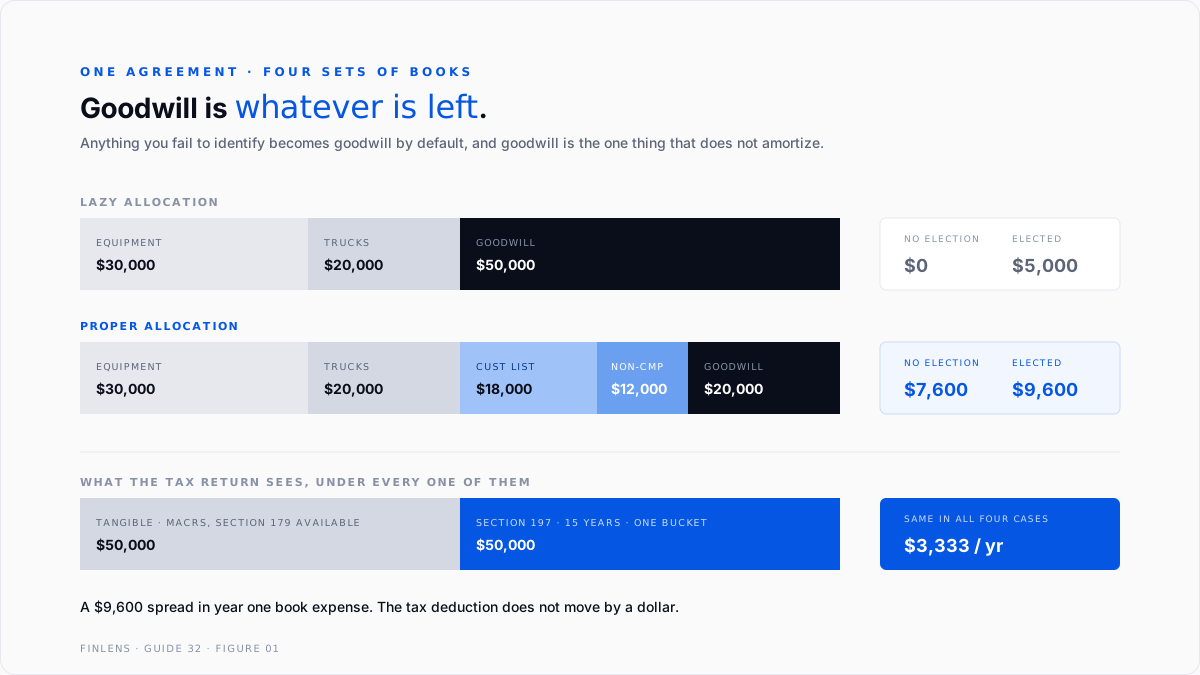
Take the deal above and allocate it properly.
Both add to $100,000. Now run year one of amortization on the intangibles only.
Proper allocation, no goodwill election. Customer list $18,000 over 5 years is $3,600. Non-compete $12,000 over 3 years is $4,000. Goodwill contributes nothing. Total $7,600.
Proper allocation, with the goodwill election. Add $20,000 over 10 years, which is $2,000. Total $9,600.
Lazy allocation, no election. Nothing is amortized at all. Total $0.
Lazy allocation, with the election. $50,000 over 10 years is $5,000. Total $5,000.
Four defensible-looking sets of books, from one purchase agreement, with a $9,600 spread in year one operating expense.
The tax life is always 15 years
Here is the part that catches people.
Per the IRS, you must generally amortize over 15 years the capitalized costs of section 197 intangibles acquired after 10 August 1993. The amortization runs ratably over 180 months beginning with the month in which the intangible was acquired, which is a month convention rather than a half-year one.
Section 197 intangibles expressly include goodwill, going concern value, workforce in place, customer-based intangibles including a customer list, any covenant not to compete entered into in connection with the acquisition of a business, and any franchise, trademark or trade name.
Read that list again against the table above. Every one of those intangibles gets the same 15-year tax life, regardless of what you decided its book life was.
So on the proper allocation, the $50,000 of intangibles amortizes for tax at $50,000 divided by 15, which is $3,333 a year. Book says $7,600 in year one. Tax says $3,333. The books expense faster than the return, which is the opposite of what most people assume about intangibles.
And on the lazy allocation, tax still says $3,333. Section 197 does not care which label you used.
That produces a precise and useful conclusion. The split between tangible and intangible matters enormously for tax, because equipment can take Section 179 or bonus and runs on a 5 or 7 year MACRS life while intangibles crawl over 15. The split among the section 197 intangibles themselves changes nothing for tax at all. It only changes your books.

One exception worth knowing. A covenant not to compete is not treated as disposed of or worthless before you dispose of your entire interest in the business it relates to. You cannot write it off early when the seller retires.
What you build, not what you buy
Internally generated intangibles follow different rules, and 2025 changed the most important one.
The Tax Cuts and Jobs Act had required research and experimental expenditures to be capitalized and amortized. The One Big Beautiful Bill Act added section 174A, which allows a deduction for domestic research or experimental expenditures, including domestic software development expenditures, paid or incurred in a taxable year beginning after 31 December 2024.
So from tax year 2025 the domestic deduction is current again. Elective alternatives remain available: capitalize and amortize over 60 months or more beginning with the month benefits are first realized, or elect a 10-year period.
Foreign research did not get the same treatment. It must still be capitalized and amortized ratably over 15 years for tax years beginning in 2025. If your development team is offshore, that distinction is the single most expensive line in your return.
Book treatment is separate again. Internal-use software has its own capitalization rules under ASC 350-40 and the book answer will not match either column above.
Negative goodwill is income, immediately
Occasionally the arithmetic runs the other way and the fair value of what you acquired exceeds what you paid.
A user posting as tt24 hit this in Negative goodwill, 4 replies and 96 views, in February 2021. They had acquired receivables and cash along with a deferred revenue liability, and the result was negative goodwill on the balance sheet.
The correct treatment appeared in the thread. A bargain purchase gain is recognised in profit and loss at the acquisition date. It is not a contra-asset, it is not deferred, and it does not sit on the balance sheet waiting.
Note the deferred revenue in that acquisition, which is its own measurement question. Deferred revenue recognition in QuickBooks covers the liability side.
Setting it up in QuickBooks
There is no intangible asset module. You build it from three accounts, which is exactly what Intuit moderator ChristieAnn 11 advised a user posting as Khurram1010 in How to record intangible assets in the QuickBooks online, 3 replies and 115 views.
An asset account for the intangible, an accumulated amortization account beneath it, and an amortization expense account. Amortization posts as a journal entry, debiting amortization expense and crediting accumulated amortization.
Build one set per identifiable intangible, not one pooled set. The whole point of identifying them separately is lost if they share a schedule, and you will need the per-asset detail when one of them becomes worthless.
Six ways this goes wrong
One, letting goodwill absorb the unidentified. If the purchase agreement names a customer list or a non-compete, your books should name them too. The agreement is the source document.
Two, amortizing goodwill without electing to. The private company alternative is an election with disclosure consequences, not a default. Taking it silently is a policy you have not documented.
Three, using the 15-year tax life as the book life. Section 197 is a tax rule. Book useful life is an estimate of the period over which the asset contributes, and for a three-year non-compete that period is three years.
Four, pooling intangibles into one account. You lose the ability to retire one, impair one, or prove one.
Five, treating a bargain purchase gain as a balance sheet item. It goes to the income statement at the acquisition date.
Six, assuming software development is still capitalized for tax. Domestic development is currently deductible again from tax year 2025. Foreign development is not, and the gap is 15 years wide.
Thresholds: how much structure the intangible needs
A single licence or trademark bought outright. One asset account, one accumulated amortization account, straight-line over the shorter of its legal and useful life.
An asset acquisition of a whole business. Get a purchase price allocation in the agreement before closing. Reconstructing it afterwards is guesswork that your preparer will have to defend.
Goodwill on the books at all. Make the ASU 2014-02 election decision explicitly and document it. Not deciding is itself a decision, and it is the expensive one.
More than one acquisition. Goodwill amortizes per amortizable unit, so each deal needs its own schedule. Pooling them breaks the 10-year cap.
Software development in house. Separate domestic from foreign spend at the time it is incurred. Splitting it later from a general ledger that never tracked it is not possible.
An intangible that has become worthless. Not a disposal in the ordinary sense, and the non-compete exception means you may not be able to write it off when you think you can.
How Finlens approaches this
An acquisition entry is only as good as the allocation behind it, and the allocation is a document, not an opinion.
Finlens starts from the purchase agreement and builds the entry from the allocation stated in it, with every identifiable intangible on its own account and its own schedule rather than pooled into goodwill.
The book schedule and the section 197 schedule are maintained as two separate records from day one, because they will never agree and reconstructing the difference years later is the expensive version of this work.
The goodwill election is raised as a decision at the first close after the deal, with the amortization and impairment paths costed, rather than discovered during an audit. Month-end and year-end close covers the cadence the schedules run inside.
Verification checklist
FAQ
Is goodwill amortized?
Not under ASC 350-20 by default. It is tested for impairment. A private company may elect under ASU 2014-02 to amortize it straight-line over 10 years or less.
How long do I amortize a customer list?
Two answers. For book purposes, over its estimated useful life, which is a judgement. For tax, it is a section 197 intangible and amortizes over 15 years. Both schedules have to exist.
Where does a non-compete go?
Its own identifiable intangible account, with a book life equal to its contractual term. For tax it joins the 15-year section 197 pool like everything else.
Can I write off a non-compete when the seller retires?
Generally no. A covenant not to compete is not treated as disposed of or worthless before you dispose of your entire interest in the business it was entered into for.
What is negative goodwill?
A bargain purchase, where fair value acquired exceeds consideration paid. The gain is recognised in the income statement at the acquisition date rather than held on the balance sheet.
Is software development capitalized or expensed?
For tax, domestic research and experimental expenditures including domestic software development are currently deductible for tax years beginning after 31 December 2024 under section 174A. Foreign research must still be amortized over 15 years. Book treatment under ASC 350-40 is a separate question again.
Does QuickBooks handle amortization automatically?
No. There is no intangible module. You create the asset, accumulated amortization and amortization expense accounts yourself and post the entry each period.
Should I just use the 15-year tax life for my books too?
Only if you can defend 15 years as the actual useful life, which for a three-year non-compete you cannot. Convenience is not an accounting policy.

