
The QuickBooks guide to marketplace facilitator reconciliation (2026)


This is a working reference for founders and controllers selling through Amazon, Etsy, eBay, Walmart, or Shopify and reconciling those settlements in QuickBooks. Every technique is sourced to Intuit's own documentation, IRS guidance and the Supreme Court's Wayfair decision, or a real thread on the QuickBooks Community. Numbers cited from user reports are flagged as anecdotal rather than benchmarks.
The problem this guide addresses
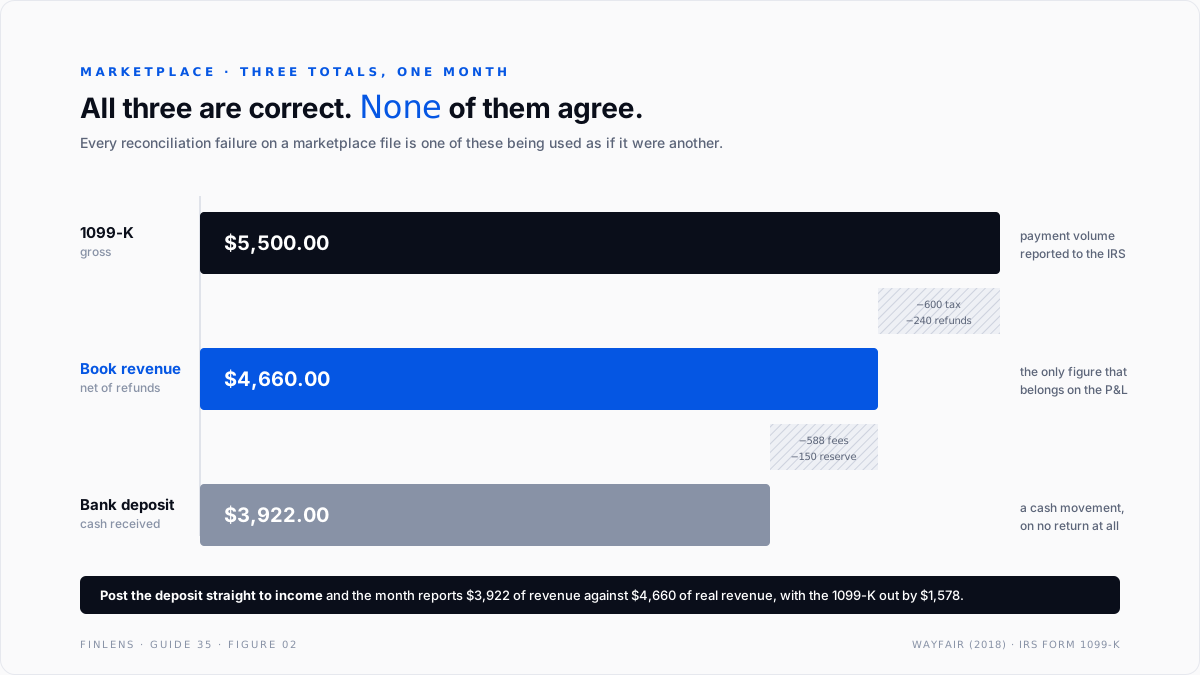
A marketplace seller works with three numbers that all describe the same month and none of which agree: the gross on the Form 1099-K, the revenue that belongs on the profit and loss, and the cash that arrived in the bank.
Every reconciliation failure in this guide is a case of treating one of those three as if it were another.
Failure mode one: the facilitator tax with nowhere to go. A QBO seller on thread 43939 described the exact shape of it. Total gross sales of $5,500 including $600 of sales tax the platform collected from buyers and will remit itself, against a net payment received of $4,900.
The seller reasoned, correctly, that the $600 should not sit in Sales Tax Payable because it is not their liability. Then asked whether it could be coded as merchant fees. It cannot. It is neither revenue nor expense, and forcing it into either one misstates the profit and loss by $600. Four replies, marked solved.
Failure mode two: the 1099-K that does not match the books. Marketplace gross reported on the 1099-K includes the sales tax the platform collected. Revenue in the books should not.
An accountant who ties revenue to the 1099-K produces a figure inflated by every dollar of facilitator tax, and an accountant who ignores the 1099-K leaves an unexplained difference the IRS matching program will find.
Both are resolved the same way: report gross, then show the reduction explicitly, so the 1099-K figure is present in the books and the revenue figure is correct.
The settlement identity
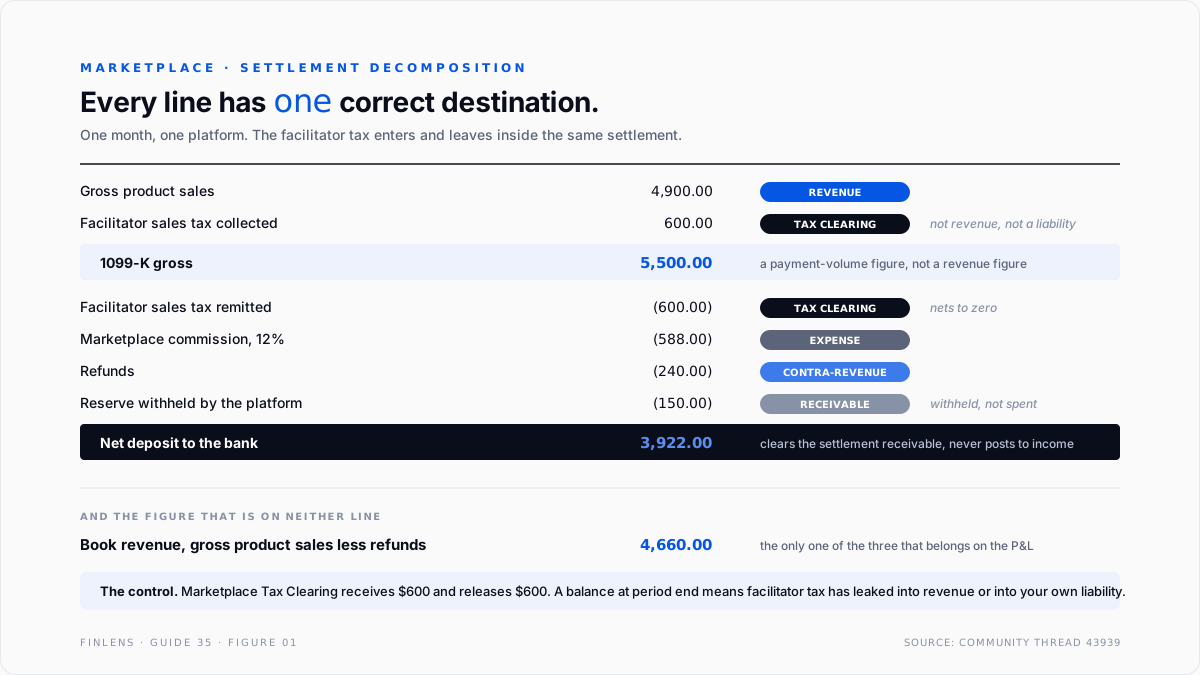
One equation decomposes every marketplace payout, and each line has exactly one correct destination.
MARKETPLACE SETTLEMENT
Gross product sales → Revenue
+ Shipping charged to buyer → Revenue (or shipping income)
+ Facilitator sales tax collected → Clearing account, NOT revenue
- Facilitator sales tax remitted → Clearing account, nets to zero
- Marketplace commission and fees → Expense
- Refunds and returns → Contra-revenue
- Chargebacks → Contra-revenue or expense
- Reserves and holdbacks → Receivable, released later
─────────────────────────────────────────────────────────
= NET DEPOSIT → Bank
Three separate totals fall out of that decomposition, and knowing which is which ends most of the confusion.
The 1099-K gross is the top two lines plus the facilitator tax. It is a payment-volume figure, not a revenue figure.
Book revenue is the top two lines, less refunds. It excludes facilitator tax entirely.
The bank deposit is the whole stack, net of everything. It matches neither of the other two and should never be recorded as revenue.
The facilitator tax line is the one that causes the trouble, because it enters and leaves within the same settlement. Running it through a Marketplace Tax Clearing account rather than through revenue or Sales Tax Payable makes it visible, makes it net to zero, and keeps it out of both the profit and loss and the seller's own tax liability.
Why the tax is not the seller's liability
Marketplace facilitator laws followed the Supreme Court's 2018 decision in South Dakota v. Wayfair, which removed the physical-presence requirement for sales tax nexus. Rather than pursue millions of small remote sellers, states shifted the collection obligation onto the platforms.
Two consequences matter for the ledger.
The platform is the taxpayer for those transactions. The seller never holds the money and never owes it. Booking it to Sales Tax Payable creates a liability the business does not have and that will never be relieved by a payment, so the balance grows forever.
The seller may still have filing obligations. Several states require a registered seller to file a return reporting marketplace sales even where the tax was collected and remitted by the platform, sometimes as a zero-dollar or informational return. Registration status and filing obligation are separate questions from who collects.
A third case sits alongside both. Where a seller also sells direct, through its own website, the direct channel tax is the seller's liability and does belong in Sales Tax Payable. That side runs through QuickBooks Online's automated sales tax, and Intuit's articles on setting up where you collect sales tax and on using automated sales tax cover the configuration.
The state list in that setup should reflect only where the seller itself collects. Adding a state because marketplace sales occurred there produces a return QuickBooks expects to file and the seller has nothing to report on. The same state can therefore carry facilitator tax that is not the seller's and direct tax that is, in the same month.
The direct-channel mechanics are covered in the sales tax, nexus and remittance guide.
The account setup
Seven accounts carry a clean marketplace reconciliation.
Marketplace Clearing is what lets the settlement post on its own date and the deposit land on its own date without either one waiting for the other. The deposit then matches against the clearing balance rather than against revenue, which is the same match-versus-add discipline covered in the bank reconciliation guide.
Intuit's own Etsy connector follows this pattern. Its documentation on importing Etsy transactions into QuickBooks Online records facilitator tax as a line item on the sales receipt and posts it to a default account named Etsy Shop Sales Tax Clearing. That naming is the product telling you what the account is for.
The reconciliation workflow
Four steps per settlement period.
Step one, pull the settlement report, not the deposit. Amazon's settlement report, Etsy's monthly statement, and the equivalent elsewhere carry the decomposition. The bank line carries only the total. Reconciling from the bank line forward is guessing.
Step two, post the settlement as a summary entry. One entry per settlement period, decomposed by the identity above, offset to Marketplace Clearing. Per-order posting is unnecessary for the general ledger and makes the file unusable at volume.
Step three, match the deposit to the clearing balance. The bank feed line clears Marketplace Clearing. It does not touch revenue. If the deposit does not clear the balance to zero, the residual is a reserve, a timing difference, or a missing fee line, and it should be identified rather than plugged.
Step four, confirm the tax clearing nets to zero. Facilitator tax collected and facilitator tax remitted should offset within the settlement. A residual balance means the platform withheld tax it has not yet remitted, or a collected line was posted without its remitted pair.
The zero-balance test is the whole control. Marketplace Tax Clearing carrying a balance at period end is the earliest signal that facilitator tax has leaked into revenue or into the seller's own liability.
The failure-mode catalog
Six diagnoses cover most marketplace work.
1. Facilitator tax booked to revenue. Symptom: revenue exceeds the platform's own gross sales figure, and gross margin falls without a cost change. Cause: the settlement was posted at 1099-K gross with no tax line. Fix: separate the tax to Marketplace Tax Clearing and restate revenue.
2. Facilitator tax booked to Sales Tax Payable. Symptom: a liability that grows every month and is never paid, and an agency in the Sales Tax Centre showing a balance no payment ever clears. Cause: the tax was treated as the seller's own.
Fix: reclassify to the clearing account and remove the agency where the seller has no direct-channel collection. Intuit's guidance on managing sales tax payments covers the payment side, but no payment will ever clear this balance because the liability was never real.
3. Facilitator tax booked as a fee. Symptom: marketplace fee expense materially higher than the platform's published rate. Cause: the thread 43939 question answered the wrong way. Fix: separate the tax from the commission, which are different economically even though both reduce the deposit.
4. Net deposit recorded as revenue. Symptom: revenue understated by the whole fee load, and no marketplace fee expense at all. Cause: the bank feed line was added to an income account instead of matched to a clearing balance. Fix: post the settlement gross and match the deposit against clearing.
5. Reserve treated as a fee. Symptom: an unexplained recurring shortfall against the settlement total. Cause: platform holdbacks expensed rather than carried as a receivable. Fix: route reserves to Marketplace Reserve and release them as the platform pays out.
6. Multi-channel state totals double counted. Symptom: a state return overstates taxable sales. Cause: marketplace sales and direct sales aggregated without separating who collected. Fix: report marketplace sales as marketplace sales on the return, which is exactly the informational line several states require. Cross-border sellers face the same split, covered in the Canada GST, HST and PST guide.
Worked example
One month on a single marketplace, using the shape reported on thread 43939 and extending it to a full settlement.
The three numbers land as follows.
None of the three equals another, and all three are correct. The bridge from 1099-K gross to revenue is $600 of facilitator tax plus $240 of refunds. The bridge from revenue to deposit is $588 of commission plus $150 of reserve.
Marketplace Tax Clearing receives $600 and releases $600, closing at zero. Sales Tax Payable is untouched, because none of this tax is the seller's. Marketplace Reserve carries $150 as a receivable until the platform releases it.
Now book it wrong. Post the $3,922 deposit straight to Sales Income and the month reports $3,922 of revenue against $4,660 of real revenue, with no commission expense, no refund visibility, no reserve asset, and a 1099-K that disagrees with the books by $1,578.
Which figure goes on which return
The three totals each have a destination, and sending the wrong one is how a correct set of books produces a wrong filing.
The income tax return takes book revenue. Gross receipts are the top two settlement lines less refunds, without facilitator tax. Reporting the 1099-K gross as receipts overstates income by the tax the platform collected, and the fee load then has to be deducted separately to reach the same profit by a longer route.
The 1099-K figure still has to appear somewhere. The IRS matches the form against the return. Where gross receipts are stated below the 1099-K total, the difference should be reconcilable from the books on request, which is the practical reason the tax and refund lines belong in named accounts rather than netted away.
The state sales tax return takes marketplace sales as marketplace sales. Several states provide a line for sales where the facilitator collected, precisely so the seller's own taxable figure excludes them. Aggregating marketplace and direct sales into one taxable number overstates the liability and invites an assessment the seller then has to argue down.
The bank deposit goes on no return at all. It is a cash movement. Its only role is to clear the settlement receivable, and any workflow that treats it as a revenue figure has skipped the entire decomposition.
Where in-QBO marketplace reconciliation stops scaling
Threshold one: more than one marketplace. Each platform decomposes its settlement differently and names the same economics differently. Two platforms means two mappings maintained by hand, and the fee taxonomy is the part that drifts.
Threshold two: settlement periods that straddle month end. Amazon settles on a rolling two-week cycle that does not respect calendar months, so a single settlement spans two reporting periods. Splitting it requires either a per-order data pull or an accrual estimate.
Threshold three: inventory sold across channels. The same SKU moving through a marketplace and a direct store draws on one average cost pool, so channel margin stops being computable inside the file. The settlement side is covered in the Amazon FBA reconciliation guide, and the storefront side in the Shopify integration guide.
The Finlens approach
Finlens reads the marketplace settlements and the QuickBooks ledger together and treats the three-number relationship as a standing test.
1. Settlement decomposition against the identity. Each settlement is parsed into its component lines and each line is checked against its destination account. A tax line reaching revenue, a fee line reaching Sales Tax Payable, or a deposit reaching income directly is raised before the period closes.
2. Tax clearing zero-balance monitoring. Marketplace Tax Clearing is tested at every settlement rather than at period end. A non-zero balance is attributed to the specific settlement and line that created it, which is the difference between a five-minute fix and a month-end investigation.
3. Three-number bridge reporting. The 1099-K gross, book revenue, and bank deposits for the period are reported together with every bridging item named, so the figure that goes on the return is defensible without rebuilding the month.
Four supporting capabilities sit around those three.
- Fee taxonomy mapping per platform, so commission, fulfilment, storage, and advertising stay separable rather than collapsing into one expense.
- Reserve ageing, tracking holdbacks from withholding to release and flagging reserves that have not cleared.
- Straddling-settlement allocation, splitting a settlement that crosses month end by transaction date rather than by payout date.
- A cross-file view for firms, listing every client with a non-zero marketplace tax clearing balance in one table.
Verification checklist
Eight lines to run before closing a period with marketplace activity.
- Marketplace Tax Clearing is zero, and every settlement's collected and remitted lines offset.
- Sales Tax Payable contains only tax the seller itself collected on direct sales.
- Book revenue excludes facilitator tax and is stated net of refunds.
- Marketplace fee expense is within a reasonable band of the platform's published rate applied to gross sales.
- Every bank deposit matched to Marketplace Clearing rather than being added to an income account.
- Marketplace Clearing is zero, or its balance is explained by a settlement not yet deposited.
- Marketplace Reserve agrees to the platform's reported withheld balance.
- The bridge from 1099-K gross to book revenue is documented and every reconciling item named.
FAQ
Is marketplace-collected sales tax revenue?
No. It is collected from the buyer by the platform and remitted by the platform. It passes through a clearing account and touches neither revenue nor expense.
Should it go to Sales Tax Payable?
No. The seller never holds the money and never owes it, so the liability is not the seller's. Booking it there creates a balance that will never be relieved.
Why does the 1099-K exceed book revenue?
Because the 1099-K reports payment volume including facilitator tax, while revenue excludes it. Refunds widen the gap further. Both figures can be correct at the same time.
Does a filing obligation still exist where the platform remits?
Frequently yes. Several states require a registered seller to report marketplace sales on its return even where the tax was collected and remitted by the platform. Registration and collection are separate questions.
Can the net deposit simply be recorded as sales?
Only at the cost of understating revenue by the entire fee load and losing refunds, reserves, and tax visibility. The deposit is the bottom of the settlement stack, not the top.
How should reserves be treated?
As a receivable. The money is owed to the seller and has been withheld, not spent, so expensing it understates both assets and profit until release.

