
The R&D Tax Credit Your Startup Already Earned but Has Not Claimed


Most founders know the R&D credit exists. Most think it only matters once the company is profitable. That was true before 2016.
Since then, a qualified small business can elect to apply the credit against the employer portion of payroll taxes instead of income taxes. A pre-revenue startup with $500,000 in engineering payroll can offset up to $500,000 per year in FICA and Medicare taxes, starting from the first quarter after the election. No taxable income required.
The catch is not eligibility. It is categorization. The credit is computed from qualified research expenses, which means every engineering dollar has to be in the right account, tagged to the right activity, before the Form 6765 preparer can use it. That is an accounting problem before it is a tax problem.
What the section 174 blog already covers
Section 174 R&D capitalization covers the deduction side: the post-OBBBA return to immediate expensing for domestic R&E, the two tracks of transition relief, and the coordination with the credit under section 280C.
This guide covers the credit side: how to qualify, what counts, how to calculate it, and how the payroll offset election works.
Section 41 and section 174 are not the same thing
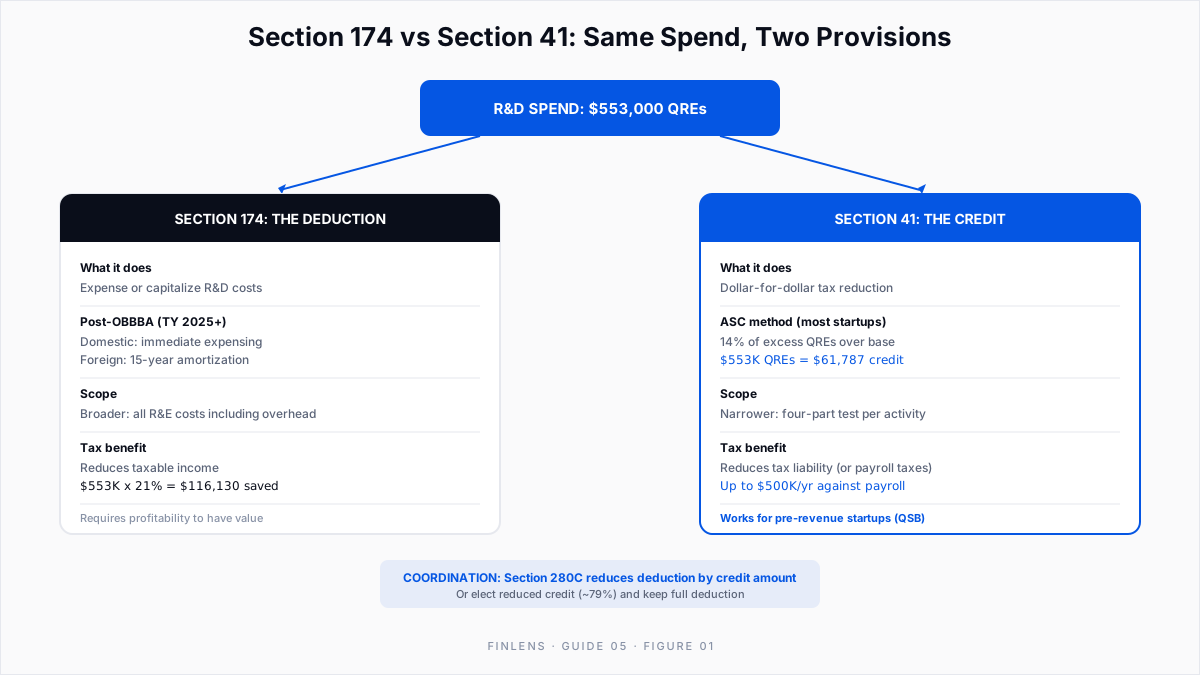
Section 174 is a deduction. It determines whether you expense or capitalize research costs. Section 41 is a credit. It gives you a dollar-for-dollar reduction in tax liability based on qualified research expenses.
You can use both, but section 280C requires you to reduce the deduction by the amount of the credit. Alternatively, you can elect to take a reduced credit at approximately 79% of the full amount (at the 21% corporate rate) and keep the full deduction. Most startups take the reduced credit because the deduction is worth more in early years.
The two provisions have different definitions of what qualifies. Section 174 is broader. Section 41 has a four-part test that is narrower and must be applied activity by activity.
The four-part test
Every activity claimed for the credit must pass all four parts. If any part fails, the entire activity is excluded.
1. Permitted purpose. The activity must relate to a new or improved business component: a product, process, technique, formula, or software. Improving the function, performance, reliability, or quality of the component counts. Style, taste, and cosmetic changes do not.
2. Technological in nature. The activity must rely fundamentally on principles of engineering, computer science, biological science, or physical science. Market research, management studies, and social science research are excluded.
3. Elimination of uncertainty. At the outset, there must be uncertainty about whether the desired result can be achieved, the method for achieving it, or the appropriate design. If the answer is known before work begins, the activity is not qualified research.
4. Process of experimentation. The taxpayer must evaluate one or more alternatives through modelling, simulation, systematic trial and error, or other methods. Writing code that implements a known algorithm is not experimentation. Writing code that tests whether a new approach to a known problem can meet a performance target is.
Software development qualifies when it meets all four parts. Building a feature with a known design does not. Building the same feature when the performance constraint requires a novel data structure does.
What counts as a qualified research expense
Three categories of costs qualify. A fourth was added recently.
Wages. Compensation paid to employees who directly perform, directly supervise, or directly support qualified research activities. The qualified portion is the percentage of time each employee spends on qualifying activities. An engineer earning $150,000 who spends 70% of their time on qualifying work contributes $105,000 in QREs.
Supplies. Tangible personal property used or consumed in the conduct of qualified research. Cloud hosting consumed during development and testing qualifies. Production hosting does not.
Contract research. 65% of amounts paid to a third party to perform qualified research on behalf of the taxpayer. If the third party is a qualified research consortium, the rate is 75%.
Cloud computing costs. Server, storage, and compute costs directly tied to qualified research activities. This includes AWS, GCP, and Azure spend consumed during development, not production serving.
What does not qualify. Internal-use software has an additional three-part test on top of the standard four (it must result in significant economic risk, be innovative, and not be commercially available). General and administrative costs, recruiting, overhead, and quality control testing after the product is complete are excluded. Market research, reverse engineering of competitor products, and adaptation of existing software to a new platform without technological uncertainty are also excluded.
The time allocation problem. Most engineers do not spend 100% of their time on qualifying activities. They also attend meetings, fix non-research bugs, answer support tickets, and write documentation. The credit requires an honest percentage. An engineer who spends 70% on qualifying work and 30% on maintenance contributes only 70% of their wages as QREs. Overstating the percentage is the single most common audit adjustment in R&D credit studies.
The standard approach is a contemporaneous time-tracking system where engineers log hours against project codes that map to qualifying activities. Reconstructed estimates prepared at year end are accepted but given less weight in an audit.
The categorizing transactions guide covers how to tag expenses correctly in QuickBooks Online. For R&D credit purposes, the minimum requirement is a separate expense account or class that isolates research-related costs from production costs.
The calculation: ASC method
Two methods exist. Almost every startup uses the Alternative Simplified Credit (ASC) because the regular method requires base period data from 1984 to 1988 that no modern company has.
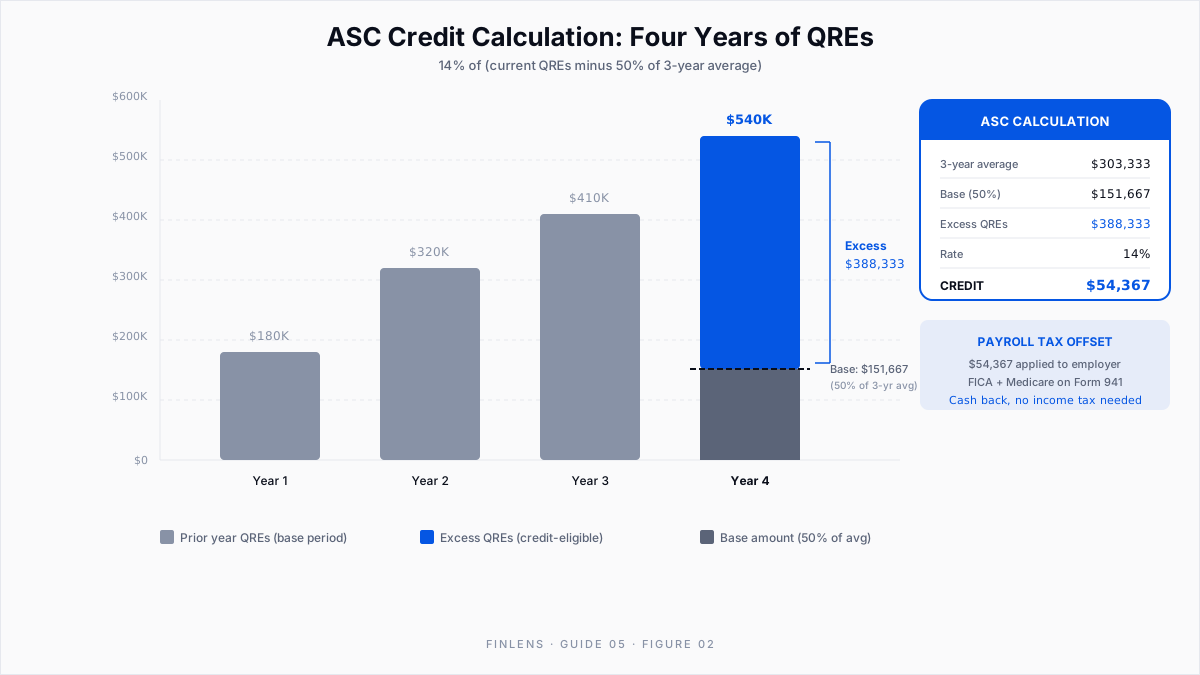
ASC formula: 14% of (current year QREs minus 50% of the average QREs for the preceding three tax years).
Worked example. A SaaS startup in its fourth year of operation.
Three-year average of prior QREs: ($180,000 + $320,000 + $410,000) / 3 = $303,333.
Base amount: 50% of $303,333 = $151,667.
Credit: 14% of ($540,000 minus $151,667) = 14% of 388,333=**54,367**.
If the startup elects the reduced credit under section 280C to keep the full deduction: 54,367times79%=**42,950**.
First-year startups with no prior QRE history get 6% of current year QREs. A company with $500,000 in first-year QREs earns a credit of $30,000.
The section 280C coordination. If you take the full $54,367 credit, your section 174 deduction for R&D expenses is reduced by $54,367. Alternatively, elect the reduced credit: $54,367 times (1 minus the 21% corporate tax rate) = $42,950. The reduced credit is smaller, but you keep the full deduction. For a startup with no taxable income, the deduction has no current value, so the full credit is better. For a profitable company, the reduced credit often produces a better after-tax result.
Credit carryforward. The R&D credit can be carried back one year and forward twenty years. For a startup using the payroll offset, the offset is limited to $500,000 per year. Any excess credit above that cap carries forward and can offset income taxes in future years when the company becomes profitable.
The payroll tax offset election
This is where the credit becomes cash for pre-revenue startups. Under section 41(h), a qualified small business can elect to apply the R&D credit against the employer portion of Social Security tax and Medicare tax instead of income tax.
Qualification as a QSB:
- Gross receipts under $5 million for the current tax year
- No gross receipts in any tax year before the five-year period ending with the current year
A company founded in 2023 that has never generated revenue qualifies through tax year 2027. A company founded in 2023 that generated its first revenue in 2025 still qualifies as long as gross receipts stay under $5 million.
The offset limits:
The offset applies to the employer portion of payroll taxes reported on Form 941, starting the quarter after the election is made. A credit elected on a 2025 tax return filed in March 2026 begins offsetting payroll taxes in Q2 2026.
The election must be made on the original, timely filed return. Form 6765, Section D. You cannot make this election on an amended return. If you file your corporate return late and miss the deadline, the payroll offset election is lost for that year. The credit still carries forward against income tax, but the cash benefit is gone.
The payroll taxes guide covers 941 filing and deposit schedules. The R&D credit offset reduces the total 941 liability for the quarter, which directly reduces the deposit the company owes.
Form 6765 and the 2026 Section G change
Form 6765, Credit for Increasing Research Activities, is filed with the corporate return. It has four sections.
For 2026 tax years, a new Section G requires detailed business component documentation: you must report at least 80% of total QREs or a maximum of 50 business components, whichever is less. Each component requires a description of the research activity, the uncertainty addressed, and the experimentation method used.
The exemption that matters. QSBs that elect the payroll tax offset are exempt from Section G. This is a significant compliance simplification. A pre-revenue startup claiming a $30,000 credit against payroll taxes files Section D and the ASC calculation. It does not have to document every business component in Section G.
This exemption only applies to the portion of the credit used as a payroll offset. If the credit exceeds the payroll cap and the excess carries forward against income tax, Section G applies to the carryforward portion.
What QuickBooks needs to show
The credit computation happens outside QuickBooks, usually in a spreadsheet or with a specialist. But QuickBooks must produce the inputs:
1. A separate R&D expense account. Create an expense account called "Research and Development" or "R&D Expenses." Every qualified cost runs through this account. The P&L customization guide covers how to filter by class or location to isolate R&D costs within a team or project.
2. Payroll detail by employee. The credit requires the percentage of time each qualifying employee spent on qualified activities. QuickBooks Payroll produces the total wages. The time allocation comes from a contemporaneous log maintained outside QBO.
3. Contractor invoices tagged to R&D. The 65% inclusion rate applies only to amounts paid for qualified research. If a contractor does both qualifying and non-qualifying work, the invoice should be split or the qualifying portion documented separately.
4. Cloud hosting expenses isolated from production. If your AWS bill includes both development and production infrastructure, you need a way to separate them. Tags in the cloud provider's billing console, mapped to a class or sub-account in QBO, are the standard approach.
The R&D credit preparer will ask for a P&L filtered to R&D expenses, a payroll register, and the time allocation documentation. If those three things are clean, the credit study takes weeks instead of months.
A software startup example end to end
A SaaS company in its third year has five engineers, two of whom spend 80% of their time building a new machine learning pipeline (qualifying) and three who spend 40% on qualifying improvements and 60% on maintenance.
Add cloud computing costs tied to development: $48,000 in AWS spend for staging and test environments. Add one contract research engagement: 60,000paidtoauniversitylabforalgorithmvalidation,ofwhich65%qualifies(39,000).
Prior two years of QREs: $280,000 and $390,000. No QREs before that.
Three-year average (using 0fortheyearwithnoQREs):(0 + $280,000 + $390,000) / 3 = $223,333. Base: 50% = $111,667.
ASC credit: 14% of ($553,000 minus $111,667) = 14% of 441,333=**61,787**.
The company has gross receipts under $5 million and is in its third year of having any gross receipts. It qualifies as a QSB and elects the payroll offset. The $61,787 credit offsets employer FICA and Medicare on the quarterly 941, starting the quarter after the return is filed.
At a combined employer rate of 7.65% on $815,000 in total payroll, the quarterly employer tax is approximately $15,587. The credit absorbs the full amount for roughly four quarters, saving $61,787 in cash that would otherwise leave the bank account.
The board package guide covers how to surface the credit in management reporting. Most boards want to see the R&D credit as a line item in the cash flow forecast.
QuickBooks Intuit L-code index
Common mistakes that reduce or kill the credit
Mixing R&D and production in one account. If engineering costs and production support costs share an account, the credit preparer cannot isolate QREs without a manual review of every transaction. Create separate accounts or use classes from day one.
No time tracking. The IRS expects contemporaneous records of how engineers spent their time. A year-end estimate based on memory is accepted but weaker. If the company is audited, the absence of contemporaneous logs is the first thing the examiner notes.
Claiming the credit on an amended return and expecting the payroll offset. The payroll offset election can only be made on the original, timely filed return. Filing an amended return for a prior year captures the income tax credit but not the payroll offset. This is a one-time-per-year window that cannot be reopened.
Forgetting the section 280C reduction. If you take the full credit and also deduct the full R&D expense, the IRS will adjust the deduction downward by the credit amount. Either reduce the deduction yourself or elect the reduced credit. Doing neither is an error on the return.
Excluding cloud computing costs. Many founders do not realize that development-related cloud spend qualifies. If you separate development and production environments at the infrastructure level, the development portion is a QRE. If your cloud bill is one undivided line, split it before year end.
Authorities cited
FAQ
Does software development always qualify?
No. Only development that involves technological uncertainty and a process of experimentation qualifies. Building a well-understood feature using established frameworks does not. Building a feature that requires novel algorithms, untested architectures, or performance characteristics beyond current capabilities does.
What if the company has both domestic and foreign engineers?
Only wages paid for research performed in the United States qualify under section 41. Wages paid to foreign employees performing research abroad are excluded. If a team is split, only the domestic portion of each qualifying employee's wages counts.
Can a sole proprietor or LLC claim the payroll tax offset?
Yes, if the entity files a return that reports QREs and meets the QSB definition. Sole proprietors report the credit on Schedule C and elect the payroll offset on Form 6765. LLCs taxed as partnerships file Form 6765 at the partnership level.
How far back can we claim missed credits?
The credit can be claimed on amended returns for open tax years, generally three years from the original filing date. However, the payroll tax offset election cannot be made on an amended return. Only the income tax credit carryforward is available retroactively.
What records should we keep?
The IRS expects contemporaneous documentation: project descriptions, time logs, and a narrative linking each activity to the four-part test. Reconstructed records from memory are weaker. Start the documentation habit in year one, even if the credit study happens later.

