
Contractor Management in QuickBooks: The $2,000 Threshold Changes Everything


The number you have been using since 1954 is wrong.
For payments made after 31 December 2025, the information reporting threshold that has sat at $600 for seventy-one years is now $2,000.
The IRS instructions for Forms 1099-MISC and 1099-NEC state it plainly: file a 1099-NEC "for each person in the course of your business during the year to whom you have paid at least $2,000." The threshold is indexed for inflation for calendar years after 2026.
Tax year 2026 is the first year this applies, which means the forms you prepare in January 2027 are the first ones affected. A great deal of published guidance, including help content inside QuickBooks itself, still says $600.
This guide covers what actually counts toward that threshold, why most of what you pay a contractor probably does not count at all, how to set a contractor up in QuickBooks so January is a lookup rather than an investigation, and what to do when the W-9 never arrives.
What this guide is not
This is the operational middle. Two neighbours cover the ends.
Whether someone is a contractor at all is a classification question with its own tests and its own penalties, and it lives in employee versus contractor classification. The filing mechanics, the boxes, the e-file route and the vendor bill workflow live in accounts payable, vendor bills and 1099 filing.
What sits between them is management: onboarding, payment method, account mapping, and the running state of the file. That is where January is won or lost.
The filter nobody applies first
Before the threshold question there is a prior question, and most people never ask it: was this payment reportable at all?
The IRS instructions are unambiguous. "Payments made with a credit card or payment card and certain other types of payments, including third-party network transactions, must be reported on Form 1099-K by the payment settlement entity under section 6050W and are not subject to reporting on Form 1099-MISC or Form 1099-NEC."
Credit card, debit card, gift card, PayPal, Venmo business, Stripe, and similar networks. You do not report those. The settlement entity does, on a 1099-K, and under the current rules that entity only files once the payee crosses $20,000 and 200 transactions.
QuickBooks implements this rule by excluding those payment types from the 1099 calculation. Which is correct, and which looks exactly like a bug.
A user posting as theproblemsolver opened Vendor not showing up on 1099 report even though they are over threshold in December 2020. It has run to 32 replies and 204 views, and people were still adding to it in January 2025.
The Intuit moderator IamjuViel gave the first cause: "Payments made electronically or by credit card, debit card, or gift card are excluded in this report." A second cause surfaced later in the thread and matters just as much: expense accounts that are not mapped to a 1099 box also drop the vendor from the detail report.
One rule of law, one configuration error, identical symptom. That is why the thread ran for four years.
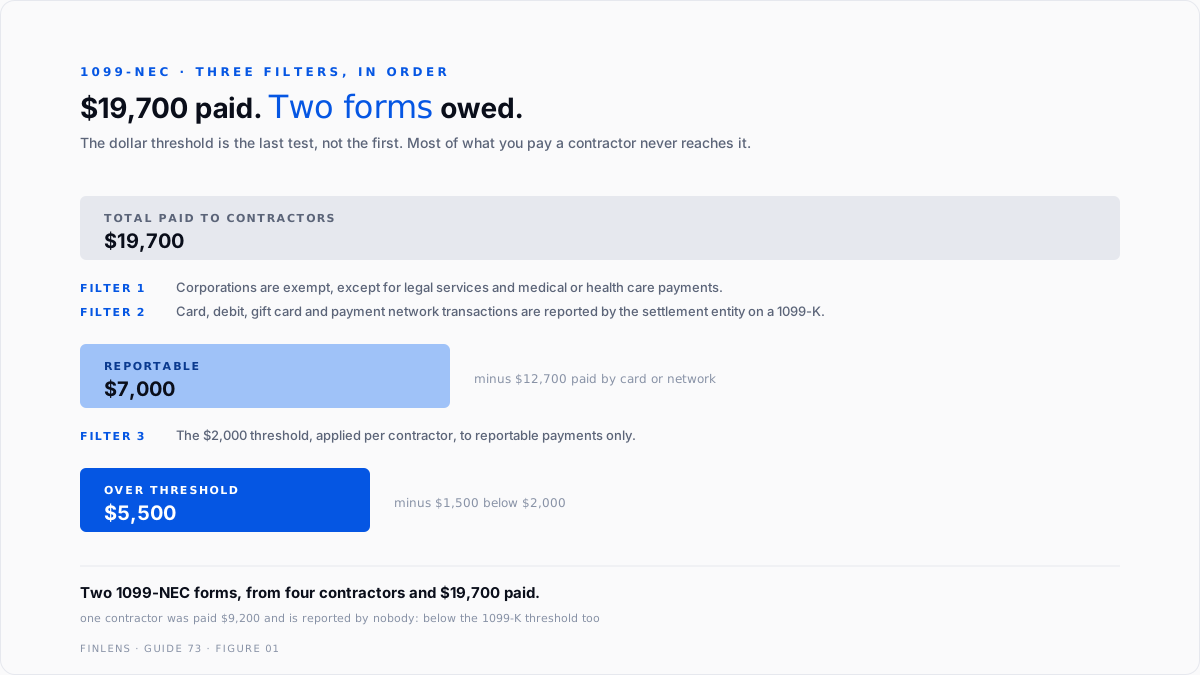
Worked example: four contractors, $19,700, two forms
A small studio pays four contractors during 2026.
Check the arithmetic. 3,500 + 0 + 9,200 + 0 = 12,700 excluded. 1,500 + 2,400 + 0 + 3,100 = 7,000 reportable. 12,700 + 7,000 = 19,700.
Three things in that table are worth sitting with.
The design studio. You paid them $5,000 and you file nothing. Under the old $600 rule the $1,500 of check payments would have required a form. Under the new rule it does not. The payment method split did not change; the threshold did.
The photographer. You paid $9,200 and nobody reports it. Not you, because it all went through a payment network. Not the network, because $9,200 is below $20,000. That is not a loophole anyone built. It is how section 6050W and section 6041 interact, and the photographer still owes tax on every dollar of it. Your obligation ends; theirs does not.
The bookkeeper. $3,100 reportable, no W-9 on file. This is the expensive one, and it is the next section.
The third filter: who the contractor is
Payment method filters first and the dollar threshold filters second. There is a third test underneath both, and it removes most of your vendor list.
The instructions are explicit that payments to a corporation, including an LLC treated as a C or S corporation, are generally exempt from reporting.
This is what the W-9 is actually for. The tax classification box on that form is the field that decides whether a vendor is ever in scope, and it is the reason a W-9 collected at onboarding saves more work than one collected in December.
Two exceptions survive incorporation, and both are easy to miss because the vendor looks exempt.
Legal services. The instructions state that "the exemption from reporting payments made to corporations does not apply to payments for legal services." Your law firm is almost certainly a corporation and you report them anyway. Attorney fees for services go in box 1a of the 1099-NEC. Gross proceeds paid to an attorney, which is a different thing, go in box 10 of the 1099-MISC.
Medical and health care payments. Payments for medical or health care services provided by corporations, including professional corporations, go in box 6 of the 1099-MISC. A practice set up as a PC is still reportable.
Both exceptions carry the same $2,000 threshold. If you pay a law firm by check and cross $2,000, you owe a form regardless of their entity type, and that is the single most commonly missed 1099 in a small business.
When the W-9 never arrives
A user posting as Logan King asked the direct question in Can a contractor be paid without their W9 being completed?, 2 replies and 32 views.
The Intuit staff reply pointed at the email invitation feature that lets a contractor fill in their own W-9, then advised contacting the IRS to confirm whether contractors can legally be paid without one. The tax question went unanswered.
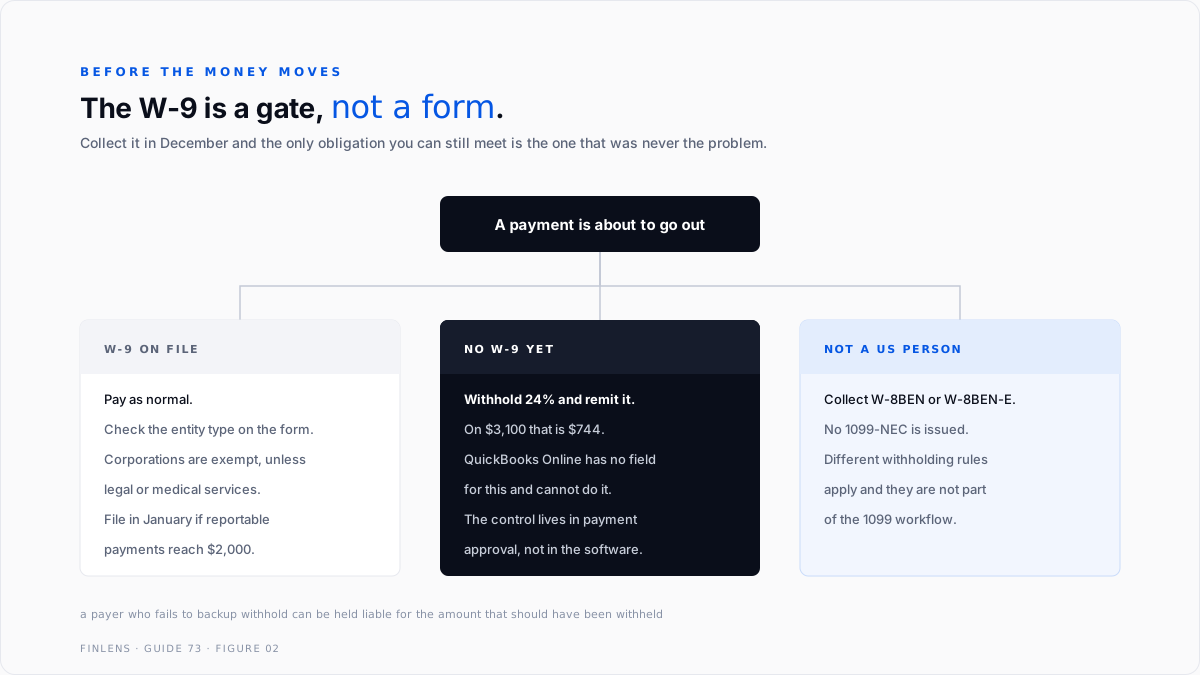
Here is the answer. You can pay them. What changes is that you are required to withhold 24% and remit it. The IRS sets backup withholding at 24 percent, triggered when a payee fails to provide a correct taxpayer identification number for reporting on the required information return.
On the bookkeeper's $3,100 that is $744 that should have been withheld and was not. It is not the contractor's problem. A payer who fails to backup withhold can be held liable for the amount.
And now the product gap. QuickBooks Online does not support backup withholding. There is no field for it and no mechanism to remit it. This is also why the contractor self-setup flow refuses to save a W-9 profile unless the exempt-from-backup-withholding box is ticked: the software has no way to represent the alternative.
So the control cannot live in QuickBooks. It has to live in your payment approval step, which means the W-9 is collected before the first payment, not before the first 1099.
Filing without a TIN. A user posting as lindak1119 hit the mechanical version of this in One of my contractors does not have a social security number, 14 replies and 100 views. QuickBooks would not save the contractor without an SSN, and a placeholder of all zeros was rejected as an invalid value.
The correct protocol from the thread: leave the identification number box empty and still submit the return. The IRS then issues a notice to the payee along with backup withholding documentation and a W-9. Filing late is a penalty. Not filing is a bigger one.
If the contractor is not a US person, none of this applies. They complete a Form W-8BEN or W-8BEN-E instead, and you do not issue a 1099 at all.
Setting the contractor up so January is a lookup
Three settings decide whether the 1099 report works. All three are set once, at onboarding, and all three are invisible until year-end.
One, the vendor is flagged as 1099 eligible and carries a tax ID. Without the flag the vendor is never considered, no matter what you paid them.
Two, the expense accounts are mapped to 1099 boxes. This is the second root cause from thread 727750. A correctly flagged vendor paid out of an unmapped account produces nothing on the detail report. Map the accounts you actually use for contractor spend, not the ones a template suggested.
Three, the payment method is recorded honestly. Not as a tax dodge, as a data problem. A card payment entered as a check inflates your reportable total and produces a form you should not file. A check entered as a card payment suppresses one you should.
This is also the argument for keeping contractor spend in dedicated accounts rather than scattering it. A single Contract Labor account mapped to box 1 answers the year-end question in one click. Spend spread across six operating accounts answers it in an afternoon. The broader structure argument is in month-end and year-end close in QuickBooks.
Six ways this goes wrong
One, assuming the threshold is still $600. It is $2,000 for tax year 2026 payments. Check what your software says, because help content lags statute.
Two, assuming the threshold is the only test. Payment method filters first. A contractor over $2,000 in total who is under $2,000 in reportable payments gets no form.
Three, collecting the W-9 at year-end. By then the leverage is gone, the backup withholding window has closed, and you are chasing someone who has already been paid.
Four, treating a missing vendor on the 1099 report as a software fault. Check the payment method first, then the account mapping. Thread 727750 ran four years because people checked neither.
Five, paying a contractor through payroll. Contractors do not belong in the payroll run. The distinction and its consequences are covered in the QuickBooks Online Payroll guide and the year-end discipline in W-2 and year-end payroll close.
Six, ignoring where the contractor sits. A long-running contractor in another state can create obligations that look nothing like a 1099. Multi-state payroll and remote employees covers the terrain, and the classification question behind it belongs to the classification guide.
Thresholds: how much structure you need
Under five contractors, all paid by check or ACH. The vendor flag and one mapped account. Review in December.
Mixed payment methods. Separate the reportable from the excluded in your own records before January. The 1099 report will do it, but you want to know the answer before the software tells you, because a surprise in January is a reconciliation you did not budget.
Any contractor approaching $2,000 in check or ACH payments. W-9 on file before the next payment, without exception.
Any foreign contractor. W-8BEN or W-8BEN-E at onboarding. Different form, different rules, and no 1099.
More than twenty contractors. The W-9 collection needs to be a gate in the vendor setup process rather than a task someone remembers. At that volume the failure is never one missing form, it is six.
Contractors who look like employees. Volume is the trigger here, not dollars. Re-read the classification tests before the relationship has run for a year.
How Finlens approaches this
The year-end question is never "who did we pay." It is "what did we pay them, and does it count."
Finlens keeps the two filters separated all year. Reportable and non-reportable contractor spend are distinguishable at any point, not reconstructed in January, and every vendor flagged as 1099 eligible has a W-9 on file before the first payment clears rather than after the last one.
The account-to-box mapping is verified against the accounts actually in use, not the default list, so the detail report and the summary agree. When they disagree, the cause is identified rather than worked around. Accounts payable, vendor bills and 1099 filing covers the filing end of the same pipeline.
Verification checklist
FAQ
Is the 1099-NEC threshold $600 or $2,000?
For payments made after 31 December 2025 it is $2,000, per the IRS instructions for Forms 1099-MISC and 1099-NEC. Tax year 2025 forms, filed in early 2026, still used $600. The threshold is indexed for inflation after 2026.
I paid a contractor $8,000 by credit card. Do I file a 1099?
No. Card and payment network transactions are reported by the settlement entity on a 1099-K under section 6050W, not by you. Your reportable total for that contractor is zero.
Then who reports it?
The card processor or payment network, and only if the contractor crosses their own threshold of $20,000 and 200 transactions. Below that, nobody files. The contractor still owes tax on the income.
Can I pay a contractor who has not returned a W-9?
Yes, but you are then required to backup withhold 24% and remit it. QuickBooks Online cannot do this, so the control has to sit in your payment approval step rather than in the software.
What if I never get the TIN?
File the 1099 with the identification number box blank. The IRS will notice the payee and send them backup withholding documentation and a W-9. Do not delay the filing and do not enter placeholder zeros, which QuickBooks rejects as invalid anyway.
Why is a contractor missing from my 1099 report?
Two causes, in this order. Payments made by card, debit, gift card or payment network are excluded by design. Then check whether the expense account is mapped to a 1099 box, because an unmapped account drops the vendor from the detail report.
How do I see everything I paid a vendor regardless of method?
Run the 1099 Transaction Detail report and set the payment type filter to All, or use a Transaction Detail report filtered to that vendor. The difference between that and the default view is your excluded total.
What about a contractor outside the United States?
Collect a Form W-8BEN or W-8BEN-E instead of a W-9. No 1099-NEC is issued. Different withholding rules apply and they are not covered by the 1099 workflow.
When is the 1099-NEC due?
On or before 31 January, under section 6071(c), by paper or electronic filing. There is no automatic extension for the recipient copy.

