
Landed Cost in QuickBooks: Freight, Duty and the Basis That Changes Your Margins


Two products arrive in the same container. The freight bill is one number. How you split it decides which product looks profitable.
Not a little. The same shipment, the same money, allocated three defensible ways, reverses which of the two products you would choose to push. That is the part nobody mentions when they tell you to "add freight to the cost."
This guide covers what has to be capitalised into inventory and what does not, the three allocation bases and what each one does to your unit cost, the workaround for the QuickBooks tiers that have no landed cost feature, and where the tax rules stop agreeing with the book rules.
What the inventory guides already cover
FIFO versus average cost inventory covers the costing method. COGS recognition in QuickBooks Online covers when cost hits the income statement. Inventory adjustments and shrinkage covers quantity changes. Both of the first two name landed cost as a threshold they stop at.
This is that threshold.
The rule: condition and location
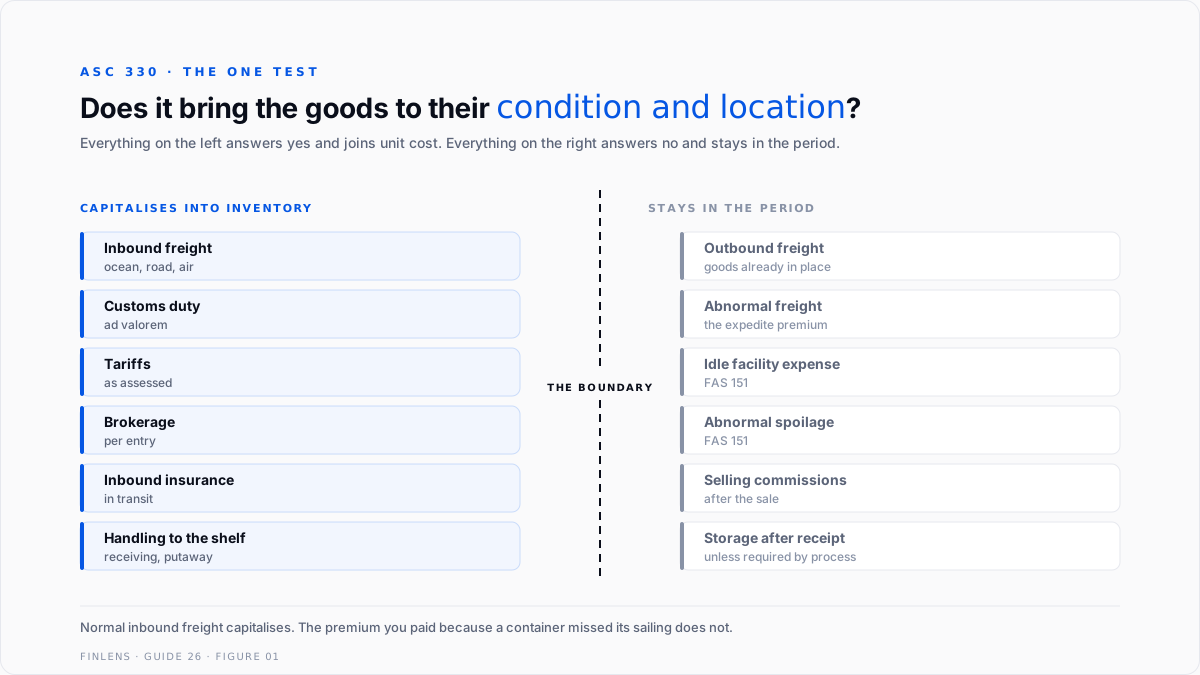
ASC 330-10-30-1 sets the principle. The primary basis of accounting for inventories is cost, and as applied to inventories, cost means the sum of the applicable expenditures and charges directly or indirectly incurred in bringing an article to its existing condition and location.
That phrase does all the work. Inbound freight, customs duty, tariffs, brokerage, inbound insurance and handling are all incurred getting the goods to where they are. They capitalise. Outbound freight to a customer happens after the inventory is already where it needs to be, so it is a selling expense, not inventory.
There is a carve-out worth knowing. Under FASB's amendment to ARB No. 43 Chapter 4, published as FAS 151, abnormal amounts of idle facility expense, freight, handling costs and spoilage must be treated as current period charges rather than as part of inventory cost.
So routine ocean freight capitalises. The emergency air freight premium you paid because a container missed its sailing does not. It is a period cost, and burying it in unit cost hides the thing you most want to see.
Three bases, three different businesses
Here is the part that changes decisions.
One container, two products, one set of charges.
Landed charges on the shipment: freight $4,200, duty $1,800, brokerage $600. Total $6,600.
Allocate by value. A takes 12,000 of 32,000, which is 37.5%, or $2,475. B takes 62.5%, or $4,125. Per unit that is $1.2375 on A and $8.25 on B.
Allocate by weight. A takes 400 of 2,000 kg, which is 20%, or $1,320. B takes 80%, or $5,280. Per unit, $0.66 on A and $10.56 on B.
Allocate by quantity. $6,600 across 2,500 units is $2.64 each. A takes $5,280, B takes $1,320.
Every split totals $6,600. Now look at the landed unit costs.
Now price them. A sells at $9.00, B at $55.00.
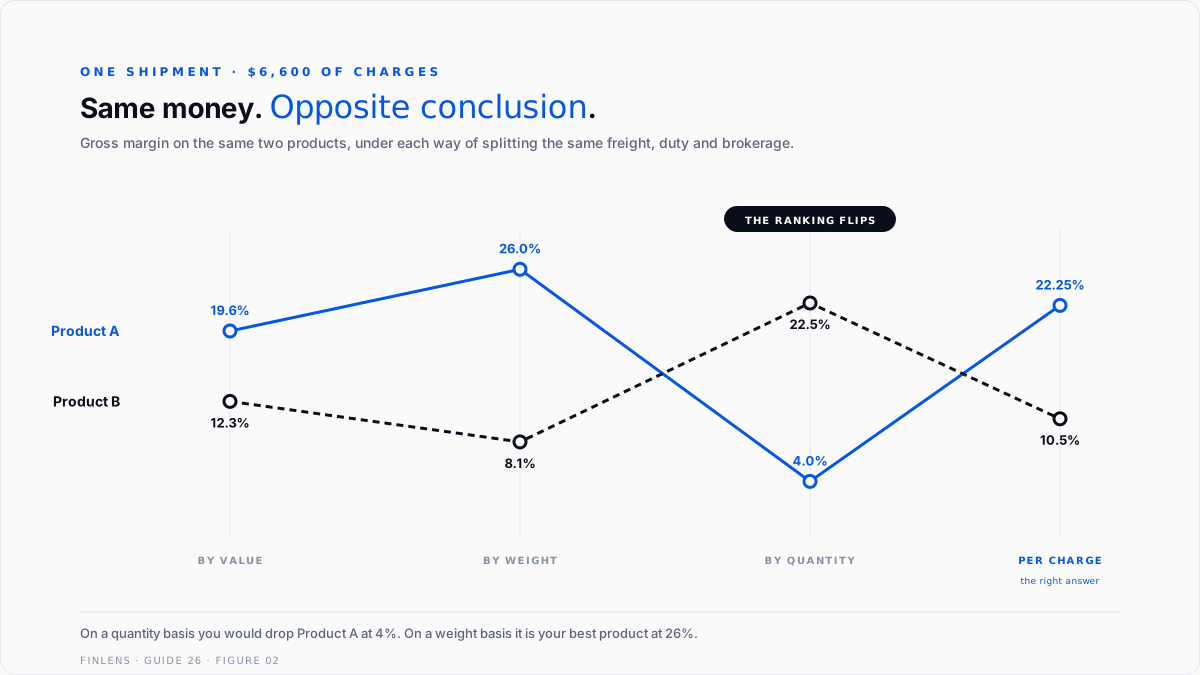
Read the last column against the one before it. On a weight basis, A is your strong product at 26% and B is marginal at 8%. On a quantity basis, the ranking inverts completely: B is the strong one at 22.5% and A is nearly worthless at 4%.
Nothing about the business changed. One spreadsheet choice did.
Which basis is right. Match the basis to what actually drives the charge. Ocean and road freight are priced on weight or volume, so freight allocates on weight or volume. Duty is almost always ad valorem, a percentage of declared value, so duty allocates on value. Brokerage is often a flat fee per entry, which makes quantity or an even split defensible.
Lumping all three charges onto one basis is the error. Splitting one bill of charges across the bases that drive them is the work, and it is why the quantity row above exists as a warning rather than a recommendation.
The fourth answer, which is the right one
Go back to the container. Allocate each charge on the basis that drives it rather than running all $6,600 through one denominator.
The two columns total $6,600, as every correct allocation must.
Per unit that is $1,995 over 2,000 units, or $0.9975 on A, and $4,605 over 500 units, or $9.21 on B. Landed unit costs become $6.9975 and $49.21.
Gross margins come out at 22.25% on A and 10.5% on B. Both are stated to the precision the inputs support, because a margin rounded to a whole point hides exactly the movement you are watching for.
Compare that against the three single-basis answers above. It is not any of them. It sits nearest the value basis, which is why value is the least bad default, and it is nowhere near the quantity basis, which would have told you to drop your best product.
The lesson is not that one basis wins. It is that the allocation is a modelling decision with a right answer, and the right answer requires knowing what each charge is actually priced on.
What QuickBooks will do for you
Enterprise Platinum and Diamond with Advanced Inventory have a real landed cost feature. Per Intuit's articles L64AiQG6p_US_en_US and L4D21nWRC_US_en_US, you set it up under Edit, Preferences, Items and Inventory, Company Preferences, Advanced Inventory Settings, then the Landed Cost tab and Setup landed cost account, using an Other Current Asset or Cost of Goods Sold account. You then map shipping and handling items, and the resulting Other Charge Items distribute to inventory.
Intuit's own list of what the feature covers is long: raw materials, shipping and freight, tarping, drayage, lumpers, weight tickets, customs, duties, taxes, tariffs, insurance, currency conversion, packaging, handling and payment fees. Allocation can run by quantity, value, weight or volume.
Every other tier has nothing. Not Pro, not Premier, and no QuickBooks Online plan at any level.
A user posting as lindak1119 worked through the consequence in How can I allocate shipping and freight costs to the inventory items purchased?, 25 replies and 329 views. They had one supplier bill with domestic shipping and a separate overseas freight vendor bill.
A Level 15 contributor posting as Rustler opened with the plain statement that QuickBooks does not handle landed costs, then gave the workaround that has become the standard answer:
- On the original bill, add a portion of shipping into each item's cost.
- Pay the third-party freight bill to a clearing account.
- Edit the original bill to increase each item's cost by its share of the third-party freight, and enter the clearing account amount as a negative in the accounts section.
- QuickBooks recalculates per-item cost as of the bill date and adjusts cost of goods sold for anything already sold.
That last line is the reason this works rather than just balancing. Editing the bill changes the item's cost at its original date, so the valuation and any COGS already recognised both correct themselves.
A user posting as Old World Cheese confirmed the same pattern applies to FOB purchases with separate freight invoices in how to capture freight in the cost of goods?, 2 replies and 75 views, where the responder pointed to Enterprise as the only native option and to the clearing account method for everyone else.
The tier question is covered in the QuickBooks Enterprise complete guide and the QuickBooks Online Advanced tier deep dive.
Where tax stops agreeing
The uniform capitalization rules of section 263A require that direct costs and a properly allocable share of indirect costs of property acquired for resale be capitalised into inventory rather than deducted.
But there is an exception, and it is wide. Under section 263A(i), a taxpayer other than a tax shelter that meets the gross receipts test in section 448(c), set at $25 million and adjusted for inflation, is not required to capitalise costs under section 263A.
The Tax Cuts and Jobs Act removed the old $10 million small reseller exception and replaced it with this broader one, which now covers producers as well as resellers.
Confirm the current year's inflation-adjusted threshold with your preparer rather than assuming the base figure.
Note which direction the divergence runs. Most two-book problems have tax requiring something the books do not. Here it is the reverse: ASC 330 requires you to capitalise inbound freight and duty into inventory regardless of your size, while the tax rules may let you deduct them currently.
A small importer can therefore be entirely correct in deducting landed costs on the return and entirely wrong in doing the same thing in QuickBooks. If the books are prepared on a GAAP basis for a lender or an investor, the capitalisation is not optional.
Six ways landed cost goes wrong
One, posting freight to a COGS or freight expense account. It feels close enough. It is not. The cost lands in the period the bill arrived rather than the period the goods sold, and your unit cost is permanently understated.
Two, one basis for every charge. Freight follows weight, duty follows value, brokerage often follows neither. One basis for all three is one right answer and two wrong ones.
Three, capitalising abnormal freight. The expedite premium is a period cost under FAS 151, and capitalising it hides exactly the number you want visible.
Four, capitalising outbound freight. Freight to the customer is a selling expense. The goods were already in their existing condition and location.
Five, applying landed cost after the goods have sold. Possible, and the clearing account method handles it by correcting COGS at the original date, but every month of delay widens the restatement.
Six, allocating in a currency you did not buy in. If the invoice and the freight are in different currencies, settle the conversion before you allocate. Multi-currency setup and transactions covers the exposure.
Thresholds: how much of this you need
Domestic purchases, freight included on the supplier invoice. Nothing to allocate. The item cost already carries it.
Domestic purchases, separate freight bills. The clearing account method, applied monthly. Fifteen minutes.
Imports with duty and brokerage. Allocate by charge type, not one basis for the lot. This is where the margin distortion starts to matter.
More than roughly twenty line items per shipment. The manual method stops scaling. Either Enterprise with Advanced Inventory, or a spreadsheet that produces the allocation and feeds one bill edit.
Goods already sold before the freight bill arrives. The clearing account method still works, but the COGS correction becomes a disclosed restatement rather than a tidy-up.
A lender, investor or buyer reading the financials. GAAP capitalisation is mandatory regardless of the section 263A exception. The two cannot be reconciled by choosing the easier one.
How Finlens approaches this
Landed cost is not a bookkeeping entry. It is the difference between knowing your gross margin and guessing it.
Finlens allocates each charge on the basis that drives it, freight on weight or volume, duty on declared value, brokerage on entries, rather than running the whole bill through one convenient denominator. The allocation is documented alongside the shipment so the unit cost can be explained to anyone who asks later.
Abnormal freight is separated at the point of entry and held in the period, so expedite spend stays visible as a cost of operations rather than disappearing into inventory. Where the client's tier has no landed cost feature, the clearing account method runs on a monthly cadence tied to the month-end close, not whenever a freight bill happens to surface.
Verification checklist
FAQ
Does QuickBooks Online have a landed cost feature?
No. Landed cost is available only in QuickBooks Desktop Enterprise Platinum or Diamond with Advanced Inventory. Every other tier needs the clearing account workaround.
Should freight be in COGS or inventory?
Inbound freight capitalises into inventory under ASC 330, then flows to COGS when the goods sell. Posting it directly to COGS recognises it in the wrong period.
What about freight to my customer?
That is outbound and it is a selling expense. The condition and location test is already satisfied before it is incurred.
How do I allocate freight across different items?
On the basis that drives the charge. Weight or volume for freight, declared value for duty, quantity or a flat split for brokerage. Using one basis for everything distorts unit cost.
What if the goods already sold before the freight bill arrived?
Edit the original bill at its original date. QuickBooks recalculates item cost from that date and adjusts cost of goods sold for the units already sold.
Is expedited air freight part of inventory cost?
The normal portion is. An abnormal premium is a current period charge under FAS 151 and should stay visible rather than being absorbed into unit cost.
Do I have to capitalise landed cost for tax?
Possibly not. The section 263A(i) small business exception, tied to the section 448(c) gross receipts test, may let you deduct it. That does not change the GAAP requirement for your books.
What is the clearing account for?
It holds the third-party freight bill so the original purchase bill can be edited to absorb the cost without double counting. Entered as a negative in the accounts section of the edited bill, it nets to zero.

