
Etsy and eBay in QuickBooks: Three Different Sales Numbers, One Is Revenue


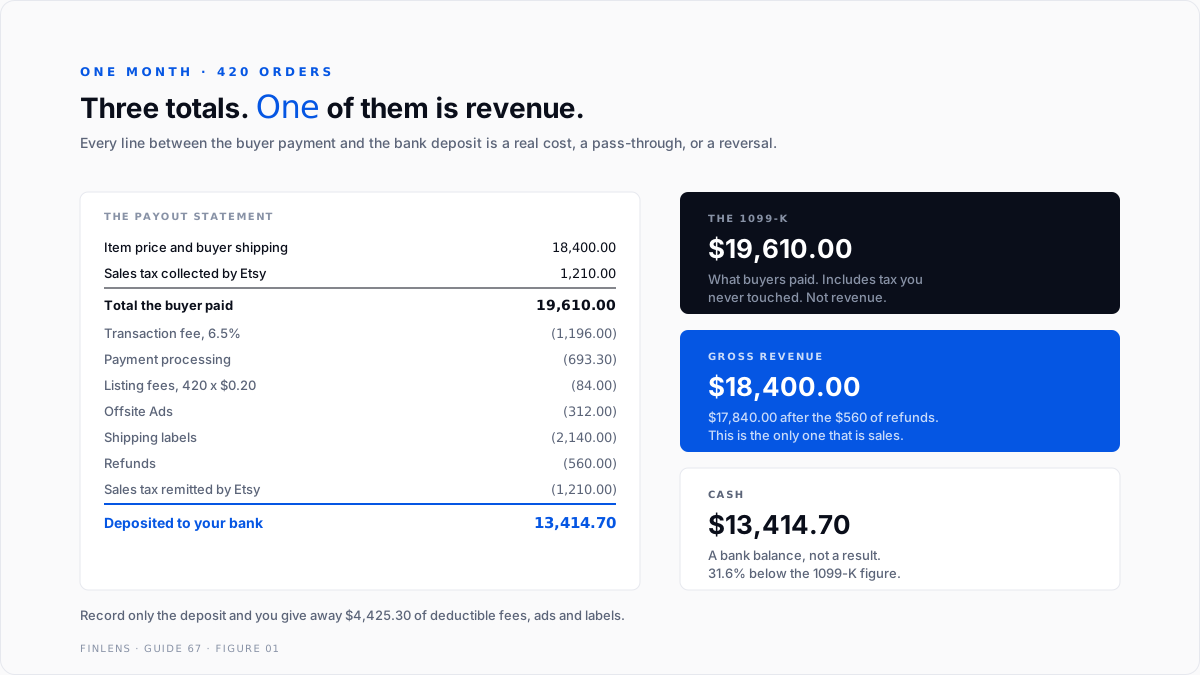
Your 1099-K says $19,610. Your bank says $13,414.70. Your revenue is neither.
Marketplace selling produces three different totals for the same month, all of them correct, all of them answering different questions. Most QuickBooks files record one of them and call it sales. Which one they pick decides whether the books are wrong by a little or by a third.
This guide covers what sits between the sale and the payout, how to record a net deposit without losing the gross, the double-counting trap in the eBay connector, and what to do with sales tax the marketplace already remitted.
What the ecommerce guides already cover
The Shopify to QuickBooks integration guide covers a storefront you control. Amazon FBA reconciliation covers settlement reports and fulfilment fees. Marketplace facilitator reconciliation covers the tax side across platforms.
All three stop at Etsy and eBay, which behave differently enough to need their own answer.
The rule: a deposit is not a sale
The money that reaches your bank has already been through five or six deductions. Recording the deposit as revenue understates sales, erases every fee, and makes your gross margin meaningless.
A user posting as ISSEP ran straight into the mechanical version of this in Match deposit of lesser value to sales receipt of greater value, 16 replies and 188 views.
Their example is as clean as it gets. One customer buys a $50 membership. The processor collects $50, takes its fee, and deposits $44.75. QuickBooks would not match the $44.75 deposit to the $50 receipt.
The moderator AlverMarkT gave the fix. Create a Service item called Processing fee in Products and services, and enter the fee in the Sales price/rate field as a negative amount.
Add it as a line on the sales receipt. The receipt now totals $44.75 and matches, while the $50 of revenue and the $5.25 of fee are both on the books.
The same shape works inside a bank deposit, under Add funds to this deposit, entering the fee as a negative.
Worked example: one month on Etsy
Four hundred and twenty orders.
Check it. 19,610.00 less 1,196.00, 693.30, 84.00, 312.00, 2,140.00, 560.00 and 1,210.00 leaves $13,414.70. The gap between the 1099-K and the bank is $6,195.30, which is 31.6% of gross.
Now name the three numbers.
$19,610.00 is the 1099-K. It is what the buyer paid, before refunds and before any fee, and it includes sales tax you never touched. It is not revenue and it never was. It exists so the IRS can see activity, and your return has to reconcile to it rather than report it.
$18,400.00 is gross revenue, or $17,840.00 after the $560.00 of refunds if you net them rather than carrying a contra-revenue account.
$13,414.70 is cash. It is a bank balance, not a result.
Every fee on that list is an expense you incurred and are entitled to deduct. Record only the deposit and you have given away $4,425.30 of deductible fees and labels, and you have no idea what Etsy costs you.
Name every fee, or you cannot price
The platforms do not charge one fee. They charge six, and three of them are not really fees at all.
The last three are the ones that get miscoded. Shipping labels bought through the platform appear on the same statement line as fees, but they are a cost of fulfilment you would incur selling anywhere. Collapse them into selling fees and your platform cost looks inflated while your fulfilment cost looks free.
Marketplace sales tax is not an expense at all, and refunds are not an expense either. Both show up in the deduction column of a payout statement, which is exactly why a statement-driven entry beats a bank-driven one.
What the platform actually takes
Run the month above through the fee stack and you get the number that matters.
Transaction fee $1,196.00, payment processing $693.30, listing fees $84.00 and Offsite Ads $312.00 total $2,285.30. Against $18,400.00 of gross revenue that is a take rate of 12.42%.
The headline transaction fee is 6.5%. The real cost of selling on the platform is nearly double it, and the difference is entirely made of charges that feel small individually.
Note what is deliberately excluded from that calculation. The $2,140.00 of shipping labels is not platform cost, because you would buy postage whichever channel the order came through.
The $1,210.00 of sales tax is not yours, and the $560.00 of refunds reduces revenue rather than adding cost. Include any of those three and the take rate inflates to something that will make you abandon a channel that was working.
This is the whole argument for coding each deduction to its own account. One line called "Etsy fees" gives you a number you cannot act on. Four accounts give you a take rate you can compare against Shopify, against eBay, and against the margin on the products you list.
The double-count
The eBay connector introduces a failure the manual method cannot.
A user posting as MarkR66 described it exactly in Ebay Managed Payments Double Counting, 14 replies and 41 views: "QBO is counting the sales receipts pulled via the app, and also the daily payments received from Ebay, as total sales thereby double counting the sales."
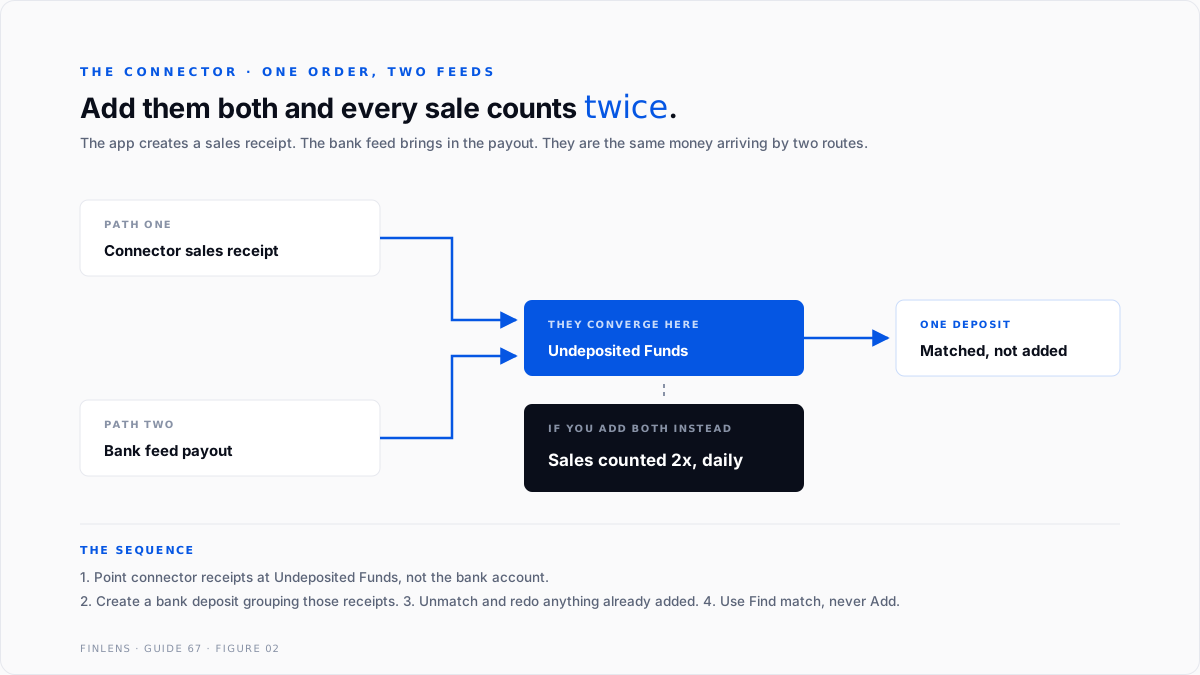
Two feeds, one event. The app creates a sales receipt for the order. The bank feed brings in the payout. Accept both and every sale is counted twice.
The fix from community member mv32 is a sequence, not a setting. Point the sales receipts at Undeposited Funds rather than the bank account. Create a bank deposit that groups those receipts and matches the eBay payout. Unmatch and redo any payment transactions already added incorrectly. Then use Find match rather than Add.
MarkR66's frustration in the thread is reasonable, because this is manual work where automation was promised. A member in the same thread noted that the free connector offers limited functionality and is not reliable, and pointed at paid third-party connectors instead.
The Undeposited Funds mechanic underneath all of this is in categorizing transactions and undeposited funds. Get it wrong and the error compounds daily.
Sales tax you never touched
Etsy and eBay collect and remit sales tax as marketplace facilitators. The money passes through. It is not your revenue and it is not your liability.
A user posting as bigleagueseller asked how to handle it in How do I record Sales Tax collected and paid by eBay, 15 replies and 74 views. The thread settled on two defensible answers.
The simple one. Mark marketplace sales as non-taxable in QuickBooks, because the marketplace is handling remittance. Nothing about the tax enters your books.
The traceable one. Create a liability account called eBay Sales Tax Payable and a non-inventory item to carry it. Mark the items non-taxable, add a line for the tax collected, and offset it against the marketplace's deduction so the account returns to zero.
Choose the second if your 1099-K reconciliation needs to show where the tax went, which it usually does. A member in the thread put the warning plainly: recording these as taxable sales creates duplicate tax liability reporting, because you would be accruing tax that somebody else already paid.
Your own nexus obligations are a separate question entirely, covered in sales tax setup, nexus and remittance and marketplace facilitator reconciliation.
The 1099-K, and why it will never match your P&L
For payments made after 31 December 2025 the Form 1099-K threshold reverted to $20,000 and 200 transactions under the One Big Beautiful Bill Act, which is a meaningful change from the $600 figure many sellers were braced for.
If you cross it, the form reports what buyers paid. Gross, before fees, before refunds, including sales tax the platform remitted. Your profit and loss will never equal it, and it is not supposed to.
What you need is a reconciliation that gets from one to the other: 1099-K gross, less marketplace-collected tax, less refunds, equals gross revenue. Then less fees, labels and ads to get to contribution. Keep that worksheet with the return. It is the entire answer to the only question anyone will ask about the discrepancy.
Six ways marketplace books go wrong
One, booking the deposit as revenue. The single most common error, and it hides every fee you paid.
Two, accepting both the connector receipt and the bank payout. Double-counted sales, every day, compounding.
Three, treating marketplace-collected tax as your sales tax liability. It is somebody else's remittance. Accruing it duplicates it.
Four, lumping fees and shipping labels together. Shipping labels bought through the platform are a cost of fulfilment, not a selling fee. Separate them or you cannot price.
Five, ignoring refunds. They reduce revenue and they are already inside the 1099-K figure, so leaving them out breaks the reconciliation at both ends.
Six, reconciling to the payout instead of the statement. The payout is a net figure the platform calculated. The platform's own statement is the support. Bank reconciliation covers the discipline the rest of this depends on.
Refunds cross period ends, and the reconciliation has to survive it
A refund issued in February against a January order is the quiet reason marketplace reconciliations stop tying.
The platform deducts it from the February payout, so the cash effect lands in February. The 1099-K counts the original January payment in full, because the form reports what the buyer paid rather than what you kept. And the revenue it reverses was recognised in January.
Three periods, one transaction. The reconciliation only works if refunds are visible as their own line rather than netted into revenue, because you need to be able to say which month each side of the pair landed in.
Carry a contra-revenue account for refunds and never net them against sales. When the annual 1099-K reconciliation runs, the full year of refunds is one figure you subtract from gross rather than a difference you have to go and find.
Thresholds: how much structure you need
Under roughly 50 orders a month, one marketplace. A monthly summary journal entry from the platform statement. Gross revenue, each fee category, refunds, tax, and the net to the bank. Twenty minutes.
Fifty to a few hundred orders. The same monthly entry, but fee categories split properly and the Undeposited Funds routine in place so deposits match.
More than one marketplace. A separate clearing account per platform, so a reconciliation failure on one does not contaminate the other.
Inventory sold across platforms. Unit cost has to come from one source. COGS recognition in QuickBooks Online covers the recognition side.
Crossing the 1099-K threshold. Build the reconciliation worksheet before January, not after the form arrives.
Selling internationally. Currency conversion fees are a separate line and the conversion itself is a separate question again.
How Finlens approaches this
The deposit is the last number in the chain, so it is the worst place to start.
Finlens books marketplace activity from the platform statement rather than the bank feed. Gross revenue, each fee type on its own account, refunds as contra-revenue, shipping labels as fulfilment cost, and marketplace-collected tax through a clearing account that proves back to zero. The deposit is then a match, not a source.
That gives a real contribution margin per platform, which is the number that decides whether a marketplace is worth selling on. It also means the 1099-K reconciliation already exists in January rather than being assembled under time pressure in March. The monthly cadence sits inside the month-end close.
Verification checklist
FAQ
Should I record the Etsy deposit as my sales?
No. The deposit is net of transaction fees, processing fees, listing fees, ads, shipping labels, refunds and marketplace-collected tax. Record gross revenue and each deduction separately.
Why does my 1099-K not match my revenue?
Because it reports what buyers paid, before fees and refunds, including sales tax the platform remitted. It is not supposed to match. Build a reconciliation from one to the other instead.
What is the 1099-K threshold now?
For payments made after 31 December 2025 it reverted to $20,000 and 200 transactions under the One Big Beautiful Bill Act.
Why are my eBay sales doubled in QuickBooks?
The connector creates a sales receipt and the bank feed brings in the payout, and both are being counted. Route receipts to Undeposited Funds, create a deposit that groups them, and match the payout rather than adding it.
Do I owe sales tax on Etsy and eBay sales?
The marketplace collects and remits as facilitator for those sales. Do not accrue it again. Your own direct sales and your own nexus are a separate question.
How do I record shipping labels bought through the platform?
As a cost of fulfilment, on their own account. They are not a selling fee and lumping them together makes per-order economics unreadable.
Is the free connector good enough?
Community experience in the threads above says it is limited and unreliable, and that a paid connector or a monthly summary entry is more dependable. Either way the Undeposited Funds routine is what prevents the double count.
What about refunds issued after month end?
They reduce revenue in the period the refund occurs, and they are inside the 1099-K for the year they are processed. Keep them visible as contra-revenue so both reconciliations work.

