
Asset Disposal in QuickBooks: Sales, Trade-Ins and the Recapture Nobody Plans For


A trade-in is not an exchange. It stopped being one in 2018, and most QuickBooks files still record it as though nothing changed.
The dealer hands you one invoice with one net number. Your books need two transactions at gross: a sale of the old asset at its trade-in allowance, and a purchase of the new one at full price.
The difference between those two treatments is a gain you recognise this year, taxed as ordinary income, on an asset you never saw a dollar of cash for.
This guide covers the disposal entry that removes both accounts rather than one, what changed for trade-ins under the Tax Cuts and Jobs Act, and how section 1245 recapture turns a gain into ordinary income at exactly the moment you were least expecting it.
Where the depreciation guide stops
Depreciation methods in QuickBooks covers the schedule and the two-book problem. It ends at disposal, because disposal is the event that needs the original cost rather than the current balance, and most files cannot produce it.
Fixed asset capitalization and the de minimis threshold covers what became an asset in the first place.
This guide covers what happens when the asset leaves.
Disposal removes two accounts, not one
The most common disposal error in QuickBooks is deleting the fixed asset and moving on.
A user posting as TRHBSI opened Vehicle Trade in with 179 depreciation, 3 replies and 143 views, describing exactly that approach.
A Level 11 contributor posting as Rainflurry disputed it directly. The posted method incorrectly removes the fixed asset from the balance sheet and fails to use the accumulated depreciation account. As they put it, "you don't remove the fixed asset from your books as you suggested."
The asset and its accumulated depreciation are two separate accounts. A disposal closes both. Remove the asset alone and accumulated depreciation stays behind as a negative balance attached to nothing, which is why so many balance sheets carry a contra-asset for equipment that was sold years ago.
The correct shape appears in How do I show that I have sold a fixed asset?, posted by lindak1119 and running to 11 replies and 345 views. The accepted answer from KH45_2: debit accumulated depreciation, credit the asset account, debit cash received, credit gain on sale.
Four lines. The asset was fully depreciated, so the entire cash received was gain.
Post partial-year depreciation first. The disposal entry uses whatever is in the accumulated depreciation account. If you have not caught the asset up to the disposal date, the gain or loss absorbs the difference and lands in the wrong account.
The four ways an asset leaves
The one in row two is the one that goes wrong.
Trade-ins stopped being like-kind exchanges in 2018
Section 13303(c) of the Tax Cuts and Jobs Act amended section 1031 to limit it to exchanges of real property, for exchanges completed after 31 December 2017.
Vehicles, machinery and equipment are personal property. They no longer qualify. A trade-in is now a sale and a purchase, and the gain on the sale is recognised in the year of the trade.
There is a narrow exception. Machinery or equipment is real property for section 1031 purposes if it comprises an inherently permanent structure, a structural component of one, or is classified as real property under state or local law. A pickup truck is none of those things.
Before 2018, the gain rolled into the basis of the replacement asset and nothing was taxed. After 2018, it is taxed now. The accounting changed, the paperwork at the dealership did not, and that gap is where the surprise lives.
Worked example: a $50,000 truck with full Section 179
These are the numbers from thread 1527155.
The facts. Truck 1 bought in 2022 for $50,000, with a full Section 179 deduction taken. Two years later the loan balance is $25,000. The dealer allows $30,000 on the trade. Truck 2 costs $65,000. The new loan is $60,000.
Read the deal first. $65,000 for the new truck, less $30,000 of trade-in allowance, is $35,000 due. Roll in the $25,000 payoff on the old loan and the new note is $60,000. That reconciles exactly, and if it does not reconcile on your deal, you are missing a fee.
The entry.
Check it. Debits 65,000 + 50,000 + 25,000 = 140,000. Credits 50,000 + 60,000 + 30,000 = 140,000.
Note what is not in that entry. There is no net number. The old truck leaves at its full original cost of $50,000 and its full accumulated depreciation of $50,000. The new truck arrives at its full price of $65,000, not at $35,000.
Where the $30,000 gain comes from. The trade-in allowance is the amount realised. The adjusted basis is $50,000 of cost less $50,000 of Section 179, which is zero. Thirty thousand minus zero is thirty thousand, and not one dollar of cash changed hands in your favour.
The tax layer: section 1245 recapture
Book gain and tax character are two different questions, and the second one costs money.
Per IRS Publication 544, a gain on the disposition of section 1245 property is treated as ordinary income to the extent of depreciation allowed or allowable. Any remaining gain is a section 1231 gain.
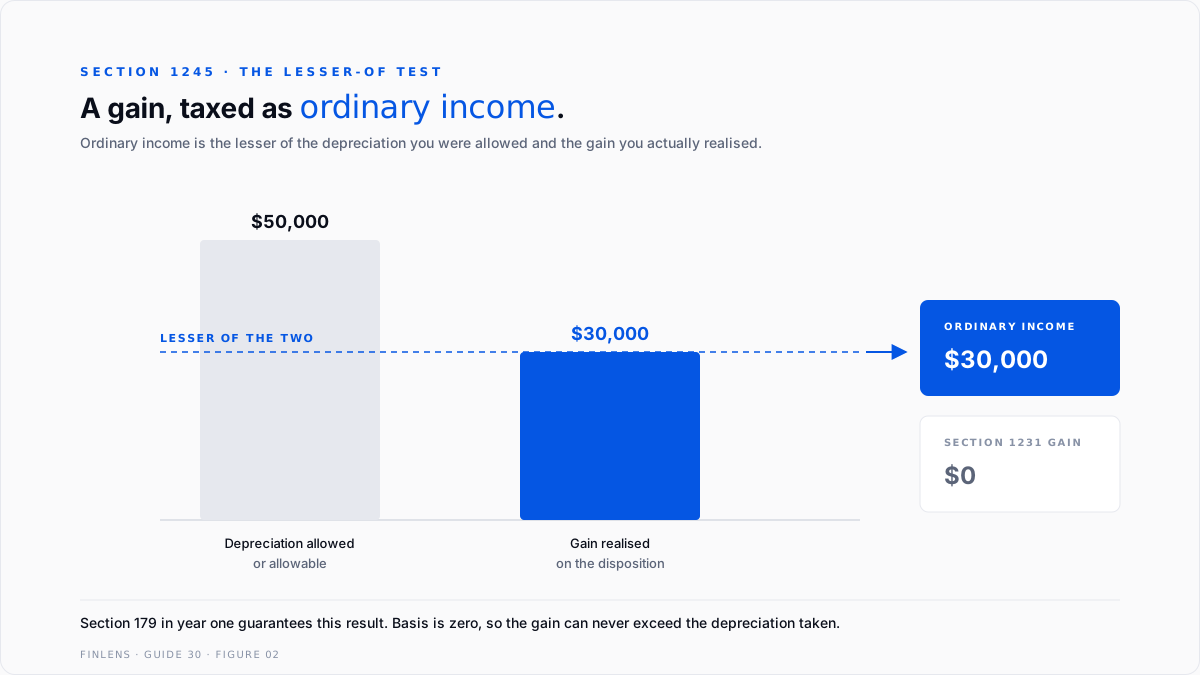
The amount treated as ordinary income is the lesser of two numbers: the depreciation allowed or allowable on the property, or the gain realised on the disposition.
Apply it to the truck. Depreciation taken is $50,000. The gain realized is $30,000. The lesser is $30,000.
The entire gain is ordinary income. There is no capital gain treatment on any part of it, because the depreciation you claimed exceeds the gain you made. That is the arithmetic consequence of taking Section 179 in year one, and it is not a penalty. It is the deduction being returned.
One offsetting point worth knowing. Because the trade-in is no longer a like-kind exchange, Truck 2 enters the books at its full $65,000 rather than at a basis reduced by the deferred gain. That larger basis is depreciable. If a Section 179 election is available on the new truck in the same year, the deduction and the recapture can land in the same return. That is a timing observation, not a strategy, and it belongs in a conversation with whoever signs the return.
"Allowed or allowable" is not a typo
The phrase in Publication 544 is "depreciation allowed or allowable."
If you never claimed depreciation on an asset, the recapture calculation still assumes you did. Your gain is computed against the basis you should have had, not the basis you actually carried. Skipping depreciation does not preserve basis. It forfeits the deduction and keeps the recapture.
This is the strongest practical argument for keeping the tax depreciation schedule current even when the books are on a different method. The two-book problem is covered in the depreciation guide, and disposal is the event that proves whether you maintained both.
Where the gain lands on the statements
A disposal gain is not revenue and it does not belong anywhere near your operating margin.
Gain or loss on disposal is a non-operating item. Posted to an income account that sits inside operating income, a $30,000 gain makes a quarter look like a sales record. Nobody who reads that statement later will know why, because the asset that produced it is gone from the balance sheet.
Give it a dedicated other income or other expense account and keep it out of the operating block. The structure argument generalises, and profit and loss customization with classes and locations covers how to keep the distinction visible in the reports people actually read.
The cash flow statement is the second place this shows up. Proceeds from selling an asset are an investing inflow, not operating, and the gain has to be removed from net income in the operating section of an indirect-method statement or it gets counted twice. That mechanic is in the cash flow statement guide.
A trade-in makes this cleaner in one respect. There are no proceeds and no investing inflow, because no cash moved. The gain still has to come out of net income.
Six ways disposals go wrong
One, deleting the asset instead of disposing of it. Deleting removes the history. Disposal closes two accounts and records a result. If the asset was ever on a tax return, deletion is not available to you.
Two, recording the dealer's net number. One invoice line becomes two transactions in your books. Netting hides the gain, understates the new asset, and understates future depreciation.
Three, forgetting the loan payoff. Negative equity gets rolled into the new note and the entry has to close the old liability. A user posting as riograndehc1 worked through this in How do I record a vehicle trade in with a note and a trade in allowance?, 12 replies and 222 views. Their deal: new vehicle $66,576, trade-in allowance $43,000, old payoff $20,658, new note $44,234. Check it: 66,576 less 43,000 is 23,576, plus the 20,658 payoff is 44,234. The accepted answer from Rustler also advised keeping the paperwork, because there is a tax form for this.
Four, skipping partial-year depreciation. The disposal uses the accumulated depreciation balance as it stands. Catch it up to the disposal date first or the gain absorbs the gap.
Five, treating a trade-in as a tax-free swap. That treatment ended for personal property after 2017. If your prior-year files did it the old way, that is a conversation to have before this year's return, not after.
Six, disposing of an asset QuickBooks never properly tracked. Native fixed asset management sits in QuickBooks Online Advanced, covered in the Advanced tier deep dive, and in QuickBooks Enterprise. On lower tiers the schedule lives outside the file and has to be reconciled to it.
Thresholds: how much rigour the disposal needs
Fully depreciated, scrapped, no proceeds. Two lines. Close the asset against accumulated depreciation. No gain, no loss, no tax event beyond removing it from the schedule.
Sold for cash, straight-line depreciation only. The four-line entry. Recapture applies but the arithmetic is small.
Section 179 or bonus depreciation was taken. Assume the entire gain is ordinary income and plan the cash for it. This is the case that surprises people.
Any trade-in. Two transactions at gross, never one at net. Get the trade-in allowance stated separately on the dealer paperwork before you sign.
Real property. Different rules. Section 1250 rather than 1245, and section 1031 is still available. Do not apply this guide to a building.
Asset moving between related entities. Not a disposal in the consolidated sense, and the intercompany treatment matters more than the gain. See multi-entity accounting and intercompany transactions.
Leased equipment coming off lease. A different lifecycle entirely, covered in lease accounting under ASC 842.
How Finlens approaches this
A disposal is only as good as the record of what the asset cost and what was taken against it.
Finlens keeps original cost and accumulated depreciation reconcilable per asset rather than in a single pooled account, so a disposal is a lookup instead of an archaeology project.
The book entry and the tax character are computed as two separate answers, because they are two separate questions, and the recapture exposure is quantified at the point of the trade rather than discovered on the return.
Trade-ins are recorded gross on both sides. The dealer's net figure is reconciled to the four underlying amounts before anything is posted, which is also how the missing fee gets found. Month-end and year-end close covers the cadence this sits inside.
Verification checklist
Before posting the disposal:

- Original cost of the asset confirmed from the acquisition record
- Accumulated depreciation balance confirmed for that specific asset
- Partial-year depreciation posted through the disposal date
- Method used on the tax return identified, including any Section 179 or bonus
- Trade-in allowance stated separately on the dealer paperwork
- Old loan payoff amount obtained from the lender, not the dealer sheet
- The deal reconciles: new price less allowance plus old payoff equals the new note
After posting:
- Fixed asset account for the disposed asset is zero
- Accumulated depreciation for that asset is zero
- Old loan liability is closed
- New asset is on the books at full purchase price, not net of trade
- New loan equals the note on the finance contract
- Gain or loss equals proceeds less adjusted basis, proved independently
- Section 1245 ordinary income computed as the lesser of depreciation taken and gain
- Depreciation schedule updated to remove the asset
- Paperwork filed for the tax preparer
FAQ
Can I just delete the fixed asset in QuickBooks?
No. Deleting removes history and leaves accumulated depreciation orphaned. Post a disposal entry that closes both the asset and its accumulated depreciation.
Is a trade-in still a like-kind exchange?
Not for vehicles, machinery or equipment. The Tax Cuts and Jobs Act limited section 1031 to real property for exchanges completed after 31 December 2017. A trade-in of personal property is a sale plus a purchase.
Why is my gain taxed as ordinary income rather than capital gain?
Section 1245 recapture. Gain is ordinary income up to the depreciation allowed or allowable on the asset. Only gain beyond that amount gets section 1231 treatment.
I took Section 179 on the asset. What happens when I sell it?
Your adjusted basis is likely zero, so the entire proceeds are gain, and the entire gain is ordinary income up to the depreciation you claimed. Plan the cash before the sale, not after.
I never claimed depreciation. Does that help?
No. Publication 544 says depreciation "allowed or allowable." The calculation assumes you took it whether you did or not. You lose the deduction and keep the recapture.
What if the asset is worth less than its book value?
You record a loss. Close both accounts and the difference between proceeds and book value is the loss. For business property that is generally an ordinary loss.
How do I record the new asset when a trade-in is involved?
At its full purchase price. Not at the price net of the trade-in allowance. The allowance is proceeds on the old asset, not a discount on the new one.
What about scrapping an asset with no proceeds?
Close the asset against accumulated depreciation. Any remaining book value becomes a loss. A fully depreciated asset scraps cleanly with no gain or loss at all.
Does QuickBooks track any of this automatically?
Fixed asset management is native to QuickBooks Online Advanced and to Enterprise. On other tiers the schedule lives outside QuickBooks and has to be reconciled to the general ledger.

