
Opening Balance Equity and the Cleanup Nobody Finishes


Opening Balance Equity is not an equity account. It is a suspense account wearing an equity costume.
QuickBooks creates it whenever you tell the software what a balance is without telling it where the other half of the entry belongs. Every dollar sitting in it is a half-finished journal entry. The number is not an error on its own, but a number that survives into the second month means nobody ever went back and finished the work.
This guide covers how to decompose an Opening Balance Equity balance into the entries that created it, prove each one, clear the account correctly, and then run the five cleanup passes that find what the opening balances did not.
The account that outlives the setup
A user posting as haskenazi1 opened a thread titled Opening Balance Equity and Retained Earnings, which ran to 10 replies and 99 views.
Their company carried a significant Opening Balance Equity balance whose last entry was dated 31 December 2015, while Retained Earnings sat at zero. They wanted to know whether that made sense.
It does not. The responder, a Level 15 contributor posting as Rustler, gave the correct answer and the correct scope with it.
Clear Opening Balance Equity to partner equity with a journal entry, debit Opening Balance Equity and credit each partner's share. Then the sentence that matters most: this is a one-time clearing. Opening Balance Equity is created during setup and never again.
A balance dated 2015 that is still on the balance sheet in a later year is not an accounting position. It is an unfinished task that stopped being visible.
What creates the balance, account by account
Per Intuit's own article on entering and managing opening balances, article L7NcxTbuu_US_en_US, the Opening Balance Equity account automatically tracks the balances you enter so your records match your statements.
The direction depends on the account type, and getting the direction wrong is its own failure.
A bookkeeper posting as MKT22191 hit the direction problem directly in a thread titled Opening balance equity on credit card, reducing the balance?, 3 replies and 225 views.
They connected business credit cards mid-cycle and found that the Opening Balance Equity entry had been coded on the payment side, which lowered the card balance rather than raising it.
A community member posting as Rainflurry gave the clearest explanation in the thread: a liability is what you owe someone else and equity is what you owe yourself, and you cannot owe the same money to both at once.
Their recommendation was to skip the opening balance field entirely for cards and enter the outstanding unpaid transactions as journal entries instead. That is better advice than the feature's own default.
The specification is the prior-period balance sheet
You cannot clear Opening Balance Equity correctly without the document it is supposed to reproduce: the balance sheet as of the day before your start date, signed off by whoever prepared it.
Intuit's guidance is explicit on one point that trips up most setups. Opening balance entries should match balance sheet account balances at the end of the last period, never Profit and Loss accounts.
That rule is where the real damage happens, and it is not about the opening balance field at all.
The trap: open invoices create revenue that is not yours
Accounts Receivable and Accounts Payable do not get an opening balance field, because you need the detail. You enter each open invoice and each open bill individually so the ageing works.
Each of those invoices credits an income account. Each of those bills debits an expense account. Both amounts belong to the prior year, and you have just recognised them again in the new file.
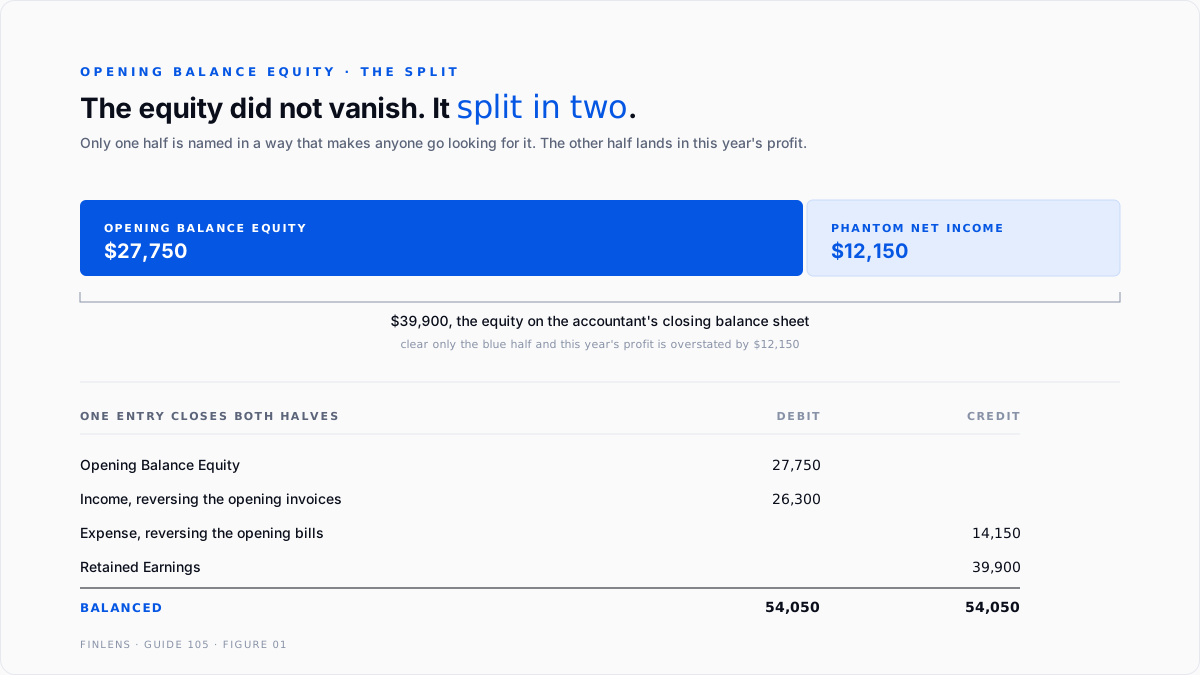
So the carrying balance splits in two. Part lands in Opening Balance Equity, and part lands in current-year net income where nobody looks for it. Clearing only the Opening Balance Equity half leaves the other half overstating this year's profit for the rest of the year.
Worked example: decompose, then clear
A company starts a new QuickBooks file on 1 January. The accountant's closing balance sheet at 31 December:
Setup proceeds normally. Everything except Accounts Receivable and Accounts Payable goes in through the opening balance field. The open invoices and open bills are entered one by one.
What Opening Balance Equity collects. Credits from the asset balances, 18,400 + 12,600 + 34,000 = 65,000. Debits from the contra-asset and liability balances, 11,900 + 3,250 + 2,100 + 20,000 = 37,250.
Opening Balance Equity now shows a credit balance of 65,000 − 37,250 = 27,750.
What the Profit and Loss collects. Income of 26,300 from the open invoices. Expense of 14,150 from the open bills. Current-year net income of 12,150, every dollar of which was earned last year.
The proof. 27,750 + 12,150 = 39,900, which is exactly the equity on the accountant's balance sheet.
That identity is the whole point. The carrying equity did not vanish. It split across two accounts, and only one of them is named in a way that makes you go looking.
Now clear both halves in one entry.
Opening Balance Equity is now zero, the Profit and Loss starts the year at zero, and Retained Earnings carries 39,900.
Compare that against the advice you will find almost everywhere, which is to journal Opening Balance Equity to Retained Earnings and stop. That version books 27,750, leaves 12,150 of last year's revenue sitting in this year's income, and overstates current-year profit by 12,150 until somebody notices. On a 39,900 equity base that is a 30% error in reported profit.
The better method, if you have not started yet. Point the opening invoices and opening bills at a dedicated clearing account rather than real income and expense accounts. No phantom Profit and Loss is created, the clearing account nets to zero against Accounts Receivable and Accounts Payable, and the final entry is the simple one everyone expects.
The five cleanup passes
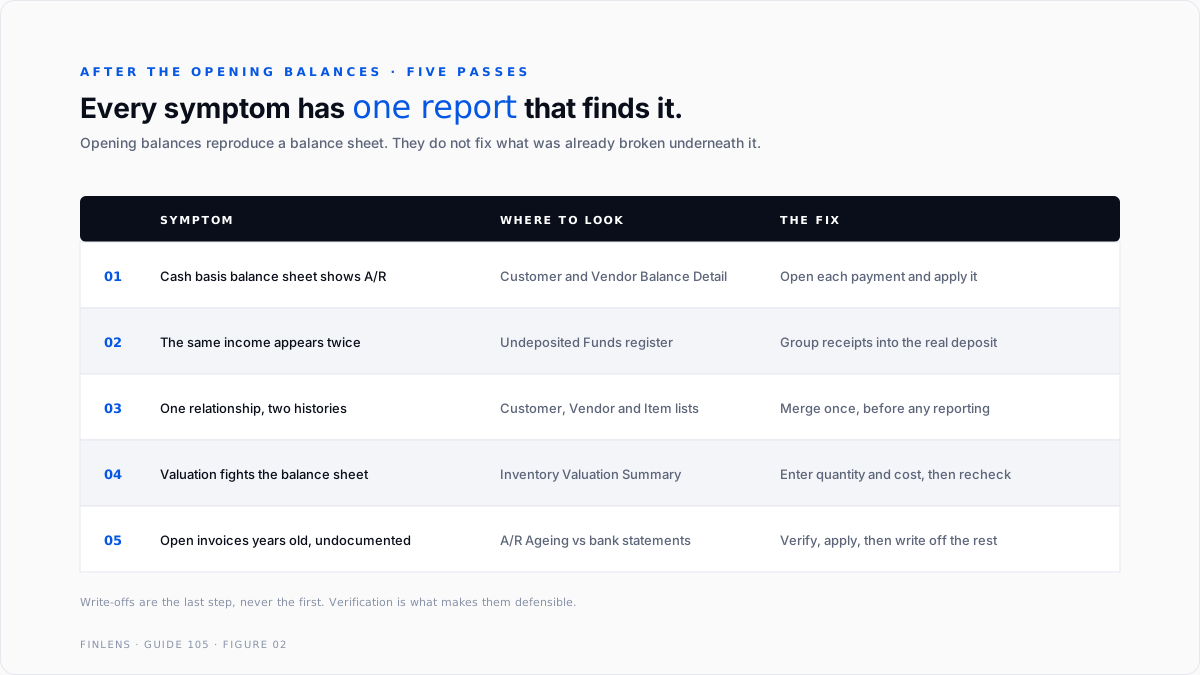
Opening balances reproduce a balance sheet. They do not fix what was already broken underneath it. Five passes find the rest, and each one has a specific report that locates the problem.
Pass one, unapplied payments. Per Intuit's article on resolving A/R and A/P balances on a cash basis balance sheet, article L7hez2k07_US_en_US, the second most common cause of a stray A/R or A/P balance is payments that were received but never applied to an invoice, and bill payments never applied to a bill. Run Customer Balance Detail and Vendor Balance Detail. Open each unapplied payment from the register and apply it.
Pass two, the undeposited funds pile. Payments that were received into Undeposited Funds and never grouped into a deposit sit there indefinitely while the bank feed brings in the real deposit separately, producing duplicate income. The mechanics are in categorizing transactions and undeposited funds in QuickBooks.
Pass three, duplicate names. Customers, vendors and items that arrived twice under slightly different spellings split the history of a single relationship. Merge them before you build any reporting on top, because merging rewrites history and you want that to happen once.
Pass four, inventory quantity against value. Inventory has two opening numbers, quantity on hand and cost. Enter one without the other and the valuation report disagrees with the balance sheet from day one. Costing method matters here too, as covered in FIFO versus average cost inventory and inventory adjustments and shrinkage.
Pass five, the aged residue. A user posting as TaFanesamekeya opened a thread titled AR Cleanup in October 2024, 7 replies and 225 views, describing open Accounts Receivable going back to 2018 with no documentation of what had been paid.
The approach the thread settled on is the right one and it is not a shortcut. Cross-check the invoices against bank statements to confirm which payments actually arrived, apply what you find, write off what is genuinely uncollectible, and then reconcile monthly so the backlog never rebuilds.
Write-offs come last, after verification, not first as a way of making the report shorter. The collections side is covered in accounts receivable, invoicing and collections, and the payables mirror in accounts payable, vendor bills and 1099 filing.
Six ways the cleanup goes wrong
One, clearing Opening Balance Equity to Retained Earnings without decomposing it first. The balance goes to zero and the error stays in the file. Prove every component before you write the entry.
Two, entering opening balances against Profit and Loss accounts. Opening balances reproduce a balance sheet. An opening balance on an income or expense account is always wrong.
Three, using a start date mid-period. Start on the first day of a period. Mid-period starts mean no single report covers the period and the opening balance has to be assembled by hand.
Four, clearing to Retained Earnings when the entity is a partnership or sole proprietorship. Retained Earnings is a corporate concept. Clear to partner or owner capital accounts in their respective shares, which is exactly what Rustler specified in thread 250138.
Five, reconciling the bank before the opening balance is proved. The first reconciliation inherits whatever the opening balance says. Prove it against the statement first, then reconcile, as covered in QuickBooks bank reconciliation.
Six, treating a cash-basis balance sheet with an A/R balance as a software bug. It is a reporting consequence of unapplied transactions, not a defect. Your method of accounting is a formal election, and the rules sit in IRS Publication 538, which is also where the constraint on changing it lives.
Thresholds: how deep to go
New file, no prior system, no inventory. Opening balances and one clearing entry. A single afternoon.
New file converted from a prior system. Add the full decomposition above. If the prior system was QuickBooks Desktop, read QuickBooks Desktop to Online migration first, because the conversion brings its own differences and they must be separated from setup errors.
Opening Balance Equity has survived more than one year-end. Stop treating it as a cleanup task. Reconstruct the original setup entries from the register before touching anything, because the balance now has multiple layers.
Inventory or fixed assets present. Both carry a second number that the opening balance field does not capture, quantity in one case and accumulated depreciation in the other. Fixed asset capitalization and the de minimis threshold and depreciation methods in QuickBooks cover what has to agree.
More than three years of undocumented A/R. Budget for verification against bank statements, not a write-off session. The write-off is the last step and it needs evidence behind it.
How Finlens approaches this
The question that matters is not what Opening Balance Equity contains. It is whether the file reproduces a balance sheet somebody already signed.
Finlens runs that comparison directly. The accountant's closing balance sheet against the new file's opening balance sheet, line by line, with every difference traced to the entry that caused it.
Opening Balance Equity is decomposed into its components rather than cleared as a lump, and the phantom Profit and Loss created by open invoices and bills is identified and reversed in the same entry.
From there the same reconciliation runs monthly, so the first close after setup is a proved close. Month-end and year-end close in QuickBooks covers what that cadence has to deliver.
Verification checklist
FAQ
Is a balance in Opening Balance Equity always an error?
During setup, no. It is the expected intermediate state. After setup is finished, yes. Intuit's position is that the account should sit at zero once everything is entered correctly, and the balance is the sum of the opening balances you entered.
Can I just delete the Opening Balance Equity transactions?
No. Each one is the offset to a real balance you entered. Deleting it removes the balance too. Clear the account with a journal entry instead.
Where should Opening Balance Equity go: Retained Earnings or owner equity?
It depends on the entity. Corporations clear to Retained Earnings. Partnerships clear to each partner's capital account in their respective shares. Sole proprietorships clear to owner equity. Retained Earnings is not a universal destination.
Does entering more transactions clear the balance?
No. This is the most common misunderstanding. New transactions have their own offsets and never touch the Opening Balance Equity balance. Only a journal entry clears it.
Why does my cash basis balance sheet show Accounts Receivable?
Almost always unapplied payments, or invoices paid with a transaction type QuickBooks cannot link to them. Intuit documents the diagnosis under article L7hez2k07_US_en_US. It is not a bug.
I never entered an opening balance at all. What now?
Enter it as a journal entry dated the day before your start date, with the offset to Opening Balance Equity, then clear it as described above. Intuit covers the route under article L4l3NZSMR_US_en_US.
How far back should I clean up old A/R?
As far as you can verify against bank statements. Verification sets the limit, not age. Anything you cannot verify and cannot collect gets written off with a note explaining why, which is what makes it defensible later.

